 Indietro
Study Notes: The Muscular System (Chapter 11, Anatomy & Physiology)
Guida di studio - Note intelligenti
 Appunti personalizzati basati sui tuoi materiali, ampliati con definizioni chiave, esempi e contesto.
The Muscular System
Overview of Skeletal Muscle Function
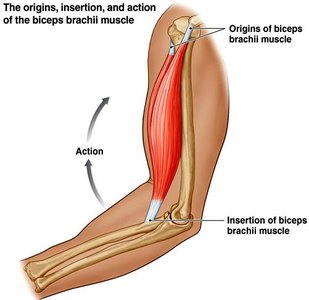
Skeletal muscles are essential for producing movement by exerting force on bones, typically at synovial joints. This force changes the angle at the joint, resulting in movement. One end of the muscle is attached to a stationary bone (origin), while the other end is attached to a movable bone (insertion). During contraction, the insertion moves toward the origin.
Origin: The fixed, stationary attachment point of the muscle.
Insertion: The movable attachment point, which is pulled during contraction.
Action: The movement produced by muscle contraction, often described relative to the joint affected.
Tendons: Both ends of a skeletal muscle are typically connected to bones via tendons.
Example: The biceps brachii muscle flexes the forearm at the elbow by pulling the insertion toward the origin.
Facial Muscles: Unique Insertions
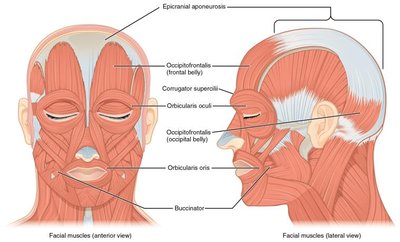
Unlike most skeletal muscles, many facial muscles insert into the skin rather than bone. This unique arrangement allows for a wide range of facial expressions, as muscle contraction moves the skin.
Facial Muscles: Muscles such as the orbicularis oculi and orbicularis oris insert into the skin, enabling expressions like smiling, frowning, and blinking.
Example: The occipitofrontalis muscle moves the scalp and eyebrows.
Muscle Naming Conventions
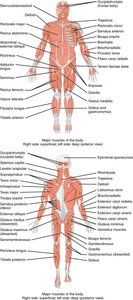
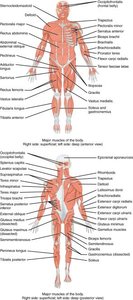
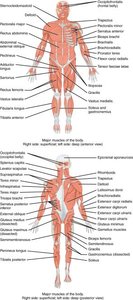
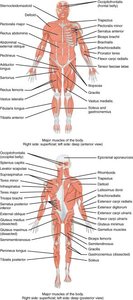
The names of skeletal muscles often reflect their distinctive features, including orientation, location, size, shape, action, number of origins, and points of origin and insertion. Understanding these conventions aids in identifying and describing muscles.
Orientation Relative to the Body Midline
Rectus: Means "straight"; muscles run parallel to the midline (e.g., rectus femoris).
Location in the Body
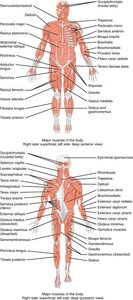
Temporalis: Named for its location near the temporal bone.
Rectus femoris: Combines orientation and location in its name.
Relative Size
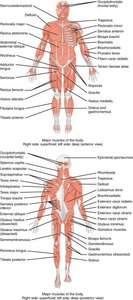
Major: Indicates a larger muscle compared to a related muscle.
Minor: Indicates a smaller muscle.
Zygomaticus major/minor: Muscles of the cheek, differing in size.
Shape
Trapezius: Trapezoid-shaped muscle.
Deltoid: Triangle-shaped muscle.
Action
Flexor: Causes flexion at a joint.
Extensor: Causes extension.
Abductor: Moves a limb away from the midline.
Retractor: Pulls a part backward.
Number of Origins
Biceps: Two origins (e.g., biceps brachii).
Triceps: Three origins (e.g., triceps brachii).
Origin and Insertion in Muscle Names
Sternocleidomastoid: Originates from the sternum and clavicle; inserts at the mastoid process of the temporal bone.
Naming Order: The origin is usually listed first, followed by the insertion.
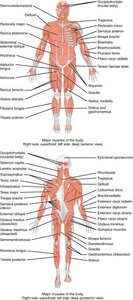
Summary Table: Muscle Naming Features
Feature | Example | Description |
|---|---|---|
Orientation | Rectus femoris | Runs straight relative to body midline |
Location | Temporalis | Located near temporal bone |
Size | Zygomaticus major/minor | Major is larger, minor is smaller |
Shape | Deltoid, trapezius | Deltoid is triangular, trapezius is trapezoid-shaped |
Action | Flexor, extensor | Describes movement produced |
Number of Origins | Biceps, triceps | Biceps has two origins, triceps has three |
Origin & Insertion | Sternocleidomastoid | Originates from sternum/clavicle, inserts at mastoid process |
Additional info:
Muscle names often combine several features for precise identification.
Understanding naming conventions aids in learning muscle anatomy and function.
