 Indietro
The Cell: Structure, Function, and Membrane Transport
Guida di studio - Note intelligenti
 Appunti personalizzati basati sui tuoi materiali, ampliati con definizioni chiave, esempi e contesto.
The Cell
General Structure of Cells
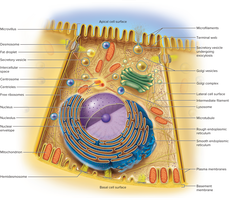
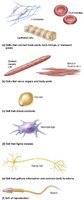
The cell is the basic structural and functional unit of all living organisms. Human cells exhibit a remarkable diversity in shape, size, and function, with approximately 200 distinct types present in the body.
Plasma membrane: The outer boundary that separates the cell from its environment.
Cytoplasm: The internal fluid containing organelles and cytoskeleton.
Nucleus: The control center housing DNA.
Example: Red blood cells are specialized for oxygen transport, while neurons are adapted for communication.
Cell Components
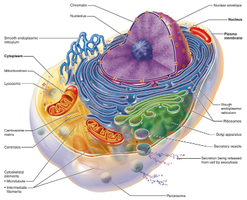
Each cell contains specialized structures called organelles, each performing unique functions necessary for cell survival and activity.
Nucleus: Contains genetic material and directs cellular activities.
Endoplasmic reticulum (ER): Synthesizes proteins (rough ER) and lipids (smooth ER).
Golgi complex: Modifies, sorts, and packages proteins and lipids.
Mitochondria: Site of ATP (energy) production.
Lysosomes and peroxisomes: Involved in digestion and detoxification.
The Cell Surface
Plasma Membrane Structure
The plasma membrane is a dynamic, selectively permeable barrier composed mainly of a phospholipid bilayer, cholesterol, and glycolipids. It separates the intracellular fluid (ICF) from the extracellular fluid (ECF).
Phospholipids: Amphipathic molecules with hydrophilic heads and hydrophobic tails.
Cholesterol: Stabilizes membrane fluidity.
Glycolipids: Contribute to cell recognition and signaling.
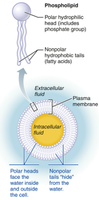
Additional info: The amphipathic nature of phospholipids allows the membrane to form a stable barrier in aqueous environments.
Membrane Proteins
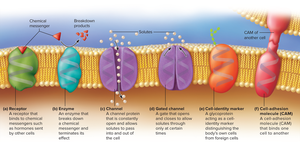
Membrane proteins are crucial for the diverse functions of the plasma membrane. They can be classified as peripheral (attached to the membrane surface) or integral (spanning the membrane).
Channel proteins: Form pores for selective passage of ions and molecules.
Gated channels: Open or close in response to stimuli.
Receptors: Bind signaling molecules (e.g., hormones) to initiate cellular responses.
Enzymes: Catalyze reactions at the membrane surface.
Cell identity markers: Distinguish self from foreign cells.
Cell adhesion molecules (CAMs): Bind cells together.
Cell Surface Extensions
Cells may possess surface extensions that increase surface area or aid in movement.
Microvilli: Increase surface area for absorption.
Cilia: Move substances across the cell surface.
Flagella: Enable cell motility (e.g., sperm cells).
Pseudopods: Temporary projections for movement or engulfing particles.
Cell Junctions
Cell junctions are protein complexes that connect cells to each other and to the extracellular matrix, providing structural integrity and communication.
Tight junctions: Seal adjacent cells to prevent leakage of extracellular fluid.
Desmosomes: Anchor cells together, providing mechanical strength.
Gap junctions: Allow direct communication between cells via passage of ions and small molecules.
Transport Through Cellular Membranes
Overview of Membrane Transport
Cells regulate the movement of substances across their membranes through various transport mechanisms, which are essential for maintaining homeostasis.
Passive transport: Does not require energy (e.g., diffusion, osmosis, filtration).
Active transport: Requires energy (ATP) to move substances against their concentration gradients.
Filtration
Filtration is the process by which physical pressure forces fluid and small solutes through a selectively permeable membrane, while larger particles are retained.
Simple Diffusion
Simple diffusion is the movement of particles from an area of higher concentration to an area of lower concentration, driven by the concentration gradient. It does not require energy.
Examples: Oxygen, carbon dioxide, and steroid hormones diffuse through the lipid bilayer.
Osmosis
Osmosis is the net movement of water across a selectively permeable membrane from an area of low solute concentration to an area of high solute concentration.
Tonicity: The ability of a solution to affect cell volume and pressure.
Isotonic: Equal solute concentration inside and outside the cell; no net water movement.
Hypertonic: Higher solute concentration outside the cell; cell loses water and shrivels.
Hypotonic: Lower solute concentration outside the cell; cell gains water and may burst.
Additional info: Osmosis is vital for maintaining cell shape and function.
Carrier-Mediated Transport
Carrier-mediated transport involves specific proteins that facilitate the movement of substances across the membrane.
Facilitated diffusion: Carrier proteins move solutes down their concentration gradient without energy input.
Active transport: Carrier proteins use ATP to move solutes against their concentration gradient.
Vesicular Transport
Vesicular transport moves large particles or fluids into or out of the cell via vesicles, requiring ATP.
Endocytosis: Bringing substances into the cell (includes phagocytosis, pinocytosis, and receptor-mediated endocytosis).
Exocytosis: Expelling substances from the cell.
The Cell Interior
Organelles
Organelles are specialized structures within the cell that perform distinct metabolic functions, contributing to the cell's survival and efficiency.
Nucleus: Contains DNA and nucleolus (site of ribosome assembly).
Endoplasmic reticulum (ER): Rough ER synthesizes proteins; smooth ER synthesizes lipids and detoxifies substances.
Golgi complex: Modifies and packages proteins and lipids.
Lysosomes: Contain enzymes for intracellular digestion and apoptosis.
Peroxisomes: Detoxify harmful substances and break down fatty acids.
Mitochondria: Generate ATP through cellular respiration; contain their own DNA.
Centrioles: Organize microtubules during cell division.
Cytoskeleton
The cytoskeleton is a network of protein filaments that provides structural support, enables cell movement, and organizes organelles.
Microfilaments: Thin filaments involved in cell movement and shape.
Intermediate filaments: Provide mechanical strength.
Microtubules: Hollow tubes that maintain cell shape and facilitate intracellular transport.
The Cell Life Cycle
Phases of the Cell Cycle
The cell cycle describes the sequence of events in the life of a cell, including growth, DNA replication, and division.
Interphase: Period of growth and DNA replication (G1, S, G2 phases).
Mitotic phase (M phase): Division of the nucleus (mitosis) and cytoplasm (cytokinesis) to produce two identical daughter cells.
Interphase
G1 phase: Cell grows and synthesizes proteins.
S phase: DNA is replicated.
G2 phase: Cell prepares for division by synthesizing necessary enzymes and replicating centrioles.
Mitosis
Prophase: Chromosomes condense, nuclear envelope dissolves, spindle fibers form.
Metaphase: Chromosomes align at the cell's equator.
Anaphase: Sister chromatids separate and move to opposite poles.
Telophase: Chromatids decondense, nuclear envelopes reform, cytokinesis begins.
Clinical Connection: Lysosomal Storage Disease
Tay-Sachs disease is a genetic disorder caused by the absence of a lysosomal enzyme needed to break down specific glycolipids in nerve cells. Accumulation of these lipids disrupts nervous system function, leading to severe developmental delays and early death.
Symptoms: Loss of developmental milestones, blindness, deafness, seizures, paralysis.
Physical finding: "Cherry red spot" on the retina.
