Indietro
The Chemical Level of Organization: Foundations for Anatomy & Physiology
Guida di studio - Note intelligenti
 Appunti personalizzati basati sui tuoi materiali, ampliati con definizioni chiave, esempi e contesto.
The Chemical Level of Organization
Introduction
The chemical level of organization forms the foundation for understanding anatomy and physiology. It explores the composition of matter, atomic structure, chemical bonds, and the essential molecules that sustain life. Mastery of these concepts is crucial for comprehending cellular processes and the physiological functions of the human body.
Matter, Elements, and Atoms
Basic Definitions
Matter: Anything that occupies space and has mass.
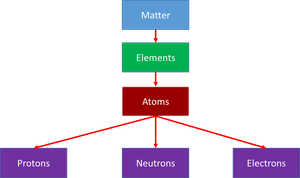
Element: A pure substance that cannot be broken down by ordinary chemical means. Each element is defined by its number of protons.
Atom: The smallest unit of an element that retains its unique properties.
Major Elements in the Human Body
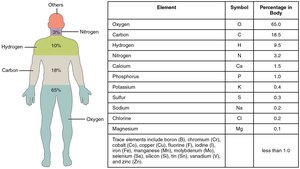
Four elements make up the bulk of the human body: Oxygen (O), Carbon (C), Hydrogen (H), and Nitrogen (N).
Other essential elements include calcium, phosphorus, potassium, sulfur, sodium, chlorine, and magnesium.
Element | Symbol | Percentage in Body |
|---|---|---|
Oxygen | O | 65.0 |
Carbon | C | 18.5 |
Hydrogen | H | 9.5 |
Nitrogen | N | 3.2 |
Calcium | Ca | 1.5 |
Phosphorus | P | 1.0 |
Potassium | K | 0.4 |
Sulfur | S | 0.3 |
Sodium | Na | 0.2 |
Chlorine | Cl | 0.2 |
Magnesium | Mg | 0.1 |
Atomic Structure
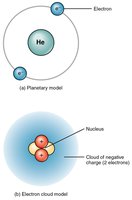
Atoms are composed of three subatomic particles:
Protons: Positively charged, located in the nucleus, 1 atomic mass unit (amu).
Neutrons: No charge, located in the nucleus, 1 amu.
Electrons: Negatively charged, orbit the nucleus, negligible mass (1/2000 amu).
Atoms are neutral when the number of protons equals the number of electrons.
Electron Shells and the Octet Rule
Electrons occupy energy levels called shells around the nucleus.
The first shell holds up to 2 electrons, the second up to 8, and the third up to 18.
The valence shell is the outermost shell; atoms are most stable with 8 electrons in this shell (the octet rule).
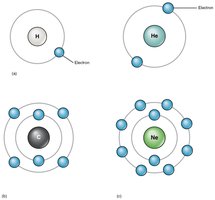
Chemical Bonds
Types of Chemical Bonds
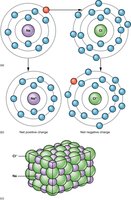
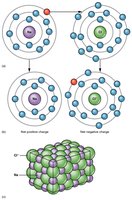
Ionic Bonds: Formed when electrons are transferred from one atom to another, creating ions (cations and anions) that attract each other.
Covalent Bonds: Formed when atoms share electrons. Can be single, double, or triple bonds.
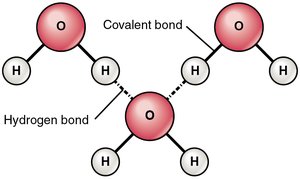
Hydrogen Bonds: Weak attractions between a hydrogen atom in a polar molecule and an electronegative atom in another molecule.
Ionic Bonds
Example: Sodium (Na) donates an electron to Chlorine (Cl), forming Na+ and Cl-, which combine to make NaCl (table salt).
Salts formed by ionic bonds dissociate in water, releasing ions (electrolytes).
Covalent Bonds
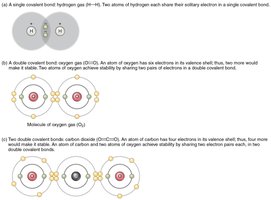
Atoms share electrons to achieve stability.
Single, double, and triple bonds involve sharing 2, 4, or 6 electrons, respectively.
Nonpolar covalent bonds: Electrons are shared equally (e.g., O2, CO2).
Polar covalent bonds: Electrons are shared unequally, creating partial charges (e.g., H2O).
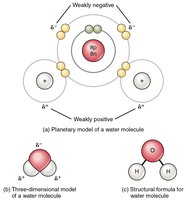
Hydrogen Bonds
Occur between molecules with polar covalent bonds, especially involving hydrogen.
Important in stabilizing the structure of proteins and DNA, and in the properties of water.
Chemical Reactions
Types of Chemical Reactions
Synthesis (Anabolism): Building larger molecules from smaller ones.
Decomposition (Catabolism): Breaking down larger molecules into smaller ones.
Exchange: Both synthesis and decomposition occur.
Reversibility and Rate of Reactions
Many reactions are reversible and reach equilibrium.
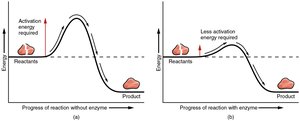
Reaction rates are influenced by temperature, concentration, pressure, particle size, and catalysts (enzymes).
Inorganic Compounds
Water
Makes up about 70% of body weight.
Functions as a heat sink, solvent, lubricant, and cushion.
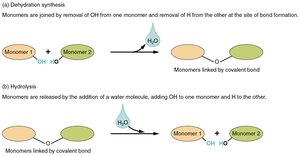
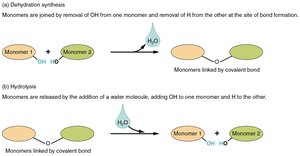
Participates in chemical reactions (dehydration synthesis and hydrolysis).
Salts, Acids, and Bases
Salts: Formed from ionic bonds, dissociate in water to release electrolytes.
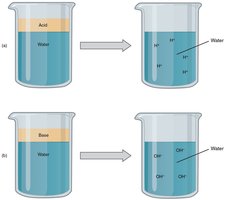
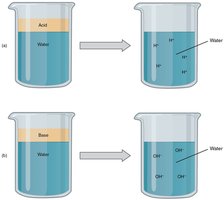
Acids: Release H+ ions in solution (e.g., HCl).
Bases: Accept H+ ions or release OH- (e.g., NaOH).
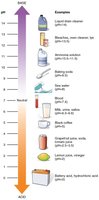
pH Scale: Measures H+ concentration; 0-6.99 is acidic, 7 is neutral, 7.01-14 is basic.
Buffers: Prevent drastic changes in pH; the carbonic acid–bicarbonate system is crucial in blood.
Organic Compounds
Carbohydrates
Composed of carbon, hydrogen, and oxygen (C, H, O).
Main function: provide energy.
Three classes:
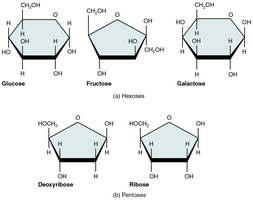
Monosaccharides: Simple sugars (e.g., glucose, fructose, galactose).
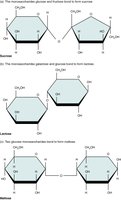
Disaccharides: Two monosaccharides joined (e.g., sucrose, lactose, maltose).
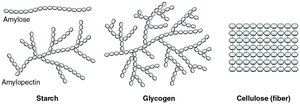
Polysaccharides: Many monosaccharides (e.g., starch, glycogen, cellulose).
Lipids
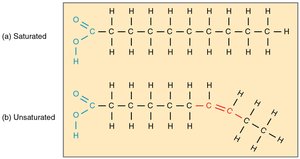
Composed mainly of hydrocarbons; hydrophobic.
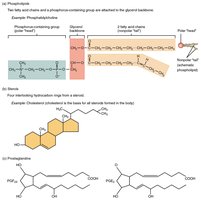
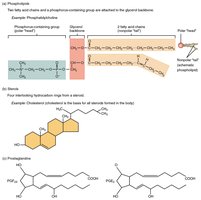
Main types: triglycerides, phospholipids, steroids.
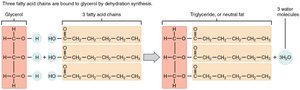
Triglycerides: Three fatty acids + glycerol; energy storage, insulation, protection.
Phospholipids: Two fatty acids + glycerol + phosphate; major component of cell membranes.
Steroids: Four-ring structure; includes cholesterol, hormones.
Proteins
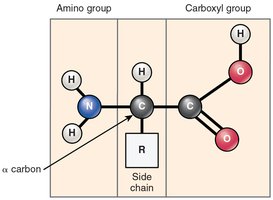
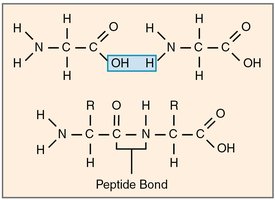
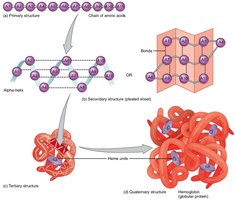
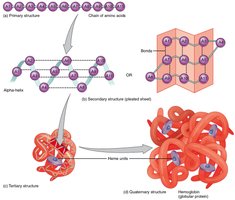
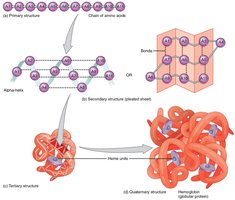
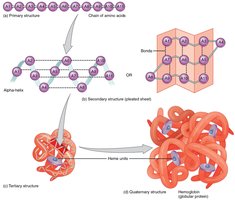
Polymers of amino acids linked by peptide bonds.
Functions: structure, enzymes, hormones, transport, protection.
Structure levels:
Primary: Amino acid sequence.
Secondary: Alpha-helix or beta-sheet (hydrogen bonds).
Tertiary: 3D folding.
Quaternary: Multiple polypeptide chains (e.g., hemoglobin).
Denaturation: Loss of structure and function due to heat, pH, etc.
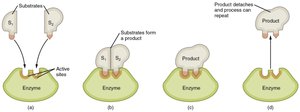
Enzymes: Proteins that catalyze reactions by lowering activation energy.
Nucleic Acids and ATP
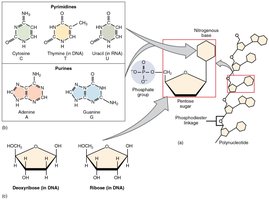
Nucleotides: Building blocks of nucleic acids; consist of a phosphate group, pentose sugar (ribose or deoxyribose), and nitrogenous base.
DNA: Stores genetic information; double helix; bases are A, T, C, G.
RNA: Single strand; involved in protein synthesis; bases are A, U, C, G.
ATP (Adenosine Triphosphate): Main energy carrier in cells; energy is released when a phosphate group is removed.