 Indietro
The Digestive System: Structure, Function, and Integration
Guida di studio - Note intelligenti
 Appunti personalizzati basati sui tuoi materiali, ampliati con definizioni chiave, esempi e contesto.
The Digestive System
Overview and Major Functions
The digestive system is responsible for the breakdown, absorption, and elimination of food. It consists of the digestive tract (gastrointestinal or GI tract) and accessory organs. The GI tract is a muscular tube extending from the oral cavity to the anus, while accessory organs include the teeth, tongue, salivary glands, liver, gallbladder, and pancreas.
Ingestion: Entry of food into the oral cavity.
Mechanical Digestion and Propulsion: Physical breakdown and movement of food along the tract.
Chemical Digestion: Enzymatic breakdown of food into absorbable molecules.
Secretion: Release of water, acids, enzymes, buffers, and salts.
Absorption: Uptake of nutrients, electrolytes, vitamins, minerals, and water into the body.
Defecation: Elimination of indigestible wastes as feces.
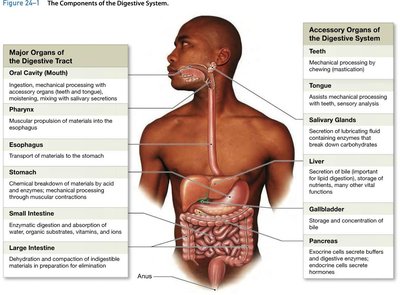
Organs of the Digestive System
Oral Cavity (Mouth): Ingestion, mechanical processing, mixing with salivary secretions.
Pharynx: Muscular propulsion of materials into the esophagus.
Esophagus: Transport of materials to the stomach.
Stomach: Chemical breakdown of materials by acid and enzymes; mechanical processing.
Small Intestine: Enzymatic digestion and absorption of water, organic substrates, vitamins, and ions.
Large Intestine: Dehydration and compaction of indigestible materials in preparation for elimination.
Histology of the Digestive Tract
Layers of the Digestive Tract
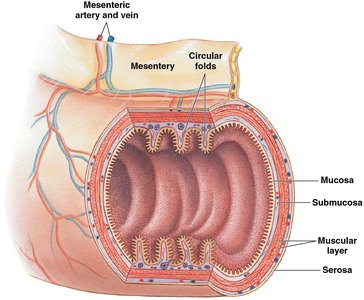
The digestive tract is composed of four major layers, each with distinct functions:
Mucosa: Innermost layer, involved in secretion and absorption.
Submucosa: Connective tissue containing blood vessels, nerves, and glands.
Muscular Layer: Smooth muscle responsible for peristalsis and segmentation.
Serosa: Outermost layer, reduces friction between digestive organs.
Structural variations exist, such as longitudinal folds in the stomach and permanent transverse folds (circular folds) in the small intestine.
Motility: Peristalsis and Deglutition
Peristalsis
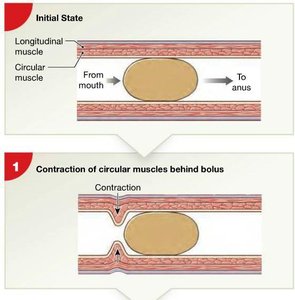
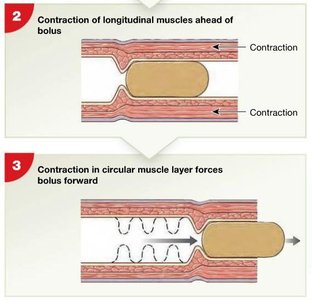
Peristalsis is a series of coordinated, wave-like muscular contractions that move a bolus (food mass) along the digestive tract. It involves both circular and longitudinal muscle layers.
Circular muscles behind the bolus contract, while those ahead relax.
Longitudinal muscles ahead of the bolus contract, shortening the segment.
A wave of contraction in the circular muscle layer forces the bolus forward.
Deglutition (Swallowing)
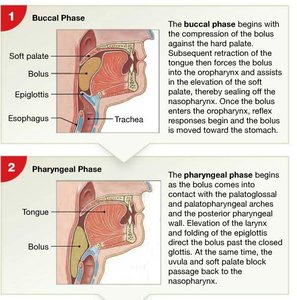
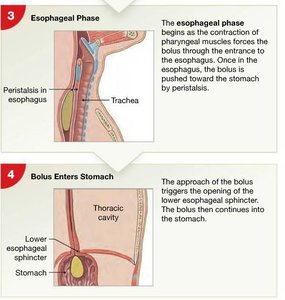
Deglutition is the process of swallowing, which can be initiated voluntarily but proceeds automatically via a reflex. It consists of three phases:
Buccal Phase: Compression of the bolus against the hard palate, movement into the oropharynx.
Pharyngeal Phase: Bolus contacts palatoglossal and palatopharyngeal arches, elevation of the larynx, closure of the glottis.
Esophageal Phase: Peristalsis moves the bolus through the esophagus.
Bolus Enters Stomach: Opening of the lower esophageal sphincter allows entry into the stomach.
The Stomach
Structure and Function
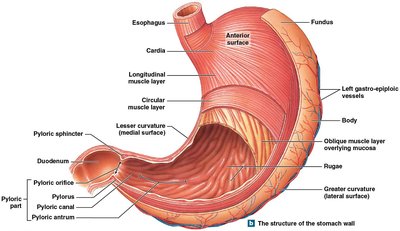
The stomach is a J-shaped organ that temporarily stores ingested food, performs mechanical digestion via muscular contractions, and chemically digests food with acid and enzymes. The mixture of partially digested food and gastric secretions is called chyme.
Cardia: Abundant mucous glands.
Fundus: Contacts the diaphragm.
Body: Largest region, mixing tank.
Pyloric Part: Between body and duodenum.
Regulation of Gastric Activity
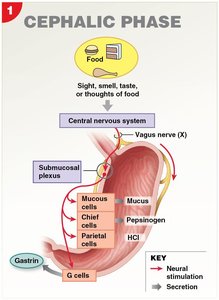
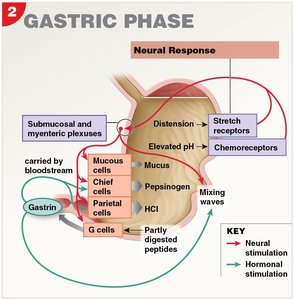
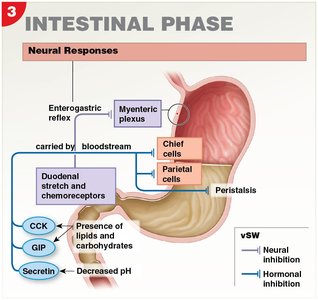
Gastric activity is regulated by the central nervous system (CNS), enteric nervous system (ENS), and hormones. There are three overlapping phases:
Cephalic Phase: Initiated by sight, smell, taste, or thought of food; stimulates gastric secretions via the vagus nerve.
Gastric Phase: Begins with arrival of food in the stomach; stretch and chemoreceptors trigger neural and hormonal responses.
Intestinal Phase: Begins when chyme enters the duodenum; inhibits gastric activity via neural and hormonal mechanisms.
The Small Intestine
Structure and Segments
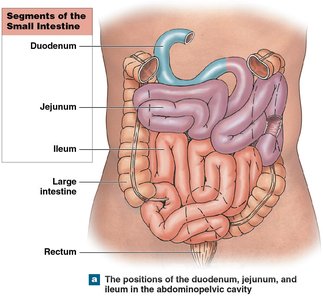
The small intestine is a long, muscular tube where most chemical digestion and nutrient absorption occur. It consists of three segments:
Duodenum: Closest to the stomach, receives chyme and digestive secretions.
Jejunum: Middle segment, site of most digestion and absorption.
Ileum: Final segment, ends at the ileocecal valve (controls flow into the large intestine).
Accessory Digestive Organs
Pancreas
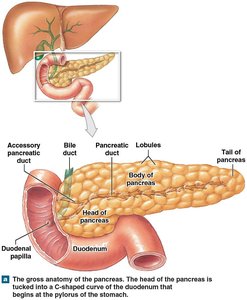
The pancreas lies posterior to the stomach and is retroperitoneal. It has both endocrine and exocrine functions:
Endocrine Cells: Secrete insulin and glucagon into the bloodstream.
Exocrine Cells: Secrete alkaline pancreatic juice (containing digestive enzymes, water, and ions) into the small intestine.
Anatomy: Head (in duodenal loop), body (extends toward spleen), tail (short and rounded), pancreatic duct (delivers secretions to duodenum).
Liver
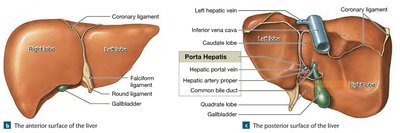
The liver is the largest visceral organ and performs essential metabolic and synthetic functions:
Metabolic Regulation: Carbohydrate, lipid, amino acid metabolism; waste removal; vitamin and mineral storage; drug inactivation.
Haematological Regulation: Removal of old RBCs, synthesis of plasma proteins, removal of hormones, antibodies, toxins.
Bile Synthesis and Secretion: Bile emulsifies fats and promotes absorption.
Structure: Divided into lobes and lobules (basic functional units).
The Large Intestine
Structure and Function
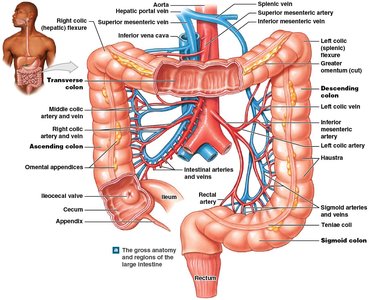
The large intestine is a horseshoe-shaped organ extending from the end of the ileum to the anus. It frames the small intestine and consists of the cecum, colon, and rectum.
Cecum: Pouchlike first portion.
Colon: Largest portion.
Rectum: Final 15 cm, end of digestive tract.
Functions of the Large Intestine
Absorption/Reabsorption: Water, nutrients, bile salts, organic wastes, vitamins, toxins.
Compaction: Formation of feces.
Storage: Fecal material prior to defecation.
Microbiome: Bacteria produce vitamins (e.g., vitamin K, biotin, vitamin B5) that supplement the diet.
Water Movement in the Digestive System
Water Absorption
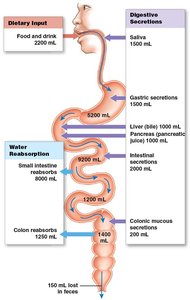
Water movement across the digestive tract is passive, following osmotic gradients. Cells cannot actively absorb or secrete water.
Integration with Other Body Systems
Systemic Interactions
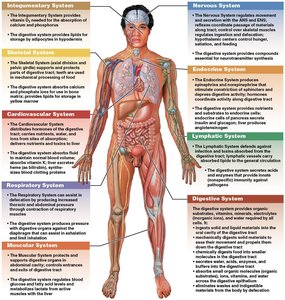
The digestive system interacts with multiple body systems, including the nervous, endocrine, cardiovascular, lymphatic, respiratory, integumentary, skeletal, and muscular systems. These interactions are essential for maintaining homeostasis and supporting overall health.
Summary Table: Major Organs and Functions
Organ | Function |
|---|---|
Oral Cavity | Ingestion, mechanical processing, mixing with saliva |
Pharynx | Propulsion of food into esophagus |
Esophagus | Transport of food to stomach |
Stomach | Mechanical and chemical digestion, storage |
Small Intestine | Digestion and absorption of nutrients |
Large Intestine | Absorption of water, formation and storage of feces |
Teeth | Mechanical processing |
Tongue | Mechanical processing, sensory analysis |
Salivary Glands | Lubrication, digestion initiation |
Liver | Metabolic regulation, bile production |
Gallbladder | Bile storage and concentration |
Pancreas | Enzyme and hormone secretion |
Key Terms and Definitions
Chyme: Partially digested food mixed with gastric secretions.
Peristalsis: Wave-like muscular contractions moving food along the GI tract.
Deglutition: The act of swallowing.
Enzyme: Protein that catalyzes chemical reactions in digestion.
Bile: Fluid produced by the liver, stored in the gallbladder, aids in fat digestion.
Microbiome: Community of microorganisms living in the digestive tract.
Relevant Equations
Osmosis (water movement):
Where is water potential, is solute potential, and is pressure potential. Water moves from regions of higher to lower water potential.
Additional info: The notes have been expanded with academic context and definitions to ensure completeness and clarity for exam preparation.
