 Indietro
The Endocrine System: Structure, Function, and Regulation
Guida di studio - Note intelligenti
 Appunti personalizzati basati sui tuoi materiali, ampliati con definizioni chiave, esempi e contesto.
The Endocrine System
Overview of the Endocrine System
The endocrine system is one of the body's two major regulatory systems, alongside the nervous system. It consists of endocrine organs that synthesize and secrete hormones—chemical messengers—into the bloodstream, where they act on specific target cells with matching receptors. Hormone binding causes functional changes in target cells, affecting various physiological processes.
Hormones are released by ductless epithelial cells into interstitial fluid and carried by blood.
Endocrine glands are distinct from exocrine glands, which use ducts to secrete substances to body surfaces or cavities.
Hormone effects are slower but longer-lasting than nervous system signals.
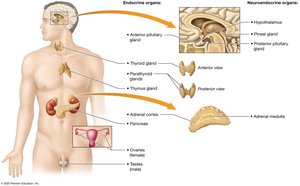
Comparison of the Endocrine and Nervous Systems
Both systems regulate body functions, but differ in speed, duration, and mechanism:
Nervous system: Fast, short-lived responses via electrical impulses and neurotransmitters.
Endocrine system: Slow, long-lasting responses via hormones in the bloodstream.
Paracrine and Autocrine Signals
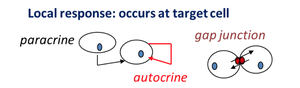
Not all cell signaling is endocrine. Paracrine signals affect nearby cells, while autocrine signals affect the same cell that released them. These are local responses and are not part of the endocrine system.
Hormones: Classes and Mechanisms
Classes of Hormones
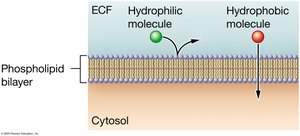
Hormones are classified by their chemical structure and solubility:
Amino acid–based hormones: Mostly hydrophilic (water-soluble), except thyroid hormone (hydrophobic).
Peptide/protein hormones: Hydrophilic.
Steroid hormones: Hydrophobic (lipid-soluble).
Mechanisms of Hormone Action
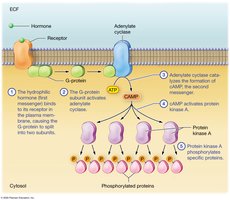
Hormones act by binding to receptors, triggering cellular responses:
Hydrophilic hormones (e.g., peptide hormones) bind to cell surface receptors and use second messenger systems (such as cAMP, IP3, DAG) to amplify signals inside the cell.
Hydrophobic hormones (e.g., steroids, thyroid hormone) diffuse through the cell membrane and bind to intracellular receptors, often affecting gene expression.
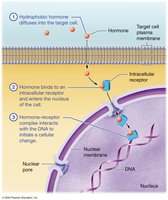
Hormones can:
Stimulate or inhibit secretion
Activate or inhibit enzymes
Influence cell division (mitosis/meiosis)
Open or close ion channels
Change gene expression
Mnemonic: S-I-M-P-L-E (Sleep, Immunity, Metabolism, Procreation, Lifespan, Emotion)
Regulation of Hormone Secretion
Hormone secretion is typically regulated by negative feedback loops to maintain homeostasis. For example:
High blood glucose stimulates insulin release; low blood glucose stimulates glucagon release.
Positive feedback is less common (e.g., oxytocin during childbirth).
Hypothalamus and Pituitary Gland
Structure of the Hypothalamus and Pituitary Gland
The hypothalamus and pituitary gland are central to endocrine regulation. The hypothalamus links the nervous and endocrine systems, controlling the pituitary gland.
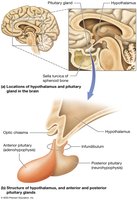
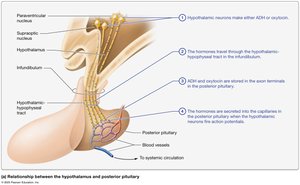
Hormones of the Hypothalamus and Posterior Pituitary
The posterior pituitary releases hormones made in the hypothalamus:
Antidiuretic Hormone (ADH/Vasopressin): Increases water reabsorption in kidneys, raising blood volume. Deficiency causes diabetes insipidus.
Oxytocin (OT): Triggers milk ejection and uterine contraction; also involved in bonding.
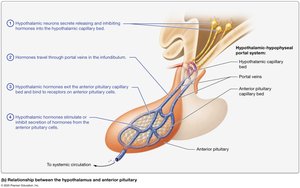
Functional Relationship of the Hypothalamus and Anterior Pituitary
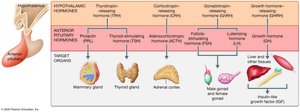
The anterior pituitary is regulated by hypothalamic releasing and inhibiting hormones via the hypophyseal portal system. It secretes hormones that act on various target organs.
Thyroid and Parathyroid Glands
Structure of the Thyroid and Parathyroid Glands
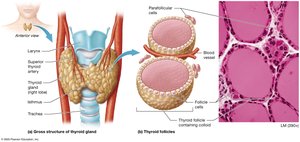
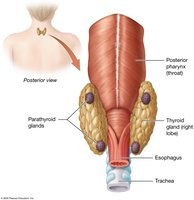
The thyroid gland is located in the anterior neck, consisting of right and left lobes joined by the isthmus. It contains follicles that produce thyroid hormones and parafollicular cells that secrete calcitonin.
Thyroid Hormones
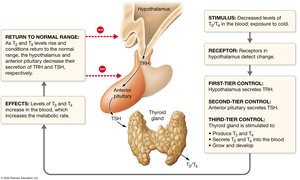
Thyroid hormones (T3 and T4) are metabolic regulators:
Triiodothyronine (T3): Three iodine atoms
Thyroxine (T4): Four iodine atoms
Regulate metabolic rate, thermoregulation, growth, and development
Thyroid Disorders
Hyperthyroidism: Excess thyroid hormones; causes weight loss, heat intolerance, rapid heartbeat, high blood pressure. Most commonly due to Graves' disease (autoimmune).
Hypothyroidism: Deficiency of thyroid hormones.
Parathyroid Hormone and Calcitonin: Bone Homeostasis
Parathyroid hormone (PTH) increases blood calcium by acting on bone, kidney, and small intestine. It is secreted in response to hypocalcemia.
Calcitonin (from parafollicular cells): Decreases blood calcium.
Adrenal Glands
Structure of the Adrenal Glands
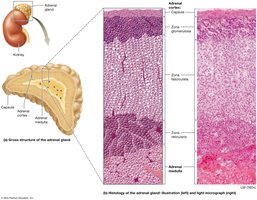
The adrenal glands are pyramid-shaped organs located on the superior end of each kidney. They consist of an outer cortex and inner medulla.
Hormones of the Adrenal Cortex and Medulla
Adrenal cortex: Produces steroid hormones (e.g., cortisol, aldosterone).
Adrenal medulla: Chromaffin cells produce epinephrine and norepinephrine, which act as neurohormones for the sympathetic "fight-or-flight" response.
Effects: Increased heart rate, blood pressure, respiration; decreased digestive activity.
Cortisol Disorders
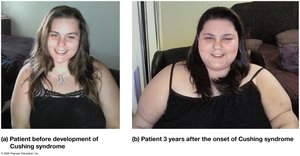
Cushing syndrome: Excess cortisol secretion.
Addison disease: Adrenal insufficiency (hyposecretion of cortisol and aldosterone).
Pancreas
Structure of the Pancreas
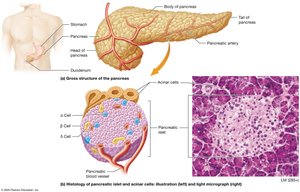
The pancreas is a club-shaped organ in the abdominal cavity, posterior to the stomach. It contains both endocrine and exocrine cells.
Pancreatic islets: Endocrine cells that secrete peptide hormones.
Acinar cells: Exocrine cells that secrete digestive enzymes.
Hormones of the Endocrine Pancreas: Glucose Homeostasis
Alpha (α) cells: Secrete glucagon (raises blood glucose).
Beta cells: Secrete insulin (lowers blood glucose).
Delta cells: Secrete somatostatin (inhibits GH, lowers blood glucose).
Type 1 Diabetes Mellitus: Autoimmune destruction of beta cells, no insulin production, requires insulin injections.
Type 2 Diabetes Mellitus: Insulin resistance, linked to obesity and genetics, most common type.
Pineal and Thymus Glands
The Pineal Gland: Melatonin
The pineal gland, part of the epithalamus, secretes melatonin, which regulates the sleep/wake cycle.
The Thymus: Thymosin and Thymopoietin
The thymus is located in the mediastinum and secretes thymosin and thymopoietin, paracrine signals that assist in T lymphocyte maturation. It is larger and more active in infants and children.
Gonads: Sex Hormones
Testes (Male)
The testes produce sperm and testosterone. Gonadotropin-releasing hormone (GnRH) stimulates the anterior pituitary to release FSH and LH:
FSH: Sperm development
LH: Testosterone secretion, spermatogenesis, male traits
Ovaries (Female)
The ovaries produce oocytes, estrogen, and progesterone. GnRH stimulates FSH and LH, which control follicle growth and ovulation. Estrogen and progesterone regulate the uterine cycle and female secondary traits.
Summary Table: Major Endocrine Glands and Their Hormones
Gland | Hormone(s) | Main Effects |
|---|---|---|
Hypothalamus | Releasing/inhibiting hormones | Regulate pituitary |
Pituitary (anterior) | GH, TSH, ACTH, FSH, LH, PRL | Growth, metabolism, reproduction |
Pituitary (posterior) | ADH, Oxytocin | Water balance, uterine contraction |
Thyroid | T3, T4, Calcitonin | Metabolism, calcium regulation |
Parathyroid | PTH | Increase blood calcium |
Adrenal cortex | Cortisol, Aldosterone | Stress, water/salt balance |
Adrenal medulla | Epinephrine, Norepinephrine | Fight-or-flight |
Pancreas | Insulin, Glucagon, Somatostatin | Glucose homeostasis |
Pineal | Melatonin | Sleep/wake cycle |
Thymus | Thymosin, Thymopoietin | T cell maturation |
Gonads | Testosterone, Estrogen, Progesterone | Reproduction, secondary traits |
