 Indietro
The Endocrine System: Structure, Function, and Regulation
Guida di studio - Note intelligenti
 Appunti personalizzati basati sui tuoi materiali, ampliati con definizioni chiave, esempi e contesto.
The Endocrine System
Overview of the Endocrine System
The endocrine system works in conjunction with the nervous system to coordinate and integrate the activities of body cells. It influences metabolic activities through the release of hormones, which are chemical messengers transported in the blood. The responses of the endocrine system are generally slower but longer-lasting than those of the nervous system. The study of hormones and endocrine organs is known as endocrinology.
Functions: Reproduction, growth and development, maintenance of electrolyte, water, and nutrient balance, regulation of cellular metabolism and energy balance, and mobilization of body defenses.
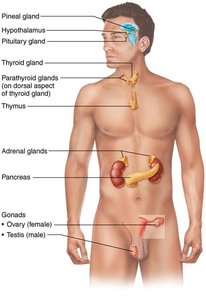
Glands: Endocrine glands (pituitary, thyroid, parathyroid, adrenal, pineal) produce hormones and lack ducts. Exocrine glands (e.g., sweat, saliva) have ducts and produce nonhormonal substances.
Other hormone-producing tissues: Pancreas, gonads, placenta, adipose cells, thymus, and cells in the small intestine, stomach, kidneys, and heart.
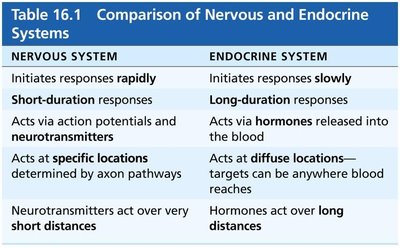
Comparison of Nervous and Endocrine Systems
The nervous and endocrine systems both regulate body functions but differ in their mechanisms and effects.
Nervous System | Endocrine System | |
|---|---|---|
Response Initiation | Rapidly | Slowly |
Duration | Short-duration | Long-duration |
Signals | Action potentials and neurotransmitters | Hormones released into blood |
Location of Action | Specific locations (axon pathways) | Diffuse locations (anywhere blood reaches) |
Distance of Action | Short distances | Long distances |
Chemical Messengers of the Endocrine System
Hormones: Long-distance chemical signals that travel in blood or lymph.
Autocrines: Chemicals that exert effects on the same cells that secrete them (local effect).
Paracrines: Locally acting chemicals that affect cells other than those that secrete them.
Hormone Classes:
Amino acid–based hormones: Includes amino acid derivatives, peptides, and proteins.
Steroids: Synthesized from cholesterol; includes gonadal and adrenocortical hormones.
Eicosanoids: Sometimes considered hormones, but mostly classified as paracrines.
Hormone Action on Target Cells
Although hormones circulate systemically, only cells with specific receptors (target cells) are affected. Hormones can:
Alter plasma membrane permeability and/or membrane potential by opening or closing ion channels
Stimulate synthesis of enzymes or other proteins
Activate or deactivate enzymes
Induce secretory activity
Stimulate mitosis
Mechanisms of Hormone Action
Hormones act in one of two main ways, depending on their chemical nature and receptor location:
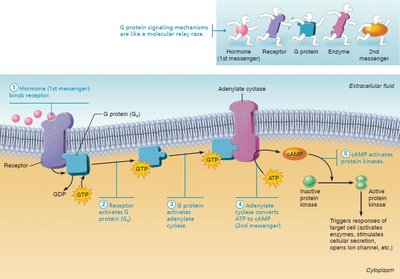
Water-soluble hormones (all amino acid–based hormones except thyroid hormone):
Act on plasma membrane receptors
Act via G protein second messengers (e.g., cAMP)
Cannot enter the cell
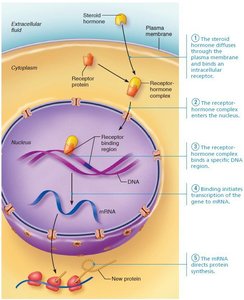
Lipid-soluble hormones (steroid and thyroid hormones):
Act on intracellular receptors that directly activate genes
Can enter the cell
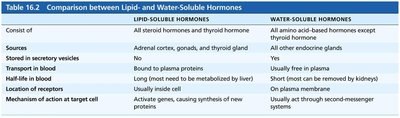
Comparison of Lipid- and Water-Soluble Hormones
Lipid-Soluble Hormones | Water-Soluble Hormones | |
|---|---|---|
Consist of | All steroid hormones and thyroid hormone | All amino acid–based hormones except thyroid hormone |
Sources | Adrenal cortex, gonads, thyroid gland | All other endocrine glands |
Stored in secretory vesicles | No | Yes |
Transport in blood | Bound to plasma proteins | Usually free in plasma |
Half-life in blood | Long (most need to be metabolized by liver) | Short (most can be removed by kidneys) |
Location of receptors | Usually inside cell | On plasma membrane |
Mechanism of action at target cell | Activate genes, causing synthesis of new proteins | Usually act through second-messenger systems |
Hormone Release and Regulation
Control of Hormone Release
Blood levels of hormones are controlled by negative feedback systems, maintaining levels within a narrow, desirable range. Hormone release is triggered by:
Endocrine gland stimuli (humoral, neural, hormonal)
Nervous system modulation
Types of Endocrine Gland Stimuli
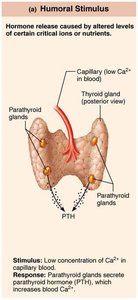
Humoral stimuli: Changing blood levels of ions and nutrients directly stimulate hormone secretion (e.g., low Ca2+ stimulates parathyroid hormone release).
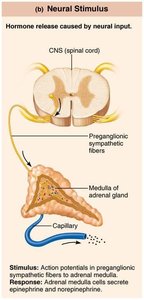
Neural stimuli: Nerve fibers stimulate hormone release (e.g., sympathetic nervous system stimulates adrenal medulla to secrete catecholamines).
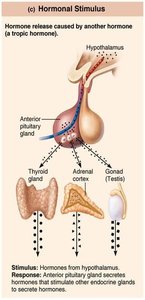
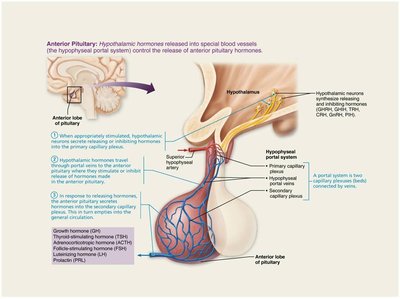
Hormonal stimuli: Hormones stimulate other endocrine organs to release their hormones (e.g., hypothalamic hormones stimulate anterior pituitary hormones).
Target Cell Specificity and Regulation
Target cells must have specific receptors for a hormone to bind and respond. Activation depends on:
Blood levels of the hormone
Relative number of receptors on/in the target cell
Affinity (strength) of binding between receptor and hormone
Cells can adjust their sensitivity to hormones by up-regulation (increasing receptors) or down-regulation (decreasing receptors).
The Hypothalamus and Pituitary Gland
Structure and Function
The hypothalamus is connected to the pituitary gland (hypophysis) via the infundibulum. The pituitary has two major lobes:
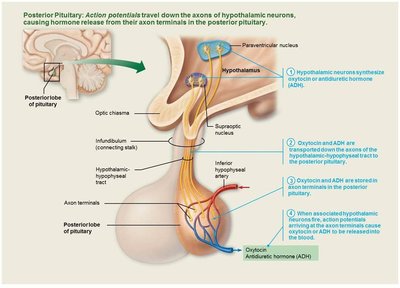
Posterior pituitary (neurohypophysis): Neural tissue that secretes neurohormones (oxytocin and ADH).
Anterior pituitary (adenohypophysis): Glandular tissue that produces and releases hormones in response to hypothalamic signals.
Posterior Pituitary Hormones
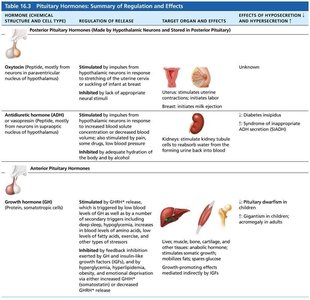
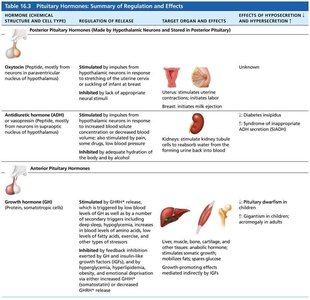
Oxytocin: Stimulates uterine contractions during childbirth and milk ejection during breastfeeding; acts via positive feedback mechanisms.
Antidiuretic hormone (ADH): Regulates water balance by targeting kidney tubules to reabsorb more water; release is triggered by high solute concentration, pain, low blood pressure, and drugs; inhibited by alcohol and diuretics.
Anterior Pituitary Hormones
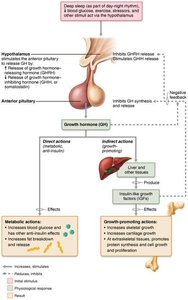
Growth hormone (GH): Stimulates growth of most tissues, especially bone and muscle; has direct metabolic effects and indirect growth-promoting effects via insulin-like growth factors (IGFs).
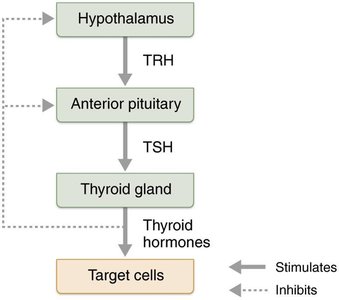
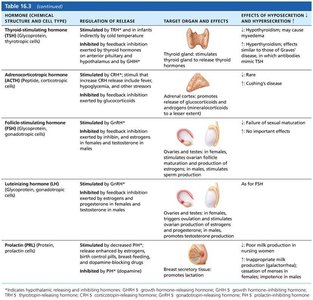
Thyroid-stimulating hormone (TSH): Stimulates thyroid gland to release thyroid hormones.
Adrenocorticotropic hormone (ACTH): Stimulates adrenal cortex to release corticosteroids.
Follicle-stimulating hormone (FSH) and Luteinizing hormone (LH): Regulate function of gonads (ovaries and testes).
Prolactin (PRL): Stimulates milk production in females.
The Thyroid Gland
Structure and Function
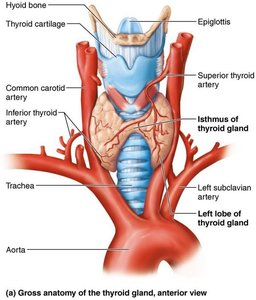
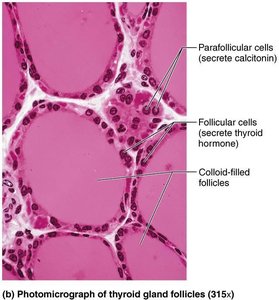
The thyroid gland is a butterfly-shaped organ located in the anterior neck, just inferior to the larynx. It consists of two lateral lobes connected by an isthmus. The gland contains follicles filled with colloid, which is the precursor to thyroid hormone, and parafollicular cells that produce calcitonin.
Thyroid Hormone (TH)
Forms: T4 (thyroxine) and T3 (triiodothyronine); both are iodine-containing amine hormones.
Functions: Increases basal metabolic rate, regulates tissue growth and development, maintains blood pressure.
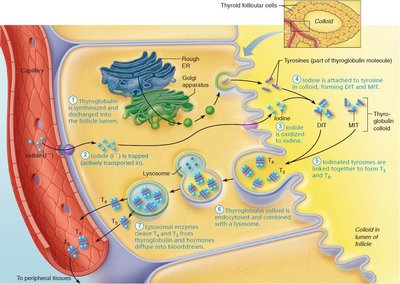
Synthesis: Involves trapping iodide, oxidation to iodine, attachment to tyrosine, coupling to form T3 and T4, endocytosis, and release into the bloodstream.
Transport: T4 and T3 are transported by thyroxine-binding globulins (TBGs); T3 is more active than T4.
Regulation: Negative feedback involving TSH and TRH.
Summary Table: Major Effects of Thyroid Hormone (T4 and T3)
Effects: Increases metabolic rate, heat production, growth and development, and maintains blood pressure.
Clinical Correlations
Hyposecretion of TH: Myxedema in adults, congenital hypothyroidism in children; may cause goiter if due to iodine deficiency.
Hypersecretion of TH: Graves' disease (autoimmune); symptoms include elevated metabolic rate, sweating, rapid heartbeat, and exophthalmos.
Parathyroid Glands
Structure and Function
Four to eight small glands embedded in the posterior aspect of the thyroid. Chief cells secrete parathyroid hormone (PTH), the most important hormone in Ca2+ homeostasis.
Functions: Stimulates osteoclasts, enhances Ca2+ reabsorption in kidneys, promotes activation of vitamin D for increased intestinal absorption of Ca2+.
Adrenal Glands
Structure and Function
Paired, pyramid-shaped organs atop the kidneys. Each consists of:
Adrenal cortex: Produces corticosteroids (mineralocorticoids, glucocorticoids, gonadocorticoids).
Adrenal medulla: Produces catecholamines (epinephrine and norepinephrine).
Adrenal Cortex Hormones
Mineralocorticoids (e.g., aldosterone): Regulate Na+ and K+ balance.
Glucocorticoids (e.g., cortisol): Influence metabolism, help resist stressors, maintain blood glucose and pressure.
Gonadocorticoids: Weak androgens contributing to puberty and sex drive.
Adrenal Medulla Hormones
Catecholamines (epinephrine and norepinephrine): Mediate short-term stress response (fight or flight), increase heart rate, blood glucose, and blood flow to muscles.
Pineal Gland
Small gland in the brain that secretes melatonin, which regulates sleep-wake cycles and other rhythmic processes.
Pancreas
Structure and Function
Both exocrine (digestive enzymes) and endocrine (hormones) functions. Endocrine cells include:
Alpha cells: Produce glucagon (raises blood glucose).
Beta cells: Produce insulin (lowers blood glucose).
Gonads and Placenta
Ovaries: Produce estrogens and progesterone (female reproductive functions).
Testes: Produce testosterone (male reproductive functions).
Placenta: Secretes estrogens, progesterone, and hCG during pregnancy.
Hormone Secretion by Other Organs
Adipose tissue: Leptin, resistin, adiponectin
Gastrointestinal tract: Gastrin, ghrelin, secretin, CCK, incretins
Heart: Atrial natriuretic peptide (ANP)
Kidneys: Erythropoietin, renin
Skeleton: Osteocalcin
Skin: Cholecalciferol, calcitriol
Thymus: Thymulin, thymopoietins, thymosins
