 Indietro
The Endocrine System: Structure, Hormones, and Regulation
Guida di studio - Note intelligenti
 Appunti personalizzati basati sui tuoi materiali, ampliati con definizioni chiave, esempi e contesto.
The Endocrine System
Overview and Essential Characteristics
The endocrine system is a complex network of glands and tissues that produce hormones to regulate various physiological processes. It works alongside the nervous system to maintain homeostasis, but differs in its mechanisms and effects.
Key Point 1: Both systems use chemical messengers, but the endocrine system uses hormones that travel through the bloodstream, affecting distant target cells, while the nervous system uses neurotransmitters for rapid, localized effects.
Key Point 2: Endocrine responses are generally slower and longer-lasting compared to the rapid, short-lived effects of nervous impulses.
Key Point 3: Endocrine organs are distributed throughout the body and release hormones directly into the extracellular fluid.
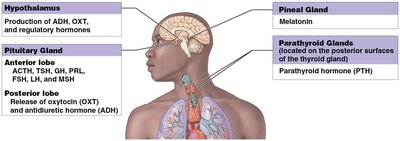
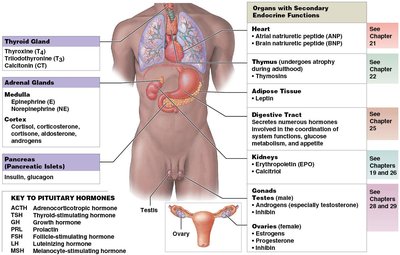
Major Endocrine Organs and Their Functions
The endocrine system includes primary glands such as the hypothalamus, pituitary, thyroid, adrenal glands, pancreas, and others. Each gland produces specific hormones that regulate distinct bodily functions.
Hypothalamus: Produces antidiuretic hormone (ADH), oxytocin (OXT), and regulatory hormones.
Pituitary Gland: Divided into anterior and posterior lobes, releasing hormones like ACTH, TSH, GH, PRL, FSH, LH, MSH, OXT, and ADH.
Thyroid Gland: Produces thyroxine (T4), triiodothyronine (T3), and calcitonin.
Adrenal Glands: Cortex produces corticosteroids and androgens; medulla produces epinephrine and norepinephrine.
Pancreas: Islets produce insulin and glucagon.
Pineal Gland: Produces melatonin.
Parathyroid Glands: Produce parathyroid hormone (PTH).
Hormones: Classes and Mechanisms
Classes of Hormones
Hormones are classified based on their chemical structure and origin.
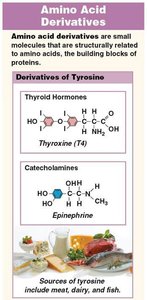
Amino Acid Derivatives: Small molecules derived from amino acids, such as tyrosine and tryptophan. Examples include thyroid hormones (T3, T4) and catecholamines (epinephrine, norepinephrine, dopamine).
Peptide Hormones: Chains of amino acids, ranging from small peptides to large glycoproteins. Examples include insulin, growth hormone, and prolactin.
Lipid Derivatives: Includes eicosanoids (derived from arachidonic acid) and steroid hormones (derived from cholesterol), such as androgens, estrogens, corticosteroids, and calcitriol.
Hormone Transport and Inactivation
Hormones may circulate freely or be bound to carrier proteins.
Free hormones: Remain functional for less than an hour, inactivated by binding to target cells, breakdown by liver/kidneys, or enzymatic degradation.
Bound hormones: Remain in circulation longer, protected by carrier proteins.
Mechanisms of Hormone Action
Hormones exert their effects by binding to specific receptors on or within target cells.
Key Point 1: Binding may alter genetic activity, protein synthesis, or membrane permeability.
Key Point 2: The presence or absence of receptors determines a cell's sensitivity to a hormone.
Up-regulation: Increased receptor numbers in response to low hormone levels.
Down-regulation: Decreased receptor numbers in response to high hormone levels.
Hypothalamus and Pituitary Gland
Anatomy and Functional Relationship
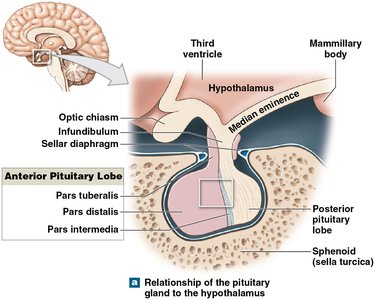
The hypothalamus and pituitary gland are central to endocrine regulation. The pituitary gland lies within the sella turcica, beneath the hypothalamus, and is isolated from the cranial cavity by the sellar diaphragm.
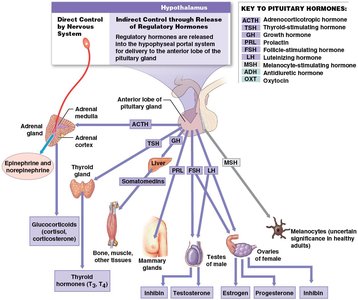
Anterior Pituitary: Releases hormones such as ACTH, TSH, GH, PRL, FSH, LH, and MSH.
Posterior Pituitary: Releases oxytocin (OXT) and antidiuretic hormone (ADH).
Regulation of Pituitary Hormones
The hypothalamus controls pituitary function through direct neural input and regulatory hormones released into the hypophyseal portal system.
Direct control: Nervous system stimulates adrenal medulla.
Indirect control: Regulatory hormones influence anterior pituitary hormone release.
The Thyroid Gland
Anatomy and Hormone Production
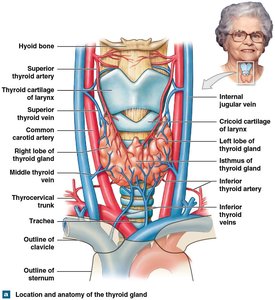
The thyroid gland is located inferior to the thyroid cartilage of the larynx and produces T3 (triiodothyronine) and T4 (thyroxine), both containing iodine atoms.
Key Point 1: Thyroid hormones affect nearly every cell in the body, entering cells via transport systems and binding to receptors in the cytoplasm, mitochondria, and nucleus.
Key Point 2: Essential for normal development of skeletal, muscular, and nervous systems in children.
Effects and Regulation of Thyroid Hormones
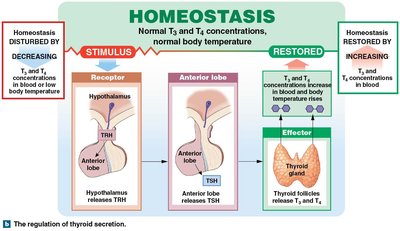
Thyroid hormones elevate oxygen and energy consumption, increase heart rate, stimulate red blood cell formation, and accelerate mineral turnover in bone. Their secretion is regulated by negative feedback involving the hypothalamus and anterior pituitary.
Regulation: Decreased T3/T4 or body temperature stimulates hypothalamus to release TRH, which prompts anterior pituitary to release TSH, stimulating thyroid hormone production.
Adrenal Glands
Anatomy and Hormone Production
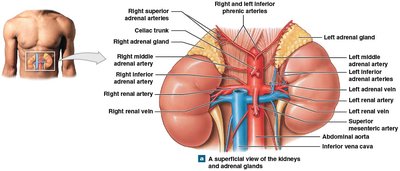
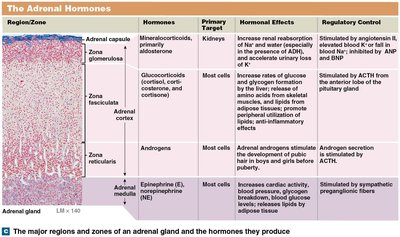
The adrenal glands are located on the superior border of each kidney and consist of an outer cortex and inner medulla.
Adrenal Cortex: Produces corticosteroids (mineralocorticoids, glucocorticoids, and androgens).
Adrenal Medulla: Produces catecholamines (epinephrine and norepinephrine).
Zones of the Adrenal Cortex and Their Hormones
The adrenal cortex is subdivided into three zones: zona glomerulosa, zona fasciculata, and zona reticularis, each producing distinct hormones.
Region/Zone | Hormones | Primary Target | Hormonal Effects | Regulatory Control |
|---|---|---|---|---|
Zona glomerulosa | Mineralocorticoids (aldosterone) | Kidneys | Increase renal reabsorption of Na+ and water; accelerate urinary loss of K+ | Stimulated by angiotensin II, elevated blood K+, inhibited by ANP and BNP |
Zona fasciculata | Glucocorticoids (cortisol, corticosterone) | Most cells | Increase rates of glucose and glycogen formation; anti-inflammatory effects | Stimulated by ACTH from anterior pituitary |
Zona reticularis | Androgens | Most cells | Stimulate development of pubic hair in boys and girls before puberty | Androgen secretion stimulated by ACTH |
Adrenal medulla | Epinephrine (E), norepinephrine (NE) | Most cells | Increase cardiac activity, blood pressure, glycogen breakdown, and blood glucose | Stimulated by sympathetic preganglionic fibers |
Pancreas
Anatomy and Dual Function
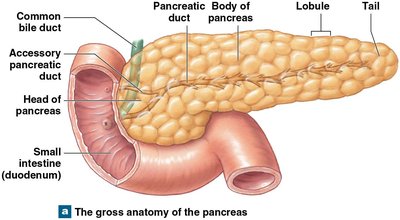
The pancreas is a large gland located between the stomach and small intestine, containing both exocrine and endocrine cells.
Exocrine pancreas: Produces enzyme-rich fluid for digestion.
Endocrine pancreas: Contains islets with alpha cells (produce glucagon) and beta cells (produce insulin).
Regulation of Blood Glucose
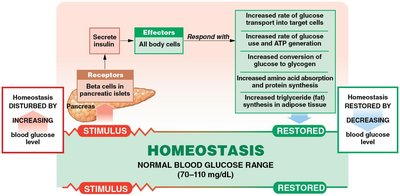
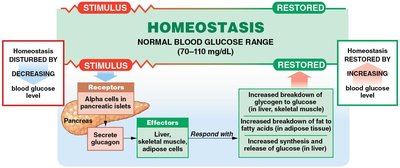
The pancreas regulates blood glucose through the actions of insulin and glucagon.
When blood glucose increases: Beta cells secrete insulin, promoting glucose uptake and storage.
When blood glucose decreases: Alpha cells secrete glucagon, stimulating glycogen breakdown and glucose release.
Diabetes Mellitus
Diabetes mellitus is a disorder of glucose regulation.
Type 1 Diabetes: Characterized by inadequate insulin production; requires insulin therapy; often develops in children and young adults.
Type 2 Diabetes: Most common; tissues are resistant to insulin; associated with obesity; weight loss can be effective.
Complications: Include kidney degeneration, retinal damage, early heart attacks, peripheral nerve problems, and tissue damage.
Summary Table: Hormone Classes and Examples
Class | Examples | Source |
|---|---|---|
Amino Acid Derivatives | Thyroid hormones (T3, T4), catecholamines (epinephrine, norepinephrine, dopamine), serotonin, melatonin | Thyroid, adrenal medulla, pineal gland |
Peptide Hormones | Insulin, growth hormone, prolactin, TSH, LH, FSH | Pancreas, pituitary gland |
Lipid Derivatives | Androgens, estrogens, corticosteroids, calcitriol, eicosanoids | Adrenal cortex, ovaries, testes, kidneys |
Key Equations
Negative Feedback Regulation (Generalized)
Hormone secretion is often regulated by negative feedback loops, maintaining homeostasis.
Blood Glucose Regulation
Normal blood glucose range: 70–110 mg/dL
Conclusion
The endocrine system is essential for regulating metabolism, growth, development, and homeostasis. Understanding the structure, function, and regulation of endocrine glands and hormones is fundamental for Anatomy & Physiology students. Additional info: Tables and diagrams have been expanded for clarity and completeness.
