 Indietro
The Human Body: An Orientation & Homeostasis – Study Notes
Guida di studio - Note intelligenti
 Appunti personalizzati basati sui tuoi materiali, ampliati con definizioni chiave, esempi e contesto.
The Language of Anatomy
Anatomical Position
The anatomical position is a standardized posture used to avoid confusion when describing the human body. It serves as the reference point for anatomical terminology.
Definition: The body stands erect, feet parallel and flat, arms at the sides with palms facing forward and thumbs pointing away from the body.
Importance: All directional and regional terms are based on this position.
Supine: Lying face up.
Prone: Lying face down.
Body Regions
The human body is divided into externally identifiable regions for clarity in anatomical study.
Head
Neck
Trunk
Upper limbs
Lower limbs
Directional Terms
Directional terms describe the location of one body structure relative to another. Most are paired with opposites.
Superior: Toward the upper part of the body.
Inferior (Caudal): Away from the head or toward the lower part.
Anterior (Ventral): Toward the front of the body.
Posterior (Dorsal): Toward the back of the body.
Medial: Toward the midline.
Lateral: Away from the midline.
Intermediate: Between medial and lateral structures.
Ipsilateral: On the same side as another structure.
Contralateral: On the opposite side.
Proximal: Closer to the origin or point of attachment.
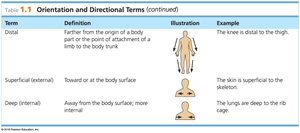
Distal: Farther from the origin or point of attachment.
Superficial (External): Toward or at the body surface.
Deep (Internal): Away from the body surface; more internal.
Term | Definition | Illustration | Example |
|---|---|---|---|
Distal | Farther from the origin of a body part or the point of attachment of a limb to the body trunk | Body diagram | The knee is distal to the thigh. |
Superficial (external) | Toward or at the body surface | Body diagram | The skin is superficial to the skeleton. |
Deep (internal) | Away from the body surface; more internal | Body diagram | The lungs are deep to the rib cage. |
Planes and Sections
Body planes are imaginary flat surfaces that divide the body or organs for anatomical study.
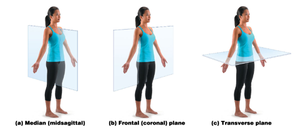
Sagittal Plane: Divides the body into right and left sides.
Midsagittal: Equal right and left sides.
Parasagittal: Unequal sides.
Frontal (Coronal) Plane: Divides into anterior (front) and posterior (back) portions.
Transverse Plane: Divides into superior and inferior portions; also called cross-sectional.
Oblique Plane: Passes at an angle between other planes.
Body Cavities
Major Body Cavities
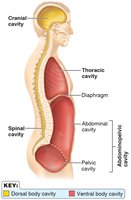
Body cavities are spaces within the body that contain, protect, and support internal organs. They are classified as dorsal and ventral cavities.
Dorsal Cavity:
Cranial cavity: Contains the brain, protected by the skull.
Spinal cavity: Contains the spinal cord, protected by vertebrae.
Ventral Cavity:
Thoracic cavity: Superior to the diaphragm; contains heart, lungs, and other organs. Subdivided into mediastinum, pericardial, and pleural cavities.
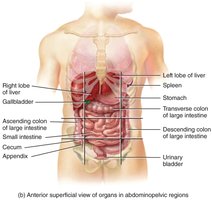
Abdominopelvic cavity: Inferior to the diaphragm; divided into abdominal (stomach, liver, intestines, etc.) and pelvic (reproductive organs, bladder, rectum) cavities.
Other Body Cavities
Oral and digestive cavities
Nasal cavity
Orbital cavities
Middle ear cavities
Homeostasis
Definition and Importance
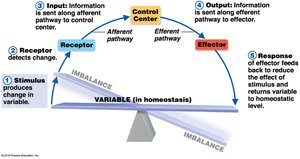
Homeostasis is the maintenance of relatively stable internal conditions in the body, ensuring normal function and survival despite external and internal changes.
Homeostatic imbalance: Disturbance in homeostasis can lead to disease or death.
Elements of a Homeostatic Control System
All homeostatic mechanisms consist of three main components:
Receptor: Detects changes (stimuli) in the environment and sends information to the control center via the afferent pathway.
Control Center: Determines the set point, analyzes information, and decides the response.
Effector: Executes the response to restore balance, receiving instructions via the efferent pathway.
Feedback Mechanisms
Feedback systems regulate homeostasis by responding to changes in the internal environment.
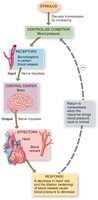
Negative Feedback: Most common; reduces or shuts off the original stimulus. Example: regulation of blood pressure.
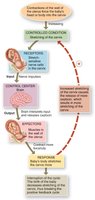
Positive Feedback: Reinforces the stimulus, leading to greater change. Examples: blood clotting, childbirth.
Homeostasis and Disease
Disorders and Diseases
Loss of homeostatic control can result in disorders or diseases. Severity determines outcome.
Disorder: Any abnormality of structure or function.
Disease: Illness with recognizable symptoms and signs.
Symptoms: Subjective changes (e.g., headache, nausea).
Signs: Objective changes (e.g., fever, rash, paralysis).
Aging and Homeostasis
Effects of Aging
Aging is a normal process that reduces the body's ability to maintain homeostasis, increasing vulnerability to stress and disease.
Observable changes: Wrinkled skin, gray hair, loss of bone and muscle mass, diminished reflexes.
Functional changes: Decreased hormone production, increased risk of heart disease, infections, and cancer.
Summary Table: Anatomical Terms and Concepts
Concept | Definition | Example |
|---|---|---|
Anatomical Position | Standard reference posture | Standing, arms at sides, palms forward |
Directional Terms | Describe location relative to other structures | Medial, lateral, proximal, distal |
Body Planes | Imaginary divisions of the body | Sagittal, frontal, transverse |
Body Cavities | Spaces containing organs | Thoracic, abdominal, pelvic |
Homeostasis | Stable internal environment | Blood pressure regulation |
Feedback Mechanisms | Regulate homeostasis | Negative and positive feedback |
Additional info: Academic context was added to clarify definitions, examples, and the importance of each concept for self-contained study notes.
