 Indietro
The Language of Anatomy: Foundational Terminology for Anatomy & Physiology
Guida di studio - Note intelligenti
 Appunti personalizzati basati sui tuoi materiali, ampliati con definizioni chiave, esempi e contesto.
The Human Body: An Orientation
Anatomy, Physiology, and Pathophysiology
Anatomy and physiology are foundational sciences for understanding the structure and function of the human body. Anatomy is the study of body structures and their relationships, while physiology focuses on how these structures function. Pathophysiology examines abnormal function or disruption of body structures due to injury or disease.
Anatomy: Structure of body parts and their relationships.
Physiology: Function of living things and their parts.
Pathophysiology: Study of abnormal function due to injury or disease.
The Anatomical Position
Definition and Importance
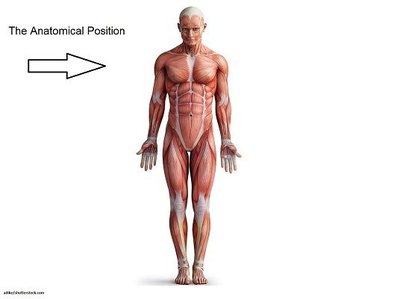
The anatomical position is a standardized posture used as a reference for anatomical terminology. All directional terms are based on this position, regardless of how a patient is found or placed.
Standing upright
Head and eyes facing forward
Arms at the sides, palms facing forward (thumbs out)
Legs slightly apart, feet flat and pointing forward
Directional Terminology
Purpose and Application
Directional terminology describes the location of internal and external body structures in relation to one another. This medical language is essential for accurately describing injuries, abnormalities, and anatomical relationships.
Used to describe the position of body parts (e.g., head to neck, elbow to wrist).
Essential for healthcare communication and documentation.

Key Directional Terms
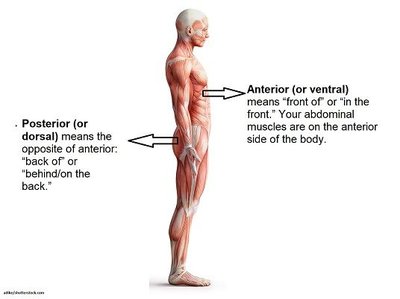
Anterior (Ventral): Toward the front of the body.
Posterior (Dorsal): Toward the back of the body.
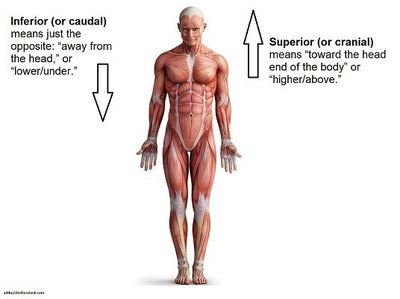
Superior (Cranial): Toward the head or upper part of a structure.
Inferior (Caudal): Away from the head or toward the lower part.
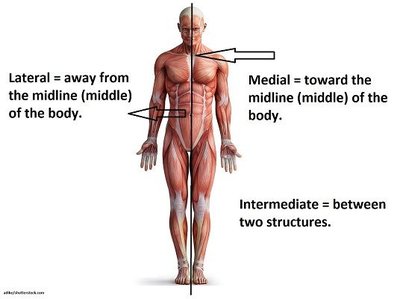
Medial: Toward the midline of the body.
Lateral: Away from the midline.
Intermediate: Between two structures.
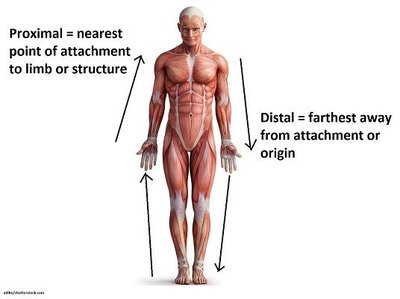
Proximal: Closer to the point of attachment or origin.
Distal: Farther from the point of attachment or origin.
Superficial: Toward or at the body surface.
Deep: Away from the body surface, more internal.
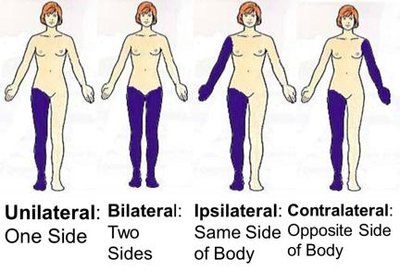
Unilateral, Bilateral, Ipsilateral, Contralateral
These terms describe relationships and occurrences on one or both sides of the body.
Unilateral: Occurring on one side of the body.
Bilateral: Occurring on both sides of the body.
Ipsilateral: On the same side as another structure.
Contralateral: On the opposite side from another structure.
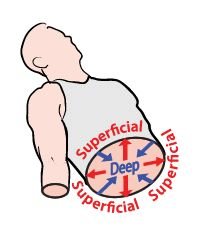
Superficial & Deep
These terms describe the depth of a structure relative to the body surface.
Superficial: Near the surface of the body.
Deep: Further from the surface, more internal.
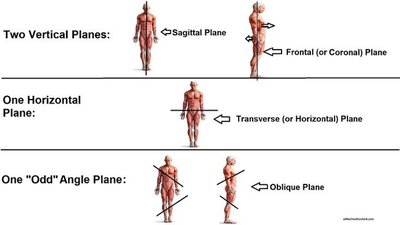
Body Planes
Definition and Types
Body planes are imaginary lines used to divide the body into sections. Understanding these planes is crucial for interpreting diagnostic images and anatomical descriptions.
Sagittal Plane: Divides the body into left and right sections.
Frontal (Coronal) Plane: Divides the body into anterior and posterior sections.
Transverse (Horizontal) Plane: Divides the body into superior and inferior sections.
Oblique Plane: Divides the body at an odd angle, not parallel to the other planes.

Body Cavities
Definition and Major Cavities
Body cavities are open chambers within the body that house organs. Understanding their locations and contents is essential for clinical practice and diagnosis.
Dorsal Cavity: Contains the cranial and spinal cavities.
Ventral Cavity: Contains the thoracic and abdominopelvic cavities.
Thoracic Cavity: Houses the heart and lungs.
Abdominopelvic Cavity: Houses digestive, urinary, and reproductive organs.
Abdominopelvic Cavity Divisions
The abdominopelvic cavity is further divided for clinical and diagnostic purposes.
Abdominal Regions: Nine regions used for precise localization.
Abdominal Quadrants: Four quadrants used for general localization.
Body Regions
Anatomical Terms for Body Regions
Specific anatomical terms are used to describe various regions of the body. These terms are essential for accurate communication in healthcare and anatomy.
Mammary Region: Chest area, overlying the pectoral muscles.
Femoral Region: Thigh area.
Patellar Region: Knee area.
Pedal Region: Foot area.
Many other regions exist; students should be familiar with all terms in their worksheets.
Application: Describing Injuries
Using anatomical, directional, and regional terms allows precise description of injuries and abnormalities. For example, "A laceration is noted anteriorly, inferior to the mammary region but superior to the abdominal region on the left side."
Practice describing injuries using at least three anatomical terms for clarity.
Summary Table: Directional Terminology
The following table summarizes key directional terms and their definitions:
Anatomical Direction | Definition |
|---|---|
Anterior (Ventral) | Toward the front of the body |
Posterior (Dorsal) | Toward the back of the body |
Superior (Cranial) | Toward the head or upper part |
Inferior (Caudal) | Away from the head or toward the lower part |
Medial | Toward the midline |
Lateral | Away from the midline |
Intermediate | Between two structures |
Proximal | Closer to the point of attachment |
Distal | Farther from the point of attachment |
Superficial | Near the surface |
Deep | Further from the surface |
Unilateral | One side of the body |
Bilateral | Both sides of the body |
Ipsilateral | Same side as another structure |
Contralateral | Opposite side from another structure |
Conclusion
Mastery of anatomical language, directional terminology, body planes, cavities, and regions is essential for success in Anatomy & Physiology. These concepts provide the foundation for understanding the human body and communicating effectively in healthcare settings.
