 Indietro
The Language of Anatomy: Orientation, Terminology, and Body Cavities
Guida di studio - Note intelligenti
 Appunti personalizzati basati sui tuoi materiali, ampliati con definizioni chiave, esempi e contesto.
The Human Body: An Orientation
Anatomical Position
The anatomical position is a standardized posture used as a reference in anatomy. The body is erect, feet slightly apart, head and toes pointed forward, and arms at the sides with palms facing forward. This position is crucial for consistent communication about body parts and locations.
Importance: Ensures clarity and precision in anatomical descriptions.
Left and Right: Always refer to the subject's left and right, not the observer's.
Regional Terms
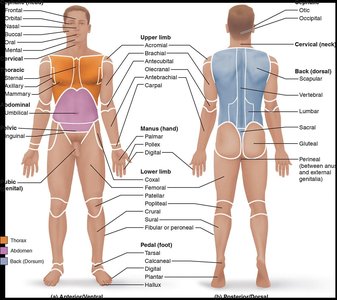
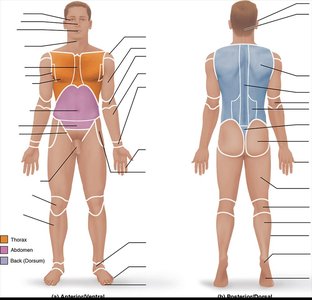
Regional terms are used to identify specific areas of the body. These include regions of the head, neck, trunk, limbs, and more. Understanding these terms is essential for locating and describing anatomical structures.
Examples: Orbital (eye), nasal (nose), buccal (cheek), axillary (armpit), femoral (thigh), patellar (knee), tarsal (ankle).
Application: Used in clinical settings to describe pain, injury, or procedures.
Directional Terms
Definitions and Applications
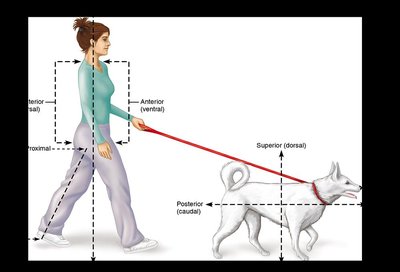
Directional terms describe the location of one body part relative to another. They are fundamental for anatomical communication and are used in both human and comparative anatomy.
Superior/Inferior: Above/below along the body's long axis (e.g., nose is superior to mouth).
Anterior/Posterior: Front/back (e.g., spine is posterior to heart).
Medial/Lateral: Toward/away from the midline (e.g., sternum is medial to ribs).
Proximal/Distal: Nearer/farther from the trunk or point of attachment (e.g., fingers are distal to elbow).
Superficial/Deep: Toward/away from the body surface (e.g., skin is superficial to muscles).
Cephalad/Caudal: Toward the head/tail; used in both humans and animals.
Ventral/Dorsal: Belly side/backside; interchangeable with anterior/posterior in humans.
Body Planes and Sections
Types of Body Planes
Body planes are imaginary lines used to divide the body for anatomical study. Sections made along these planes reveal internal structures and are essential for medical imaging and dissection.
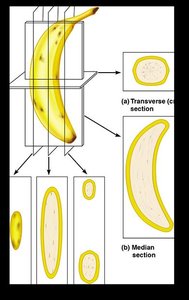
Sagittal Plane: Divides body into right and left parts. If equal, called midsagittal.
Frontal (Coronal) Plane: Divides body into anterior and posterior parts.
Transverse Plane: Divides body into superior and inferior parts; also called cross section.
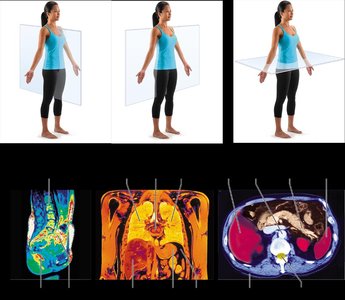
Example: Sectioning a banana in different planes shows how the appearance changes, similar to sectioning organs.
Body Cavities
Major Body Cavities
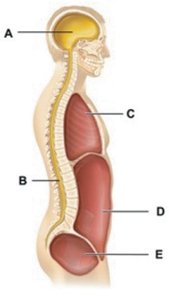
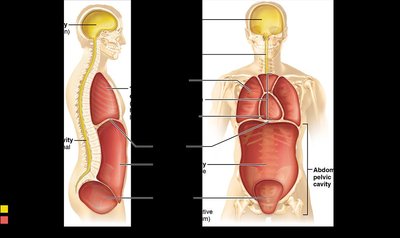
The body contains large cavities that house and protect internal organs. These are classified as dorsal and ventral cavities, each with subdivisions.
Dorsal Body Cavity: Includes the cranial cavity (brain) and vertebral cavity (spinal cord).
Ventral Body Cavity: Includes the thoracic cavity (heart, lungs) and abdominopelvic cavity (digestive, urinary, reproductive organs).
Diaphragm: Muscle that separates thoracic and abdominopelvic cavities.
Serous Membranes
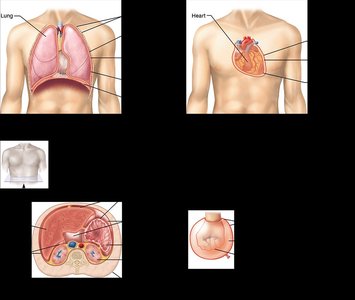
Serous membranes line the ventral body cavities and cover organs. They consist of two layers: parietal (lines cavity walls) and visceral (covers organs). These membranes produce lubricating fluid to reduce friction and compartmentalize organs, preventing infection spread.
Peritoneum: Lines abdominal cavity and covers abdominal organs.
Pleura: Encloses lungs.
Pericardium: Surrounds heart.
Abdominopelvic Quadrants and Regions
Quadrants
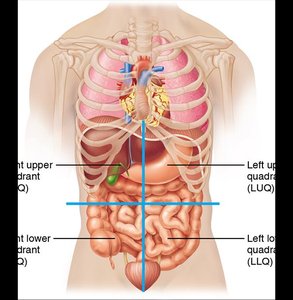
The abdominopelvic cavity is divided into four quadrants for clinical reference: right upper, right lower, left upper, and left lower. This helps locate organs and describe pain or pathology.
Right Upper Quadrant (RUQ): Contains liver, gallbladder.
Left Upper Quadrant (LUQ): Contains stomach, spleen.
Right Lower Quadrant (RLQ): Contains appendix, cecum.
Left Lower Quadrant (LLQ): Contains descending colon, sigmoid colon.
Regions
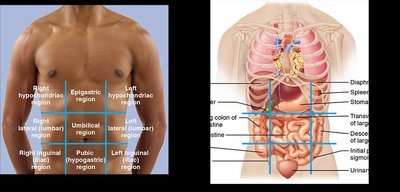
Anatomists use a nine-region scheme for more precise localization. These regions are delineated by four planes and include the umbilical, epigastric, hypogastric, iliac, lumbar, and hypochondriac regions.
Umbilical: Center, includes navel.
Epigastric: Superior to umbilical, overlies stomach.
Hypogastric (Pubic): Inferior to umbilical, encompasses pubic area.
Iliac (Inguinal): Lateral to hypogastric, over hip bones.
Lumbar: Lateral to umbilical, between ribs and hip bones.
Hypochondriac: Flanking epigastric, over lower ribs.
Other Body Cavities
Smaller Cavities
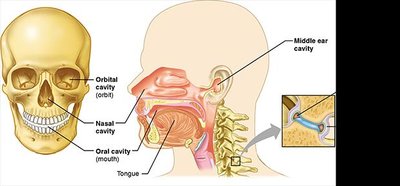
In addition to the major cavities, the body contains several smaller cavities, mostly in the head, which open to the exterior or are found in joints.
Oral Cavity: Mouth, contains tongue and teeth.
Nasal Cavity: Behind the nose, part of respiratory system.
Orbital Cavities: House the eyes.
Middle Ear Cavities: Medial to eardrum, contain bones for hearing.
Synovial Cavities: Found in joints, lined with membranes that secrete lubricating fluid.
Summary Table: Major Body Cavities and Their Organs
Body Cavity | Main Organs |
|---|---|
Cranial | Brain |
Vertebral | Spinal cord |
Thoracic | Heart, lungs |
Abdominal | Stomach, intestines, liver |
Pelvic | Bladder, reproductive organs, rectum |
Mediastinum | Heart |
Clinical Applications
Blood Draw: Usually from the antecubital region (inner elbow).
Appendicitis Pain: Located in the right lower quadrant (RLQ).
Hysterectomy: Requires opening the pelvic cavity.
Knee Replacement: Involves opening a synovial cavity.
Umbilical Hernia: Involves the peritoneum and small intestine.
Additional info:
Serous membranes provide a protective barrier and secrete serous fluid, reducing friction between organs and tissues.
Plane: An imaginary flat surface that divides the body or organs into sections.
