 Indietro
The Lymphatic System and Body Defenses: Structured Study Notes
Guida di studio - Note intelligenti
 Appunti personalizzati basati sui tuoi materiali, ampliati con definizioni chiave, esempi e contesto.
The Lymphatic System
Functions of the Lymphatic System
The lymphatic system is essential for maintaining fluid balance, absorbing fats, and defending the body against pathogens. It works closely with the cardiovascular and immune systems to ensure homeostasis and protection.
Fluid Balance: Excess interstitial fluid enters lymphatic capillaries and becomes lymph. Approximately 30L of fluid leaves capillaries daily, with 27L returning and 3L becoming lymph.
Fat Absorption: Specialized lymphatic vessels called lacteals absorb fats and other substances from the digestive tract. The absorbed fluid is called chyme.
Defense: Lymph nodes filter microorganisms and foreign substances from lymph, while the spleen filters blood.
Components of the Lymphatic System
The lymphatic system consists of lymphatic vessels and lymphoid tissues/organs, which transport fluids and play key roles in immune defense.
Lymphatic Vessels: Transport escaped fluids from the cardiovascular system back to the blood.
Lymphoid Tissues and Organs: Include lymph nodes, spleen, thymus, tonsils, Peyer's patches, and appendix.
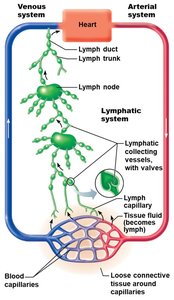
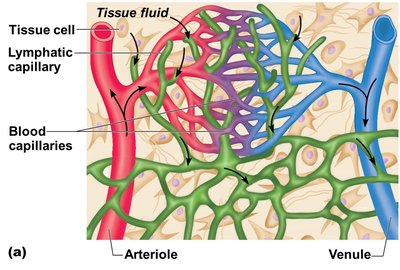
Fluid Exchange Across Capillaries
Fluid movement across capillary walls is governed by hydrostatic and osmotic pressures. Most fluid returns to the blood, but a portion enters lymphatic capillaries.
Filtration: At the arterial end, net hydrostatic pressure pushes fluid out.
Absorption: At the venous end, net osmotic pressure draws fluid in.
Lymph Formation: About 1/10 of the fluid enters lymphatic capillaries.
Lymphatic Vessels Structure and Function
Lymphatic vessels form a one-way system, ensuring lymph flows only toward the heart. They are more permeable than blood capillaries and have unique structural features.
Lymph Capillaries: Weave between tissue cells and blood capillaries, with overlapping walls forming minivalves.
Collecting Vessels: Collect lymph from capillaries and return it to veins near the heart.
Ducts: The right lymphatic duct drains the right arm, head, and thorax; the thoracic duct drains the rest of the body.
Transport Mechanisms: Lymph transport is aided by skeletal muscle contraction, thoracic pressure changes during breathing, and smooth muscle contraction.
Lymph Nodes
Lymph nodes filter lymph before it returns to the blood, removing harmful materials such as bacteria, viruses, cancer cells, and foreign substances.
Defense Cells: Macrophages engulf and destroy pathogens; lymphocytes respond to foreign substances.
Structure: Kidney-shaped, surrounded by a capsule, divided by trabeculae. Cortex contains follicles (lymphocytes), medulla contains phagocytic macrophages.
Other Lymphoid Organs
Several organs contribute to lymphatic function, each with specialized roles in immunity and filtration.
Spleen: Filters blood, destroys worn-out red blood cells, stores platelets, and acts as a blood reservoir.
Thymus: Site of T cell maturation; functions most actively during youth.
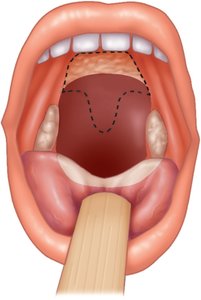
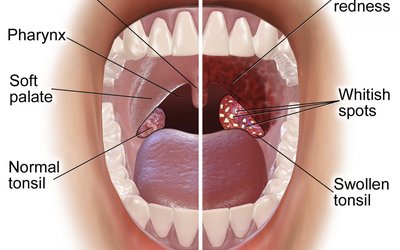
Tonsils: Trap and remove pathogens entering the throat; include palatine, pharyngeal, and lingual groups.
Peyer's Patches & Appendix: Located in the intestine; capture and destroy bacteria.
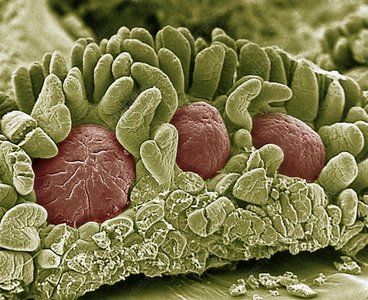
Mucosa-Associated Lymphoid Tissue (MALT): Protects respiratory and digestive tracts from foreign matter.
Body Defenses
Overview of Immune System Mechanisms
The immune system protects the body from foreign materials using two main mechanisms: innate (nonspecific) and adaptive (specific) defenses.
Innate (Nonspecific) Defense: Provides immediate, general protection against pathogens.
Adaptive (Specific) Defense: Targets specific pathogens and remembers previous encounters.
Innate (Nonspecific) Defenses
Innate defenses include physical barriers, chemical mediators, and cellular responses. These mechanisms are always present and act the same way each time.
Physical Barriers: Skin, mucous membranes, tears, saliva, mucus.
Chemical Mediators: Promote phagocytosis and inflammation.
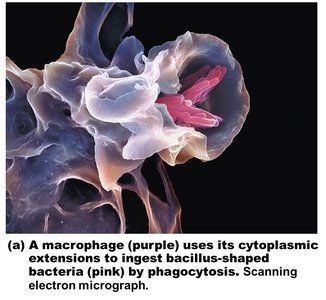
Cells: Phagocytes (macrophages, neutrophils), natural killer cells.
Surface Membrane Barriers
Category | Protective Mechanism |
|---|---|
Intact skin (epidermis) | Mechanical barrier preventing entry of pathogens |
Acid mantle | Skin secretions make surface acidic, inhibiting bacterial growth |
Keratin | Resists acids, alkalis, and bacterial enzymes |
Mucous membranes | Mechanical barrier; mucus traps microorganisms |
Nasal hairs | Filter and trap airborne particles |
Cilia | Propel debris-laden mucus away from respiratory passages |
Gastric juice | Destroys pathogens in stomach |
Lacrimal secretion (tears); saliva | Contain lysozyme, an enzyme that destroys microorganisms |
Cellular and Chemical Defenses
Category | Protective Mechanism |
|---|---|
Phagocytes | Engulf and destroy pathogens |
Natural killer cells | Promote cell lysis by direct attack |
Inflammatory response | Prevents spread, disposes of pathogens, promotes repair |
Antimicrobial chemicals | Complement proteins lyse microorganisms; interferons protect against viruses |
Fever | Inhibits bacterial multiplication, enhances repair |
Inflammatory Response
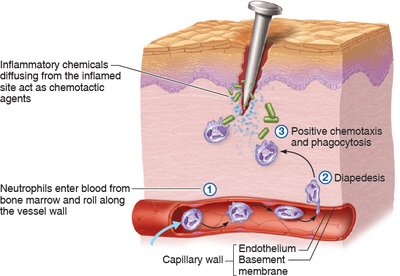
The inflammatory response is triggered by tissue injury and involves several steps to contain damage and promote healing.
Cardinal Signs: Redness, heat, pain, swelling (edema).
Chemicals Released: Histamine and kinin cause blood vessel dilation and increased permeability.
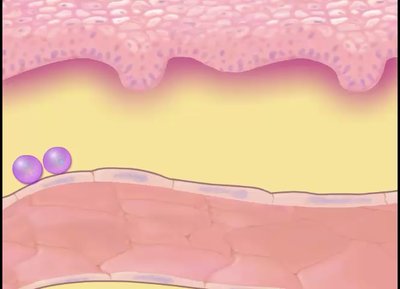
Phagocyte Mobilization: Neutrophils migrate, squeeze through capillary walls (diapedesis), and consume foreign material (positive chemotaxis).
Antimicrobial Proteins
Antimicrobial proteins enhance innate defenses by attacking microorganisms and hindering their reproduction.
Complement Proteins: At least 20 plasma proteins that, when activated, form membrane attack complexes (MACs) to lyse cells and enhance inflammation. (Helps your other immune cells)
Interferons: Proteins released by virus-infected cells that protect neighboring cells from viral takeover.
Fever
Fever is a systemic response to infection, regulated by the hypothalamus. It inhibits bacterial growth and speeds up repair processes.
Pyrogens: Secreted by white blood cells, reset the hypothalamic thermostat higher.
High Temperature: Inhibits release of iron and zinc needed by bacteria.
Adaptive (Specific) Body Defenses
Overview of Adaptive Immunity
Adaptive defenses are the body's specific defense system, targeting particular pathogens and remembering previous encounters.
Antigen Specific: Recognizes and acts against specific foreign substances.
Systemic: Immunity is not restricted to the initial infection site.
Memory: Mounts a stronger attack on previously encountered pathogens.
Arms of Adaptive Defense
Humoral Immunity: Antibody-mediated; antibodies present in body fluids.
Cellular Immunity: Cell-mediated; targets virus-infected cells, cancer cells, and foreign grafts.
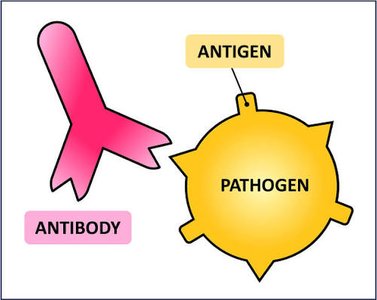
Antigens
Antigens are substances capable of exciting the immune system and provoking an immune response. They can be self or nonself.
Nonself Antigens: Foreign proteins, nucleic acids, carbohydrates, lipids, pollen, microorganisms.
Self Antigens: Human cells have protein and carbohydrate molecules recognized as self; can trigger immune response in other individuals (important for transplants).
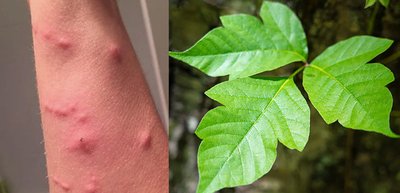
Haptens: Incomplete antigens that become antigenic when linked to body proteins (e.g., poison ivy, animal dander).
Summary Table: Innate vs. Adaptive Immunity
Feature | Innate Immunity | Adaptive Immunity |
|---|---|---|
Specificity | Non-specific | Specific to antigens |
Memory | None | Present |
Components | Physical barriers, phagocytes, NK cells, inflammation, complement, interferons | Lymphocytes (B and T cells), antibodies |
Response Time | Immediate | Delayed (days) |
Additional info: Adaptive immunity is the basis for vaccination, which exposes the body to antigens to build memory and protection against future infections.
