 Indietro
The Lymphatic System: Structure, Function, and Major Organs
Guida di studio - Note intelligenti
 Appunti personalizzati basati sui tuoi materiali, ampliati con definizioni chiave, esempi e contesto.
The Lymphatic System Overview
Introduction
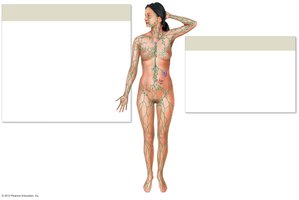
The lymphatic system is a crucial component of the human body, responsible for maintaining fluid balance, supporting immune function, and facilitating the absorption of dietary lipids. It consists of a network of vessels, tissues, and organs that work together to return excess interstitial fluid to the bloodstream and defend against pathogens.
Lymphatic system functions: Drains excess interstitial fluid, returns it to circulation, and houses immune cells.
Lymph: The fluid within lymphatic vessels, filtered by lymph nodes.
Lymphatic tissue and organs: Sites for lymphocyte production, maturation, and immune response.
Lacteals: Specialized lymphatic vessels in the digestive system that absorb lipids.
Lymphatic Vessels and Lymphatic Drainage
Structure and Function of Lymphatic Vessels
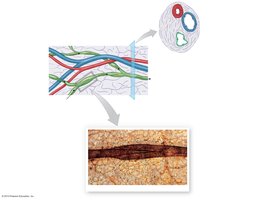
Lymphatic vessels begin as microscopic lymphatic capillaries in tissues, which collect excess interstitial fluid. These capillaries merge into larger vessels, equipped with valves to ensure one-way flow under low pressure. The vessels eventually converge into lymphatic trunks and ducts, which return lymph to the venous system.
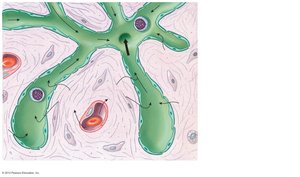
Lymphatic capillaries: Highly permeable, lined by overlapping endothelial cells acting as one-way valves.
Valves: Prevent backflow, ensuring lymph moves toward the heart.
Cisterna chyli: Collects lipid-rich lymph (chyle) from lacteals.
Right lymphatic duct and thoracic duct: Final vessels draining lymph into the right and left subclavian veins, respectively.
Circulation of Extracellular Fluid
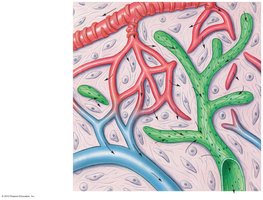
The movement of fluid between blood vessels and tissues is essential for nutrient delivery and waste removal. Blood pressure in capillaries forces water and solutes into interstitial fluid, some of which enters lymphatic vessels to become lymph. Lymphatic vessels return this fluid to the bloodstream, maintaining fluid balance.
Arteries: Carry blood away from the heart.
Veins: Return blood to the heart.
Capillaries: Site of exchange between blood and interstitial fluid.
Lymph formation: Occurs as interstitial fluid enters lymphatic capillaries.
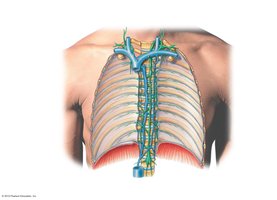
Lymphoid Tissues and Organs
Lymphoid Tissue
Lymphoid tissue is composed primarily of reticular fibers, providing a supportive framework for immune cells. It can be dense (nodules) or diffuse, and may be encapsulated (as in lymph nodes) or non-encapsulated (blending with other tissues).
Reticular fibers: Form the structural network of lymphoid tissue.
Lymphocytes and macrophages: Key immune cells housed in lymphoid tissue.
Encapsulated organs: Lymph nodes, spleen, thymus.
Non-encapsulated tissue: MALT (mucosa-associated lymphoid tissue) in various tracts.
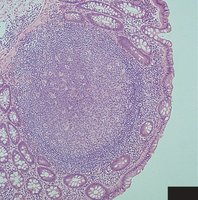
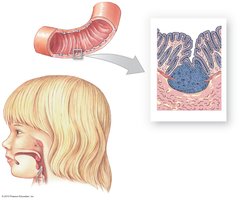
Mucosa-Associated Lymphoid Tissue (MALT) and Tonsils
MALT is found in the digestive, respiratory, urinary, and reproductive tracts, providing localized immune defense. Tonsils are specialized lymphoid tissues in the pharynx, with the palatine tonsil being the most prominent.
MALT: Protects mucosal surfaces from pathogens.
Tonsils: Include pharyngeal, palatine, and lingual tonsils.
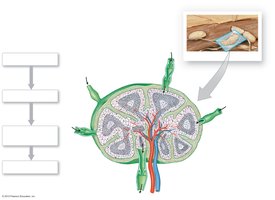
Lymph Nodes
Structure and Function
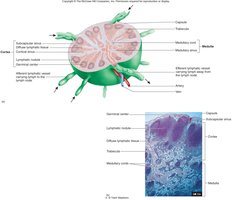
Lymph nodes are encapsulated organs that filter lymph, removing antigens and initiating immune responses. They have afferent vessels (bringing lymph in) and efferent vessels (draining filtered lymph out). The cortex contains dense nodules, while the medulla is more diffuse.
Filtration: Removes at least 99% of antigens from lymph.
Immune response: Can be stimulated within the node.
Structural features: Outer capsule, cortex with nodules, medulla with diffuse tissue.
The Thymus
Structure and Function
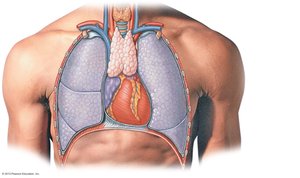
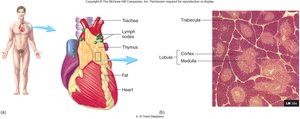
The thymus is a glandular organ in the mediastinum, essential for the maturation of T-lymphocytes. It produces thymosins, hormones that promote T-cell development. The thymus becomes fibrous and atrophies with age.
Location: Mediastinum, above the heart.
Function: Maturation of T-lymphocytes, production of thymosins.
Age-related changes: Atrophies and becomes fibrous in adulthood.
The Spleen
Structure and Function
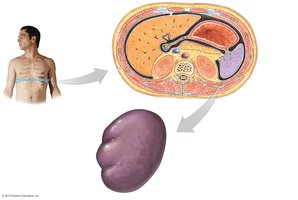
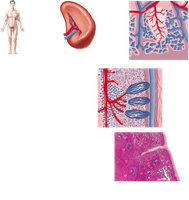
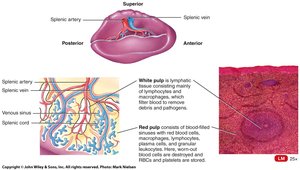
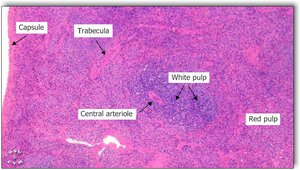
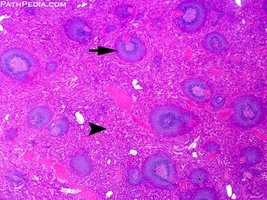
The spleen is the largest mass of lymphatic tissue, with three major functions: filtering antigens from blood, destroying defective red blood cells, and serving as a blood reservoir. It contains white pulp (lymphatic tissue) and red pulp (blood-filled sinuses).
White pulp: Lymphatic tissue surrounding arteries, involved in immune response.
Red pulp: Venous sinuses and splenic cords, site of blood processing and RBC destruction.
Blood reservoir: Stores blood for release during emergencies.
Summary Table: Major Lymphatic Organs and Their Functions
Organ | Main Function | Key Features |
|---|---|---|
Lymph Node | Filters lymph, initiates immune response | Encapsulated, cortex and medulla, afferent/efferent vessels |
Thymus | Maturation of T-lymphocytes | Produces thymosins, atrophies with age |
Spleen | Filters blood, destroys defective RBCs, blood reservoir | White pulp (immune), red pulp (blood processing) |
MALT | Local immune defense | Diffuse, non-encapsulated, found in mucosal tracts |
Key Terms and Concepts
Lymphocyte: White blood cell involved in adaptive immunity.
Macrophage: Phagocytic cell that engulfs pathogens and debris.
Antigen: Substance that triggers an immune response.
Chyle: Lipid-rich lymph absorbed from the digestive tract.
Thymosin: Hormone produced by the thymus for T-cell development.
Relevant Equations
Fluid Exchange at Capillaries
The net movement of fluid across capillary walls is governed by Starling's equation: Where:
= net fluid movement
= filtration coefficient
= capillary hydrostatic pressure
= interstitial hydrostatic pressure
= reflection coefficient
= capillary oncotic pressure
= interstitial oncotic pressure
Conclusion
The lymphatic system is essential for fluid balance, immune defense, and lipid absorption. Its vessels, tissues, and organs work together to protect the body from pathogens and maintain homeostasis. Additional info: Academic context and expanded explanations were added to ensure completeness and clarity for college-level Anatomy & Physiology students.
