 Indietro
The Muscular System: Structure, Function, and Major Muscles
Guida di studio - Note intelligenti
 Appunti personalizzati basati sui tuoi materiali, ampliati con definizioni chiave, esempi e contesto.
The Muscular System
Muscle Actions
The muscular system is responsible for producing movement by contracting and pulling on bones. Muscles work together or in opposition to create a wide variety of movements, but they can only pull, never push. The insertion (movable bone) moves toward the origin (immovable point of attachment) when a muscle shortens. Functional groups of muscles include:
Prime mover (agonist): Muscle with the major responsibility for producing a specific movement.
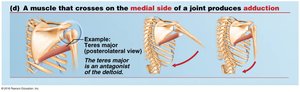
Antagonist: Muscle that opposes or reverses a particular movement. When prime movers are active, antagonists are relaxed.
Synergist: Assists prime movers by adding extra force or reducing undesirable movement.
Fixator: A synergist that immobilizes a bone or muscle’s origin, providing a stable base for the prime mover.
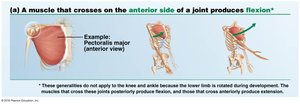
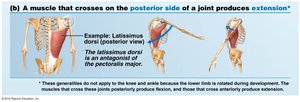
Example: The pectoralis major acts as a prime mover of arm flexion, while the latissimus dorsi is a prime mover for arm extension and an antagonist for arm flexion.
Naming Skeletal Muscles
Skeletal muscles are named according to several criteria, which help identify their location, shape, and function:
Location: Associated with a bone or body region (e.g., temporalis over temporal bone).
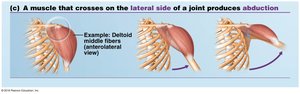
Shape: Distinctive shapes (e.g., deltoid = triangle).
Size: Maximus (largest), minimus (smallest), longus (long), brevis (short).
Direction of fibers: Rectus (straight), transversus (right angles), oblique (slantwise).
Number of origins: Biceps (two origins), triceps (three origins).
Location of attachments: Named for origin and insertion (e.g., sternocleidomastoid attaches to sternum and clavicle, inserts on mastoid process).
Action: Named for the action they produce (e.g., flexor, extensor).
Combined criteria: Extensor carpi radialis longus (extends wrist, attached to radius, long muscle).
Fascicle Arrangements
Fascicles are bundles of muscle fibers, and their arrangement determines muscle shape and functional capabilities. The main patterns include:
Circular: Fascicles arranged in concentric rings (e.g., orbicularis oris).
Convergent: Broad origin, fascicles converge toward a single tendon insertion (e.g., pectoralis major).
Parallel: Fascicles run parallel to the long axis of the muscle (e.g., sartorius).
Fusiform: Spindle-shaped muscles with parallel fibers (e.g., biceps brachii).
Pennate: Short fascicles attach obliquely to a central tendon. Types include unipennate (one side), bipennate (both sides, featherlike), and multipennate (many feathers into one tendon).
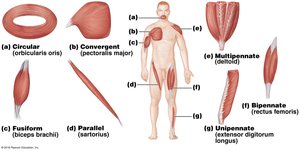
Functional significance: Fascicle arrangement affects muscle’s range of motion and power. Long, parallel fibers shorten more but are less powerful. Bipennate and multipennate muscles have more fibers, shorten less, but are more powerful.
Lever Systems
Most skeletal muscles move bones using leverage. A lever system consists of:
Lever: Rigid bar (bone) that moves on a fixed point (fulcrum, usually a joint).
Effort: Force applied by muscle contraction to move the lever.
Load: Resistance moved by the effort (bone, tissues, added weight).
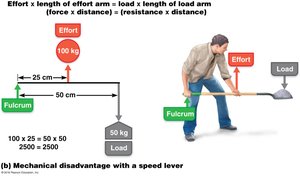
Levers allow a given effort to move a heavier load or move a load farther/faster, depending on the position of the fulcrum relative to load and effort.
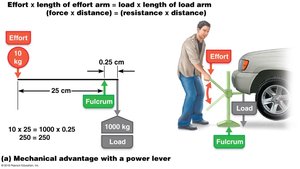
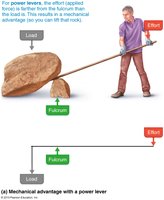
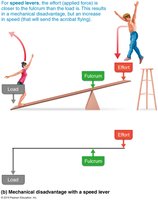
Mechanical advantage (power lever): Load is close to fulcrum, effort applied far from fulcrum. Small effort moves large load over a small distance.
Mechanical disadvantage (speed lever): Load is far from fulcrum, effort applied close to fulcrum. Load moves rapidly over a large distance, offering a wider range of motion.
Basic lever principle:
Effort farther than load from fulcrum = mechanical advantage
Effort nearer than load to fulcrum = mechanical disadvantage
Equation for lever systems:
Classes of Levers
Levers are classified based on the relative position of effort, fulcrum, and load:
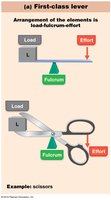
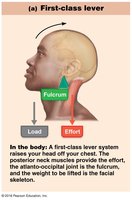
First-class lever: Effort applied at one end, load at the other, fulcrum between them (e.g., seesaw, scissors, lifting head off chest).
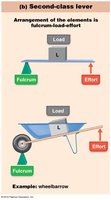
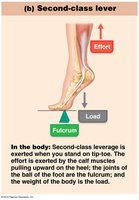
Second-class lever: Effort at one end, fulcrum at the other, load between them (e.g., wheelbarrow, standing on toes).
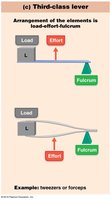
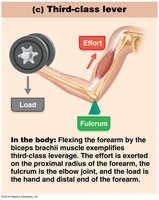
Third-class lever: Effort applied between fulcrum and load (e.g., tweezers, forceps, most skeletal muscles).
Summary: Mechanical disadvantage (speed levers) sacrifices force for speed and range of movement. Mechanical advantage (power levers) is slower but more stable, used where strength is a priority.
Major Skeletal Muscles of the Body
There are over 600 skeletal muscles, grouped by function and location. Muscle tables typically include:
Description: Location relative to other muscles
Origin and insertion: Usually a joint between origin and insertion
Actions: Movement caused by contraction
Innervation: Major nerve supplying the muscle
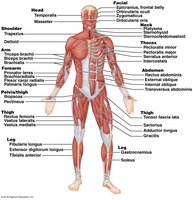
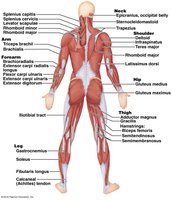
Muscles of the Head
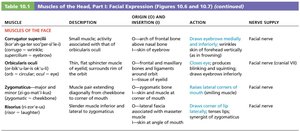
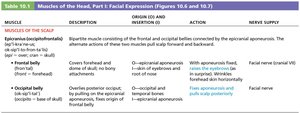
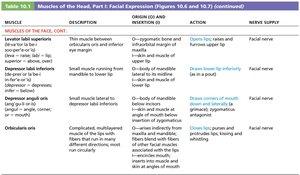
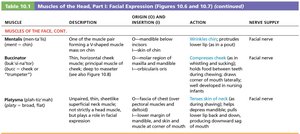
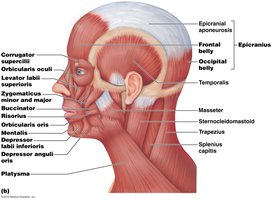
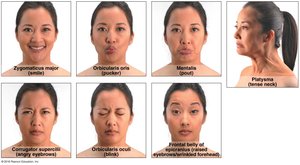
Muscles of facial expression are unique because they insert into skin, not bone, and are important for nonverbal communication. All are innervated by cranial nerve VII (facial nerve). They are divided into:
Muscles of the scalp: Epicranius (occipitofrontalis) consists of frontalis and occipitalis, connected by cranial aponeurosis.
Muscles of the face: Responsible for various facial expressions.
Muscles of Mastication and Tongue Movement
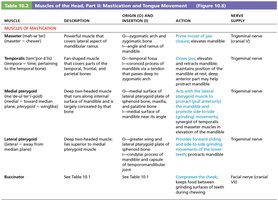
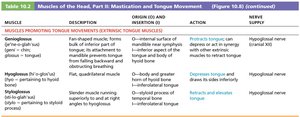
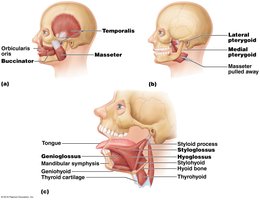
Muscles of mastication are innervated by the trigeminal nerve (V), except the buccinator (facial nerve VII). Prime movers of jaw closure are the temporalis and masseter; pterygoids are involved in grinding movements, and the buccinator assists in chewing. Muscles promoting tongue movements are extrinsic muscles (genioglossus, hyoglossus, styloglossus) innervated by the hypoglossal nerve (XII).
Muscles of the Anterior Neck and Throat
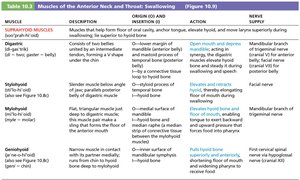
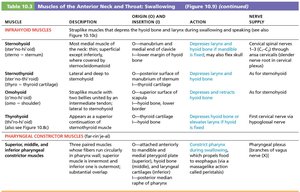
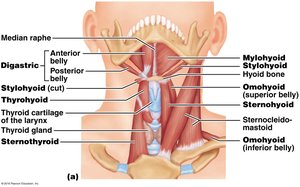
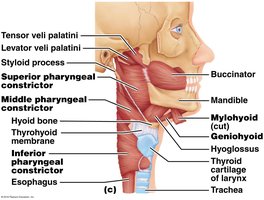
The sternocleidomastoid divides the neck into anterior and posterior triangles. Suprahyoid muscles (above hyoid) are involved in swallowing, forming the floor of the oral cavity, anchoring the tongue, elevating the hyoid bone, and moving the larynx. Infrahyoid muscles (below hyoid) depress the hyoid bone and larynx during swallowing and speaking.
Muscles of the Neck and Vertebral Column
Muscles involved in head movement and trunk extension are divided into:
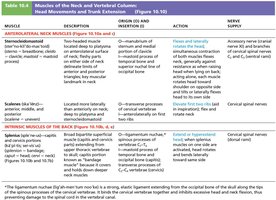
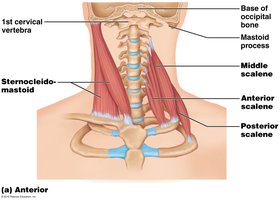
Anterolateral neck muscles: Move the head (e.g., sternocleidomastoid, scalenes).
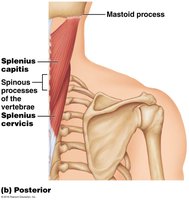
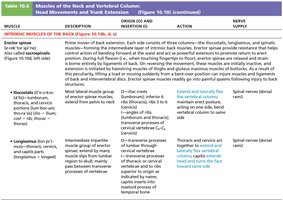
Intrinsic muscles of the back: Extend the trunk and maintain posture (e.g., splenius, erector spinae, semispinalis, quadratus lumborum).
Summary Table: Functional Groups of Muscles
Group | Function | Example |
|---|---|---|
Prime mover (agonist) | Major responsibility for movement | Pectoralis major (arm flexion) |
Antagonist | Opposes/reverses movement | Latissimus dorsi (arm extension) |
Synergist | Assists prime mover | Brachialis (assists biceps brachii) |
Fixator | Stabilizes origin | Muscles stabilizing scapula |
Summary Table: Fascicle Arrangements
Arrangement | Description | Example |
|---|---|---|
Circular | Concentric rings | Orbicularis oris |
Convergent | Broad origin, converges to tendon | Pectoralis major |
Parallel | Parallel to long axis | Sartorius |
Fusiform | Spindle-shaped, parallel fibers | Biceps brachii |
Pennate | Short fascicles attach obliquely | Rectus femoris (bipennate), deltoid (multipennate) |
Summary Table: Classes of Levers
Class | Arrangement | Example (Body) |
|---|---|---|
First-class | Fulcrum between load and effort | Lifting head off chest |
Second-class | Load between fulcrum and effort | Standing on toes |
Third-class | Effort between fulcrum and load | Flexing forearm by biceps brachii |
Summary Table: Muscles of Mastication and Tongue Movement
Muscle | Action | Nerve Supply |
|---|---|---|
Masseter | Prime mover of jaw closure | Trigeminal nerve (V) |
Temporalis | Closes jaw, elevates/retracts mandible | Trigeminal nerve (V) |
Medial/Lateral pterygoid | Grinding movements | Trigeminal nerve (V) |
Buccinator | Compresses cheek | Facial nerve (VII) |
Genioglossus | Protracts tongue | Hypoglossal nerve (XII) |
Hyoglossus | Depresses tongue | Hypoglossal nerve (XII) |
Styloglossus | Retracts/elevates tongue | Hypoglossal nerve (XII) |
Summary Table: Muscles of the Neck and Vertebral Column
Muscle | Action | Nerve Supply |
|---|---|---|
Sternocleidomastoid | Flexes and laterally rotates head | Cranial nerve XI |
Scalenes | Elevate first two ribs, flex/rotate neck | Cervical spinal nerves |
Splenius | Extend/hyperextend head | Cervical spinal nerves |
Erector spinae | Prime mover of back extension | Spinal nerves |
Semispinalis | Extends vertebral column/head | Spinal nerves |
Quadratus lumborum | Flexes vertebral column laterally | T12, L1-L4 |
