 Indietro
The Muscular System: Structure, Function, and Mechanics
Guida di studio - Note intelligenti
 Appunti personalizzati basati sui tuoi materiali, ampliati con definizioni chiave, esempi e contesto.
The Muscular System
Muscle Actions and Interactions
The muscular system is responsible for movement in the human body, with muscles acting in coordinated groups to produce, oppose, or stabilize movements. Muscles can only pull, never push, and their actions are defined by their anatomical relationships and functional roles.
Prime mover (agonist): The muscle primarily responsible for a specific movement.
Antagonist: The muscle that opposes or reverses the action of the prime mover.
Synergist: Assists the prime mover by adding force or reducing unnecessary movements.
Fixator: A type of synergist that stabilizes the origin of the prime mover, providing a stable base.
Muscle Actions Relative to Joint Position
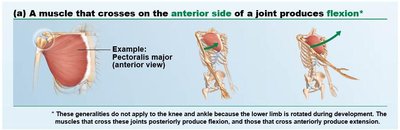
Flexion: Produced by muscles crossing the anterior side of a joint (e.g., pectoralis major).
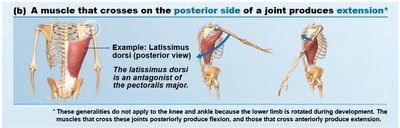
Extension: Produced by muscles crossing the posterior side of a joint (e.g., latissimus dorsi).
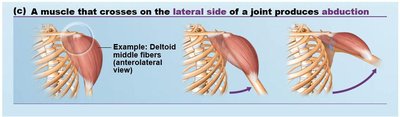
Abduction: Produced by muscles crossing the lateral side of a joint (e.g., deltoid).
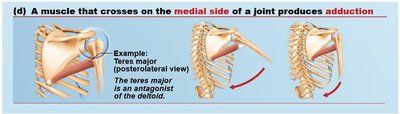
Adduction: Produced by muscles crossing the medial side of a joint (e.g., teres major).
Naming Skeletal Muscles
Skeletal muscles are named according to several criteria, which often reflect their anatomical features or functional roles.
Location: Associated bone or body region (e.g., brachialis).
Shape: Distinctive muscle shapes (e.g., deltoid).
Size: Relative size (e.g., maximus, minimus, longus).
Direction of fibers: Orientation of muscle fibers (e.g., rectus, transversus, oblique).
Number of origins: Number of tendinous attachments (e.g., biceps, triceps).
Location of attachments: Points of origin and insertion.
Action: Movement produced (e.g., flexor, extensor).
Combined criteria: Names may reflect multiple features (e.g., extensor carpi radialis longus).
Fascicle Arrangements
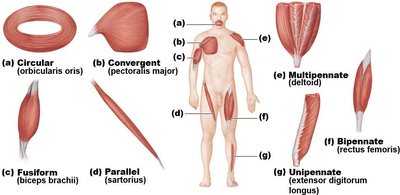
Fascicles are bundles of muscle fibers, and their arrangement determines the shape and functional capacity of a muscle. The main patterns include:
Circular: Fascicles arranged in concentric rings (e.g., orbicularis oris).
Convergent: Broad origin, fascicles converge toward a single tendon (e.g., pectoralis major).
Parallel: Fascicles run parallel to the long axis (e.g., sartorius).
Fusiform: Spindle-shaped with parallel fibers (e.g., biceps brachii).
Pennate: Short fascicles attach obliquely to a central tendon. Types include:
Unipennate: Fascicles attach to one side (e.g., extensor digitorum longus).
Bipennate: Fascicles attach to both sides (e.g., rectus femoris).
Multipennate: Multiple fascicles insert into one tendon (e.g., deltoid).
Lever Systems in Muscle Movement
Muscles use bones as levers to move loads. The lever system consists of:
Lever: Rigid bar (bone) that moves about a fulcrum (joint).
Fulcrum: Fixed point around which the lever moves.
Effort: Force applied by muscle contraction.
Load: Resistance moved by the lever (bone, tissues, added weight).
Classes of Levers
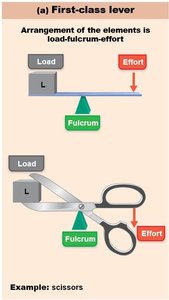
First-class lever: Fulcrum is between load and effort (e.g., scissors, seesaw).
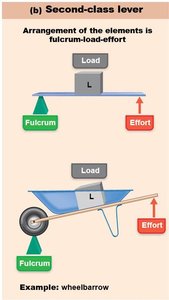
Second-class lever: Load is between fulcrum and effort (e.g., wheelbarrow, standing on toes).
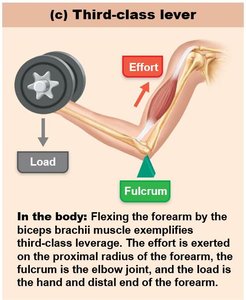
Third-class lever: Effort is between fulcrum and load (e.g., tweezers, most skeletal muscles).
Class | Arrangement | Example |
|---|---|---|
First-class | Fulcrum between load and effort | Scissors, neck muscles |
Second-class | Load between fulcrum and effort | Wheelbarrow, standing on toes |
Third-class | Effort between fulcrum and load | Tweezers, biceps brachii |
Lever System Equations
The mechanical advantage of a lever is determined by the ratio of the distances from the fulcrum to the effort and load:
Mechanical Advantage:
Force Balance:
Summary Table: Muscle Actions and Fascicle Arrangements
Muscle Action | Joint Side | Example Muscle |
|---|---|---|
Flexion | Anterior | Pectoralis major |
Extension | Posterior | Latissimus dorsi |
Abduction | Lateral | Deltoid |
Adduction | Medial | Teres major |
Fascicle Arrangement | Example Muscle |
|---|---|
Circular | Orbicularis oris |
Convergent | Pectoralis major |
Parallel | Sartorius |
Fusiform | Biceps brachii |
Unipennate | Extensor digitorum longus |
Bipennate | Rectus femoris |
Multipennate | Deltoid |
Example: The biceps brachii muscle acts as a third-class lever during forearm flexion, with the elbow as the fulcrum, the hand as the load, and the effort applied by the muscle.
Additional info: Lever systems are fundamental to understanding biomechanics and the efficiency of muscle actions in the human body.
