 Indietro
The Muscular System: Structure, Naming, and Function
Guida di studio - Note intelligenti
 Appunti personalizzati basati sui tuoi materiali, ampliati con definizioni chiave, esempi e contesto.
The Muscular System
Overview of Skeletal Muscle Function
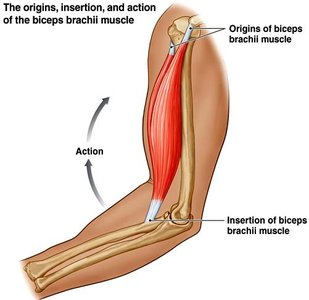
Skeletal muscles are essential for producing movement in the human body by exerting force on bones. This force typically changes the angle at a synovial joint, resulting in movement. Muscles are attached to bones via tendons, and their contraction pulls the movable end toward the fixed end.
Origin: The fixed, stationary attachment point of the muscle.
Insertion: The movable attachment point, which is pulled during contraction.
Action: The movement produced when the muscle contracts, often changing the angle at a joint.
Example: The biceps brachii muscle flexes the forearm at the elbow by pulling the insertion toward the origin.
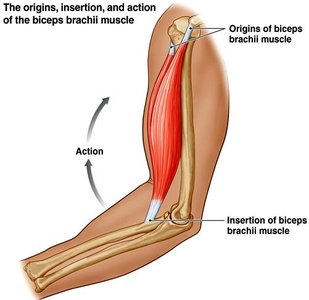
Muscle Attachments: Origin and Insertion
Both ends of a skeletal muscle are typically attached to bones via tendons. The origin is the fixed end, while the insertion is the movable end. During contraction, the insertion moves toward the origin, facilitating movement at the joint.
Origin: Usually proximal and less movable.
Insertion: Usually distal and more movable.
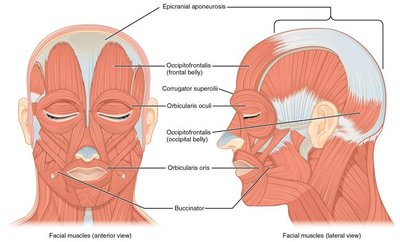
Facial Muscles: Unique Insertions
Unlike most skeletal muscles, many facial muscles insert into the skin rather than bone. This unique arrangement allows for a wide range of facial expressions, as muscle contraction moves the skin.
Example: Muscles such as the orbicularis oris and zygomaticus insert into the skin, enabling movements like smiling or frowning.
Naming Skeletal Muscles: Principles and Examples
The names of skeletal muscles often reflect their distinctive features, including orientation, location, size, shape, action, number of origins, and points of origin and insertion. Understanding these naming conventions aids in identifying and learning muscle anatomy.
Orientation: Terms like rectus (straight) indicate muscle direction relative to the body midline. Example: Rectus femoris runs straight down the thigh.
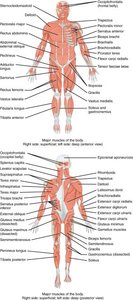
Location: Muscles may be named for their anatomical location. Example: Temporalis is located near the temporal bone.
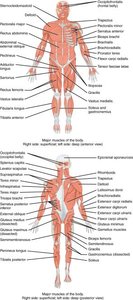
Size: Terms like major and minor distinguish between larger and smaller muscles. Example: Zygomaticus major and zygomaticus minor.
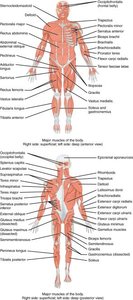
Shape: Muscle names may reflect their shape. Example: Trapezius (trapezoid-shaped), deltoid (triangle-shaped).
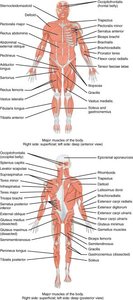
Action: Names may indicate the muscle's function, such as flexor, extensor, abductor, or retractor. Example: Flexor carpi radialis flexes the wrist.
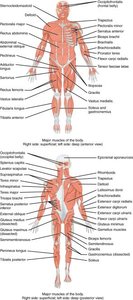
Number of Origins: Prefixes like biceps (two origins) and triceps (three origins) indicate the number of tendinous attachments. Example: Biceps brachii, triceps brachii.
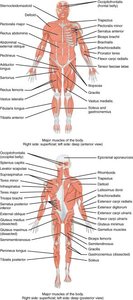
Origin and Insertion: Some muscle names specify both points. Example: Sternocleidomastoid originates from the sternum and clavicle, and inserts at the mastoid process of the temporal bone. The origin is usually listed first, followed by the insertion.
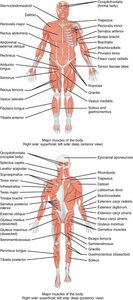
Summary Table: Muscle Naming Conventions
Feature | Example | Description |
|---|---|---|
Orientation | Rectus femoris | Straight relative to midline |
Location | Temporalis | Near temporal bone |
Size | Zygomaticus major/minor | Major = larger, minor = smaller |
Shape | Trapezius, Deltoid | Trapezoid, triangle shapes |
Action | Flexor, Extensor | Indicates muscle function |
Number of Origins | Biceps, Triceps | Two or three origins |
Origin & Insertion | Sternocleidomastoid | Origin: sternum/clavicle; Insertion: mastoid process |
Additional info:
Muscle contraction is governed by the sliding filament theory, where actin and myosin filaments slide past each other to shorten the muscle fiber.
Muscle names often use Latin or Greek roots to describe their features.
