 Indietro
The Muscular System: Structure, Naming, and Function
Guida di studio - Note intelligenti
 Appunti personalizzati basati sui tuoi materiali, ampliati con definizioni chiave, esempi e contesto.
The Muscular System
Muscle Attachment and Movement
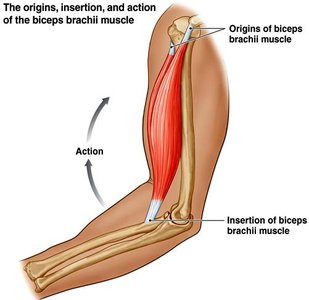
The majority of skeletal muscles produce movement by pulling on bones, thereby changing the angle at a synovial joint. Typically, one end of a muscle is attached to a fixed bone (origin), while the other end is attached to a movable bone (insertion). During contraction, the insertion moves toward the origin, resulting in movement at the joint.
Origin: The fixed, stationary end of the muscle.
Insertion: The movable end of the muscle, which is pulled during contraction.
Action: The movement produced when the muscle contracts, usually changing the angle at a synovial joint.
Tendons: Both ends of a muscle are typically connected to bones via tendons.
Facial Muscles and Unique Insertions
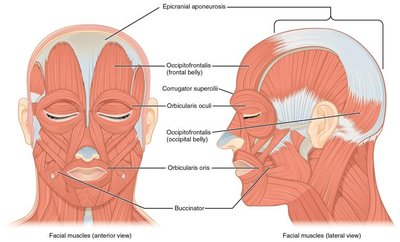
Unlike most skeletal muscles, many facial muscles insert into the skin rather than bone. This unique arrangement allows for a wide range of facial expressions, as the contraction of these muscles moves the skin.
Facial Muscles: Muscles such as the orbicularis oculi, orbicularis oris, and buccinator insert into the skin.
Function: Enables facial expressions by moving the skin.
Naming Skeletal Muscles
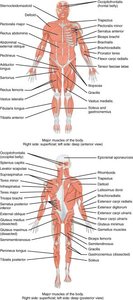
The names of skeletal muscles often combine several words that describe distinctive features. These features include orientation, location, size, shape, action, number of origins, and points of origin and insertion.
Orientation: Describes the direction of muscle fibers relative to the midline. For example, rectus means "straight" (e.g., rectus femoris).
Location: Indicates where the muscle is found in the body. For example, temporalis is located near the temporal bone.
Size: Terms like major (larger) and minor (smaller) distinguish between related muscles (e.g., zygomaticus major and zygomaticus minor).
Shape: Names may reflect the muscle's shape, such as trapezius (trapezoid) and deltoid (triangle).
Action: Indicates the primary movement, such as flexor, extensor, abductor, or retractor.
Number of Origins: Prefixes like biceps (two origins) and triceps (three origins) describe the number of tendons at the origin.
Origin and Insertion: Some muscle names specify both origin and insertion, such as sternocleidomastoid (originates from the sternum and clavicle, inserts at the mastoid process).
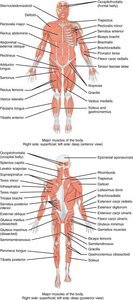
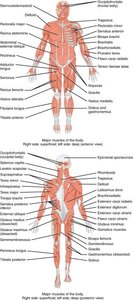
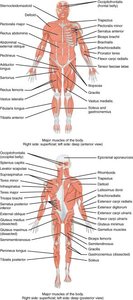
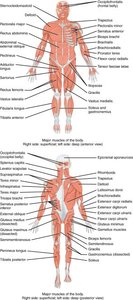
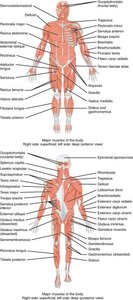
Summary Table: Muscle Naming Criteria
The following table summarizes the main criteria used in naming skeletal muscles:
Criteria | Example | Description |
|---|---|---|
Orientation | Rectus femoris | Fibers run straight relative to the midline |
Location | Temporalis | Located near the temporal bone |
Size | Zygomaticus major/minor | Major is larger, minor is smaller |
Shape | Trapezius, Deltoid | Trapezoid and triangle shapes |
Action | Flexor, Extensor | Indicates movement produced |
Number of Origins | Biceps, Triceps | Two or three origins |
Origin & Insertion | Sternocleidomastoid | Originates from sternum/clavicle, inserts at mastoid process |
Key Terms and Definitions
Origin: The fixed attachment point of a muscle.
Insertion: The movable attachment point of a muscle.
Tendon: A fibrous connective tissue that attaches muscle to bone.
Flexor: A muscle that decreases the angle at a joint.
Extensor: A muscle that increases the angle at a joint.
Abductor: A muscle that moves a limb away from the midline.
Adductor: A muscle that moves a limb toward the midline.
Example: Biceps Brachii
The biceps brachii muscle has two origins and one insertion. Its contraction results in flexion of the forearm at the elbow joint.
Origins: Scapula (two points)
Insertion: Radius (forearm bone)
Action: Flexes the elbow
Example: Sternocleidomastoid
The sternocleidomastoid muscle is named for its points of origin and insertion. It originates from the sternum and clavicle and inserts at the mastoid process of the temporal bone. Its contraction rotates and flexes the neck.
Origin: Sternum and clavicle
Insertion: Mastoid process of temporal bone
Action: Rotates and flexes the neck
Additional info:
Muscle names often provide clues to their function, location, and structure, aiding in identification and understanding of their roles in movement and stability.
Facial muscles are unique in their insertion into the skin, which is essential for nonverbal communication.
