 Indietro
The Nervous System: Part 1
Guida di studio - Note intelligenti
 Appunti personalizzati basati sui tuoi materiali, ampliati con definizioni chiave, esempi e contesto.
Nervous System Overview
Introduction
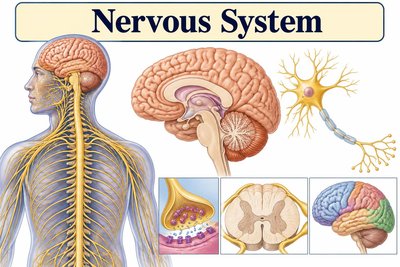
The nervous system is the primary control and communication system of the human body. It detects changes in both the internal and external environment and responds rapidly to maintain homeostasis, often in coordination with the endocrine system.
Control and Communication: The nervous system regulates body functions and coordinates responses.
Homeostasis: Works with the endocrine system to maintain internal balance.
Functions of the Nervous System
Major Functions
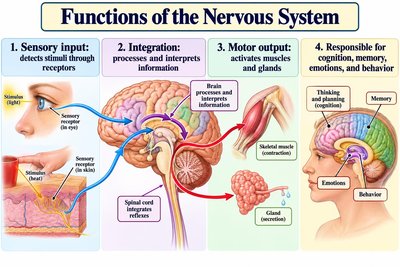
The nervous system performs four essential functions:
Sensory Input: Detects stimuli through specialized receptors.
Integration: Processes and interprets sensory information.
Motor Output: Activates muscles and glands to produce responses.
Cognition and Behavior: Responsible for memory, emotions, and complex behaviors.
Organization of the Nervous System
Structural Divisions
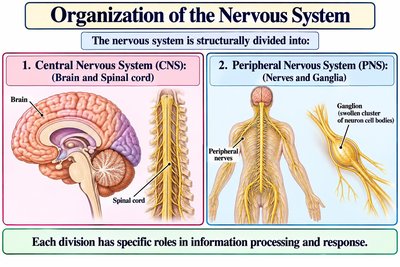
The nervous system is divided into two main structural components:
Central Nervous System (CNS): Consists of the brain and spinal cord; serves as the integration and command center.
Peripheral Nervous System (PNS): Composed of nerves and ganglia; connects the CNS to the rest of the body.
Central Nervous System (CNS)
Role and Components
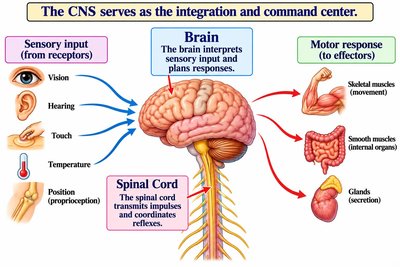
The CNS interprets sensory input, plans responses, and coordinates reflexes.
Brain: Processes sensory information and initiates motor responses.
Spinal Cord: Transmits impulses and coordinates reflex actions.
Peripheral Nervous System (PNS)
Role and Components
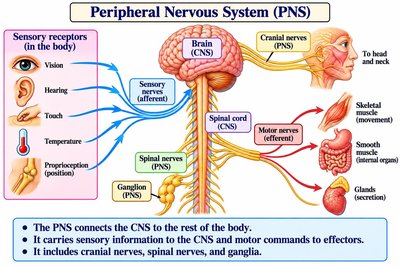
The PNS connects the CNS to the rest of the body, carrying sensory information to the CNS and motor commands to effectors.
Cranial Nerves: Serve the head and neck.
Spinal Nerves: Serve the trunk and limbs.
Ganglia: Clusters of neuron cell bodies outside the CNS.
Functional Divisions of the PNS
Sensory and Motor Divisions
The PNS is functionally divided into:
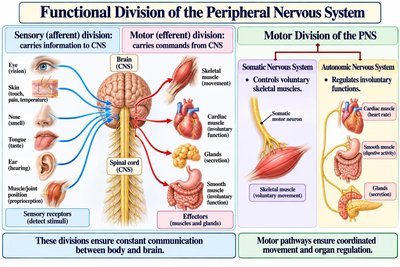
Sensory (Afferent) Division: Carries information from sensory receptors to the CNS.
Motor (Efferent) Division: Carries commands from the CNS to muscles and glands.
Motor Division Subtypes
Somatic Nervous System: Controls voluntary movements of skeletal muscles.
Autonomic Nervous System: Regulates involuntary functions (e.g., heart rate, digestion).
Autonomic Nervous System
Divisions and Functions
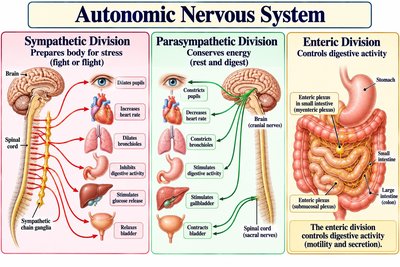
The autonomic nervous system (ANS) is responsible for involuntary regulation of internal organs. It is divided into:
Sympathetic Division: Prepares the body for stress (fight or flight).
Parasympathetic Division: Conserves energy (rest and digest).
Enteric Division: Controls digestive activity independently of CNS input.
Cells of the Nervous System
Neurons and Neuroglia
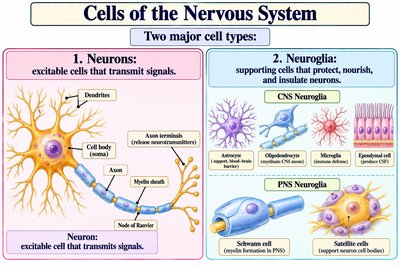
The nervous system contains two major cell types:
Neurons: Excitable cells that transmit electrical signals.
Neuroglia: Supporting cells that protect, nourish, and insulate neurons.
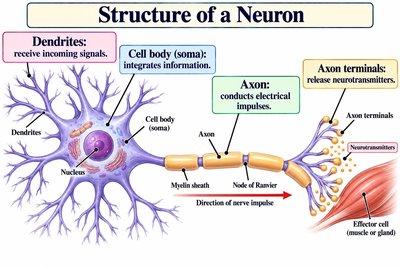
Structure of a Neuron
Key Components
A typical neuron consists of:
Dendrites: Receive incoming signals.
Cell Body (Soma): Integrates information.
Axon: Conducts electrical impulses.
Axon Terminals: Release neurotransmitters to communicate with other cells.
Types of Neurons
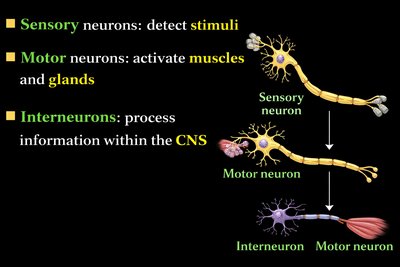
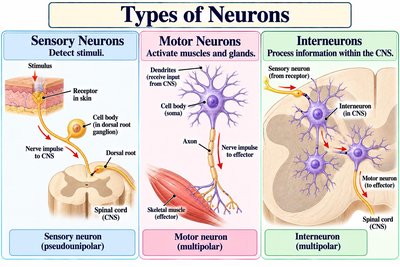
Classification and Functions
Sensory Neurons: Detect stimuli and transmit signals to the CNS.
Motor Neurons: Activate muscles and glands.
Interneurons: Process information within the CNS.
Summary
The nervous system controls, coordinates, and communicates throughout the body. It consists of the CNS (brain and spinal cord) and PNS (nerves and ganglia). Neurons transmit signals, while neuroglia support and protect neurons. Neurons communicate through action potentials, synapses, and neurotransmitters. The cerebrum is divided into frontal, parietal, temporal, and occipital lobes, each with specialized functions. The motor and sensory homunculi represent areas of the cerebral cortex involved in movement and sensation.
