 Indietro
The Respiratory System: Physiology, Pressures, and Gas Exchange
Guida di studio - Note intelligenti
 Appunti personalizzati basati sui tuoi materiali, ampliati con definizioni chiave, esempi e contesto.
22. The Respiratory System
Introduction to Lung Physiology
The respiratory system is responsible for the exchange of gases (O2 and CO2) between the body and the environment. This process is essential for cellular respiration and maintaining homeostasis. The study of lung physiology includes understanding ventilation, pressures within the lungs, and the mechanisms of gas exchange.
Ventilation and Respiration
Components of Breathing
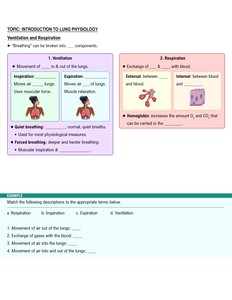
"Breathing" can be divided into two main components: ventilation and respiration.
Ventilation: The movement of air into and out of the lungs. It includes:
Inspiration: Air moves into the lungs, driven by muscle contraction.
Expiration: Air moves out of the lungs, often a passive process during quiet breathing.
Respiration: The exchange of gases between the air and blood (external respiration) and between blood and tissues (internal respiration).
External Respiration: Gas exchange between alveoli and blood.
Internal Respiration: Gas exchange between blood and tissues.
Mechanics of Ventilation
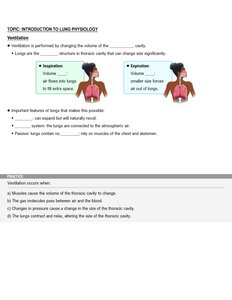
Ventilation is performed by changing the volume of the thoracic cavity, which alters the pressure within the lungs and allows air to flow in or out. The lungs are the only structures in the thoracic cavity that can change size significantly.
Inspiration: Volume increases, pressure decreases, air flows into lungs.
Expiration: Volume decreases, pressure increases, air flows out of lungs.
Quiet Breathing: Passive process, mainly involves the diaphragm and external intercostal muscles.
Forced Breathing: Involves additional muscles such as the abdominal and internal intercostal muscles.
Pressure in the Lungs and Pleural Cavities
Forces That Shape the Lungs
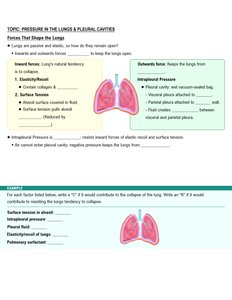
The lungs are passive and elastic, tending to collapse due to their own elastic recoil. However, they remain open due to outward forces and negative pressure in the pleural cavity.
Inward Forces: Elasticity/recoil, surface tension of alveolar fluid.
Outward Forces: Chest wall expansion, negative intrapleural pressure.
Intrapleural Pressure: Always negative relative to intrapulmonary pressure, preventing lung collapse.
Pressure Relationships in the Lungs
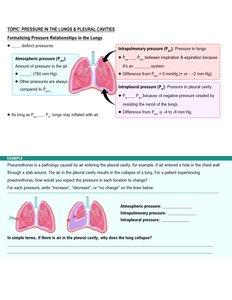
Several pressures are important in lung physiology:
Atmospheric Pressure (Patm): Pressure of air outside the body (typically 760 mm Hg at sea level).
Intrapulmonary Pressure (Ppul): Pressure within the alveoli; equalizes with atmospheric pressure during breathing.
Intrapleural Pressure (Pip): Pressure within the pleural cavity; always negative to prevent lung collapse.
Transpulmonary Pressure: Difference between intrapulmonary and intrapleural pressures; keeps lungs inflated.
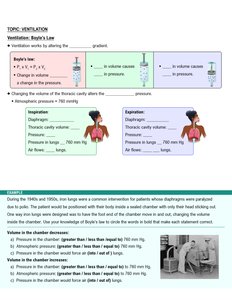
Ventilation: Boyle's Law
Boyle's Law and Breathing
Boyle's Law states that the pressure of a gas is inversely proportional to its volume (at constant temperature):
Increasing thoracic volume decreases pressure, causing air to flow in (inspiration).
Decreasing thoracic volume increases pressure, causing air to flow out (expiration).
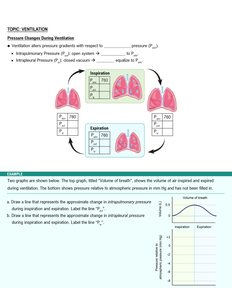
Pressure Changes During Ventilation
During inspiration, intrapulmonary pressure drops below atmospheric pressure, drawing air in. During expiration, intrapulmonary pressure rises above atmospheric pressure, pushing air out.
Inspiration: Ppul < Patm
Expiration: Ppul > Patm
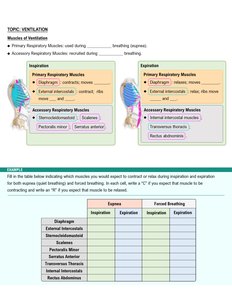
Muscles of Ventilation
Primary and Accessory Respiratory Muscles
Ventilation involves both primary and accessory muscles:
Primary Muscles: Diaphragm and external intercostals (active during quiet breathing).
Accessory Muscles: Sternocleidomastoid, scalenes, pectoralis minor, and abdominal muscles (recruited during forced breathing).
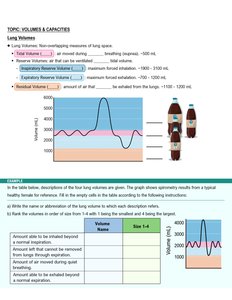
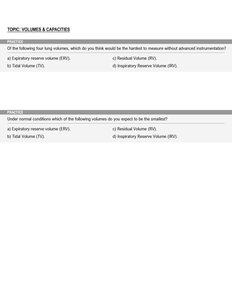
Lung Volumes and Capacities
Lung Volumes
Lung volumes are measures of the amount of air associated with different phases of the respiratory cycle:
Tidal Volume (TV): Air moved in or out during normal breathing (~500 mL).
Inspiratory Reserve Volume (IRV): Maximum air inhaled beyond normal inspiration (~3100 mL).
Expiratory Reserve Volume (ERV): Maximum air exhaled beyond normal expiration (~1200 mL).
Residual Volume (RV): Air remaining in lungs after maximal exhalation (~1200 mL).
Lung Capacities
Lung capacities are combinations of two or more lung volumes:
Inspiratory Capacity (IC): TV + IRV
Functional Residual Capacity (FRC): ERV + RV
Vital Capacity (VC): TV + IRV + ERV
Total Lung Capacity (TLC): TV + IRV + ERV + RV
Law of Partial Pressure
Partial Pressure and Gas Exchange
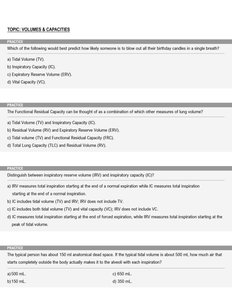
The movement of gases (O2 and CO2) depends on partial pressure gradients. Each gas in a mixture exerts its own pressure, called partial pressure, which drives diffusion.
Dalton's Law: The total pressure of a gas mixture is the sum of the partial pressures of each individual gas.
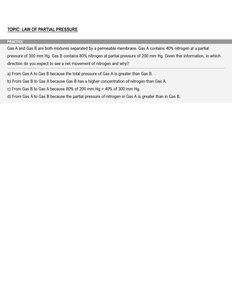
Henry's Law: The amount of gas that dissolves in a liquid is proportional to its partial pressure and solubility.
Respiration: External and Internal
External Respiration
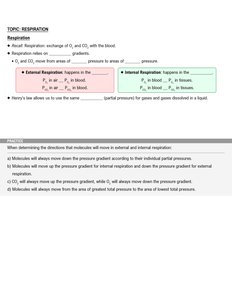
External respiration is the exchange of gases between alveoli and blood. Oxygen diffuses from alveoli into blood, while carbon dioxide diffuses from blood into alveoli. The direction and rate of diffusion are determined by partial pressure gradients.
Internal Respiration
Internal respiration is the exchange of gases between blood and tissues. Oxygen diffuses from blood into tissues, and carbon dioxide diffuses from tissues into blood. This process is also driven by partial pressure gradients.
Summary Table: Key Lung Volumes and Capacities
Volume/Capacity | Definition | Typical Value (mL) |
|---|---|---|
Tidal Volume (TV) | Air moved in/out during normal breathing | 500 |
Inspiratory Reserve Volume (IRV) | Max air inhaled beyond normal inspiration | 3100 |
Expiratory Reserve Volume (ERV) | Max air exhaled beyond normal expiration | 1200 |
Residual Volume (RV) | Air remaining after maximal exhalation | 1200 |
Vital Capacity (VC) | TV + IRV + ERV | 4800 |
Total Lung Capacity (TLC) | TV + IRV + ERV + RV | 6000 |
Key Equations
Boyle's Law:
Dalton's Law:
Henry's Law: (where C = concentration of dissolved gas, k = solubility constant, P = partial pressure)
Additional info:
Hemoglobin increases the amount of O2 and CO2 that can be carried in the blood by binding these gases, thus enhancing transport efficiency.
Diseases such as COPD can alter lung volumes and capacities, affecting gas exchange and ventilation.
