Indietro
The Respiratory System: Pulmonary Ventilation, Gas Exchange, and Regulation
Guida di studio - Note intelligenti
 Appunti personalizzati basati sui tuoi materiali, ampliati con definizioni chiave, esempi e contesto.
The Respiratory System
Overview of Respiration
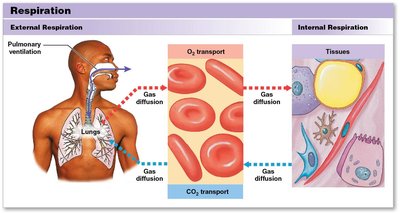
The respiratory system is responsible for the exchange of gases—oxygen (O2) and carbon dioxide (CO2)—between the body and the external environment. Respiration consists of two integrated processes: external respiration and internal respiration.
External Respiration: All processes involved in the exchange of O2 and CO2 with the external environment, including pulmonary ventilation and gas diffusion across the alveolar membrane.
Internal Respiration: Uptake of O2 and release of CO2 by cells, resulting from cellular respiration.
Pulmonary Ventilation
Mechanics of Breathing
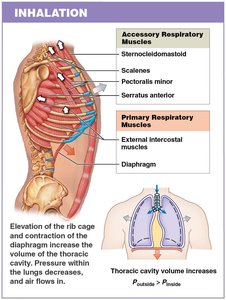
Pulmonary ventilation refers to the movement of air into and out of the lungs. It is driven by pressure differences between the atmosphere and the lungs, which are created by changes in the volume of the thoracic cavity.
Inspiration (Inhalation): Active process involving contraction of the diaphragm and external intercostal muscles, increasing thoracic volume and decreasing pressure, causing air to flow in.
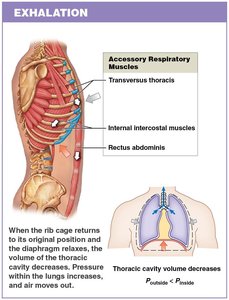
Expiration (Exhalation): Can be passive (relaxation of muscles) or active (involvement of accessory muscles), decreasing thoracic volume and increasing pressure, causing air to flow out.
Primary Respiratory Muscles: Diaphragm and external intercostals.
Accessory Respiratory Muscles: Used during forced breathing, including sternocleidomastoid, scalenes, pectoralis minor, transversus thoracis, internal intercostals, and rectus abdominis.
Pressure and Volume Changes
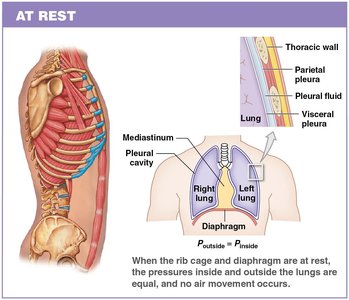
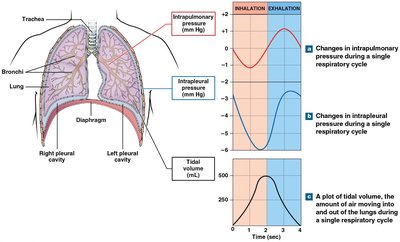
Air flows from areas of higher pressure to lower pressure. The respiratory cycle involves changes in intrapulmonary and intrapleural pressures, which drive the movement of air.
Quiet Breathing (Eupnea): Active inhalation and passive exhalation.
Forced Breathing (Hyperpnea): Active inhalation and exhalation, assisted by accessory muscles.
Elastic Rebound: When inhalation muscles relax, elastic tissues recoil, returning the diaphragm and rib cage to their original positions.
Respiratory Volumes and Capacities
The respiratory system adapts to changing oxygen demands by varying the number of breaths per minute (respiratory rate) and the amount of air moved per breath (tidal volume).
Tidal Volume (VT): Amount of air moved in quiet breathing, typically 500 mL.
Vital Capacity (VC): Largest possible breath, from full inspiration to full expiration, typically 4.5 L.
Residual Volume: Air remaining in airways after full expiration.
Respiratory Minute Volume (VE): Amount of air moved per minute, calculated as:
Gas Exchange
Principles of Gas Diffusion
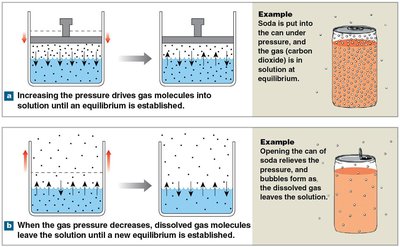
Gas exchange occurs between blood and alveolar air across the blood-air barrier. It depends on the partial pressures of gases and the diffusion of molecules between gas and liquid phases.
Diffusion: Occurs in response to concentration gradients; rate depends on physical principles (gas laws).
Partial Pressure: The pressure exerted by a single gas in a mixture; drives diffusion.
External and Internal Gas Exchange
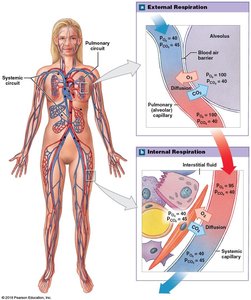
O2 and CO2 are exchanged in the lungs (external respiration) and in tissues (internal respiration) based on partial pressure gradients.
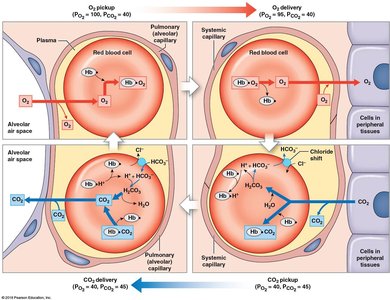
External Respiration: O2 diffuses from alveoli into blood; CO2 diffuses from blood into alveoli.
Internal Respiration: O2 diffuses from blood into tissues; CO2 diffuses from tissues into blood.
Gas Transport
Transport of Oxygen and Carbon Dioxide
Blood plasma alone cannot transport enough O2 or CO2 to meet physiological needs. Red blood cells (RBCs) and hemoglobin play a crucial role in gas transport.
Oxyhemoglobin (HbO2): Hemoglobin bound to O2.
Carbaminohemoglobin (HbCO2): Hemoglobin bound to CO2.
CO2 Conversion: CO2 is converted to carbonic acid (H2CO3), which dissociates into H+ and bicarbonate (HCO3−).
Regulation of Respiration
Neural Control and Chemoreceptor Response
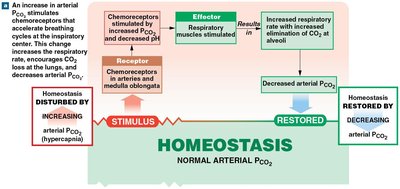
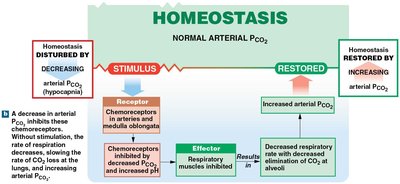
Respiratory centers in the brain regulate breathing rates in response to changing oxygen and carbon dioxide levels, detected by chemoreceptors. CO2 receptors are more sensitive than O2 receptors.
Hypercapnia: Elevated CO2 levels stimulate increased respiratory rate and depth.
Hypocapnia: Depressed CO2 levels decrease chemoreceptor activity and respiratory rate.
Age-Related Changes in Respiration
Effects of Aging
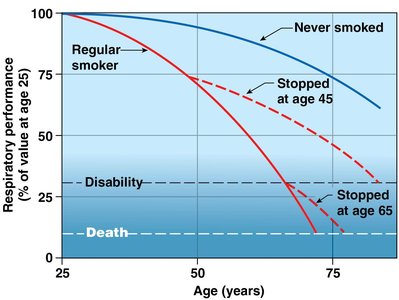
Aging affects the respiratory system by reducing elasticity, altering lung compliance, and lowering vital capacity. Arthritic changes restrict chest movements and limit respiratory minute volume. Emphysema, often seen in individuals over age 50, is influenced by exposure to respiratory irritants such as cigarette smoke.
Elastic Tissue Deterioration: Reduces lung compliance and vital capacity.
Arthritic Changes: Restrict chest movement and limit ventilation.
Emphysema: Progressive loss of alveolar surface area, reducing gas exchange efficiency.
Integration with Other Body Systems
Systemic Interactions
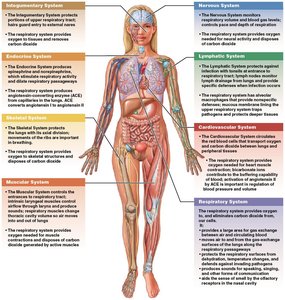
The respiratory system interacts with multiple other body systems to maintain homeostasis. It provides oxygen for cellular metabolism and removes carbon dioxide, a metabolic waste product. Other systems, such as the cardiovascular, nervous, and muscular systems, support and regulate respiratory function.
Cardiovascular System: Transports gases between lungs and tissues.
Nervous System: Regulates respiratory rate and depth.
Muscular System: Provides muscles for breathing movements.
Endocrine System: Modulates respiratory activity via hormones.