 Indietro
The Respiratory System: Structure and Function
Guida di studio - Note intelligenti
 Appunti personalizzati basati sui tuoi materiali, ampliati con definizioni chiave, esempi e contesto.
The Respiratory System
Overview and Primary Functions
The respiratory system is essential for gas exchange, supplying oxygen to body tissues and removing carbon dioxide produced by cellular metabolism. It consists of specialized structures that facilitate the movement and conditioning of air, as well as mechanisms to protect delicate exchange surfaces from pathogens and debris.
Gas Exchange: Provides a large surface area for oxygen and carbon dioxide exchange between air and blood.
Air Movement: Moves air to and from the lungs' exchange surfaces.
Protection: Defends respiratory surfaces from dehydration, temperature changes, and pathogens.
Sound Production: Produces sounds for communication.
Olfaction: Detects odors via olfactory receptors in the nasal cavity.
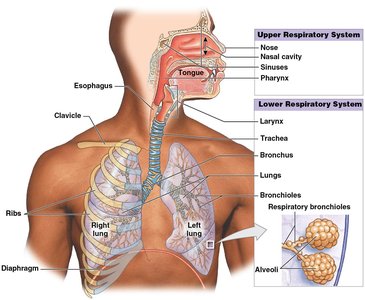
Organization of the Respiratory System
Upper vs. Lower Respiratory System
The respiratory system is divided into upper and lower regions, each with distinct anatomical structures and functions.
Upper Respiratory System: Includes the nose, nasal cavity, paranasal sinuses, and pharynx. These structures filter, warm, and humidify incoming air.
Lower Respiratory System: Comprises the larynx, trachea, bronchi, bronchioles, and alveoli. These structures conduct air to the lungs and facilitate gas exchange.
Respiratory Mucosa and Defense Mechanisms
Structure and Function of Respiratory Mucosa
The respiratory mucosa lines the conducting portions of the respiratory tract and plays a critical role in defense against inhaled particles and pathogens.
Epithelium: Forms a barrier and contains ciliated cells that move mucus.
Lamina Propria: Areolar tissue layer supporting the epithelium; contains mucous glands in the upper system and smooth muscle in the lower system.
Mucous Cells and Glands: Produce mucus to trap debris and microorganisms.
Cilia: Propel mucus toward the pharynx for removal.
Alveolar Macrophages: Engulf small particles that reach the alveoli.
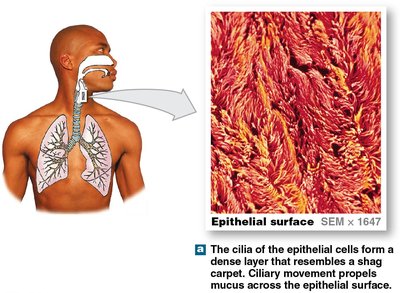
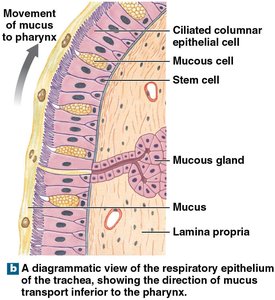
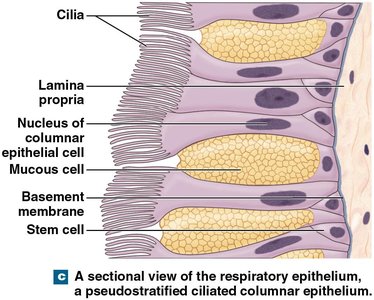
Upper Respiratory System
Nose and Nasal Cavity
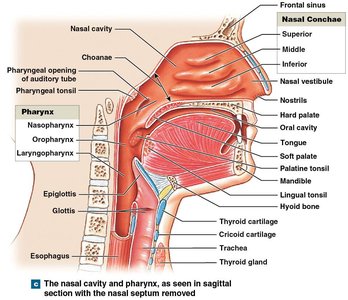
The nose is the primary entryway for air, which passes through the nostrils into the nasal vestibule. Nasal hairs and mucus trap large particles, while the nasal cavity warms and humidifies air and brings olfactory stimuli to receptors.
Pharynx
The pharynx is a shared chamber for the respiratory and digestive systems, extending from the nasal cavity to the larynx. It is divided into three regions: nasopharynx, oropharynx, and laryngopharynx.
Lower Respiratory System
Larynx and Glottis
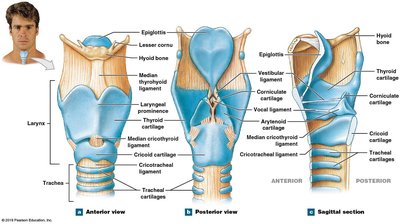
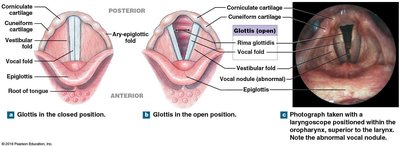
The larynx is a cartilaginous structure that houses the vocal cords and forms the glottis, the opening into the trachea. The glottis is involved in sound production and protects the airway by closing during swallowing.
Trachea
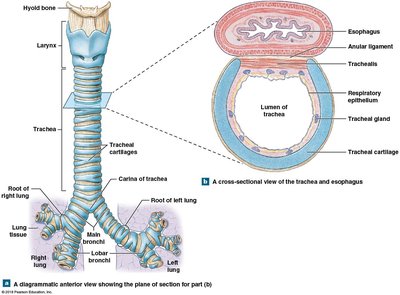
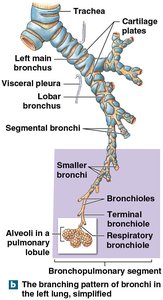
The trachea, or windpipe, is a tough, flexible tube supported by tracheal cartilage. It branches into the right and left main bronchi, which lead to the lungs.
Bronchial Tree
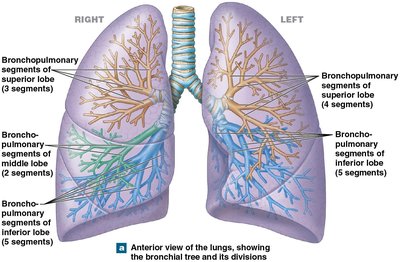
The bronchial tree consists of branching airways that supply air to specific regions of the lungs. Each segmental bronchus serves a bronchopulmonary segment.
Right Lung: 10 segments
Left Lung: 8 or 9 segments
Bronchodilation and Bronchoconstriction
Regulation of Airway Diameter
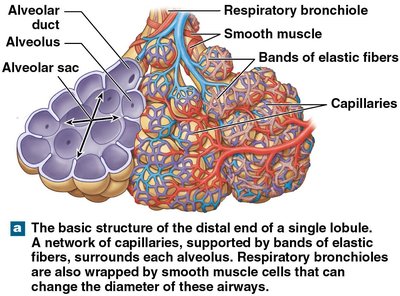
Airway diameter is regulated by smooth muscle in the bronchi and bronchioles, affecting airflow resistance.
Bronchodilation: Sympathetic activation enlarges airway diameter, reducing resistance.
Bronchoconstriction: Parasympathetic activation or histamine release narrows airways, increasing resistance. Excessive bronchoconstriction, as seen in asthma, restricts airflow.
Gas Exchange Structures
Alveoli and Pulmonary Lobules
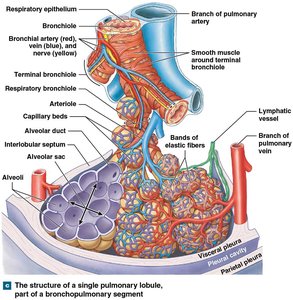
Terminal bronchioles branch into respiratory bronchioles, which connect to alveolar ducts and alveolar sacs. Alveoli are surrounded by capillaries and elastic fibers, forming the blood-air barrier for efficient gas exchange.
The Lungs
Lobes and Surface Anatomy
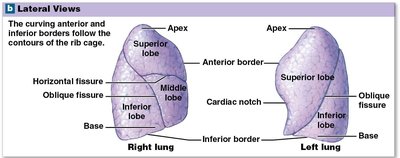
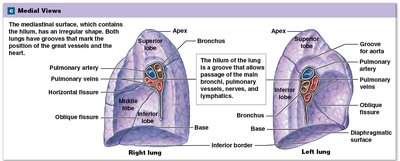
The lungs are located in the pleural cavities and are divided into lobes separated by fissures.
Right Lung: Three lobes (superior, middle, inferior), separated by horizontal and oblique fissures; wider and displaced upward by the liver.
Left Lung: Two lobes (superior, inferior), separated by an oblique fissure; longer and indented medially by the cardiac notch.
Summary Table: Major Components of the Respiratory System
Component | Location | Function |
|---|---|---|
Nose & Nasal Cavity | Upper | Filters, warms, humidifies air; olfaction |
Pharynx | Upper | Passage for air and food |
Larynx | Lower | Sound production; airway protection |
Trachea | Lower | Conducts air to bronchi |
Bronchi & Bronchioles | Lower | Air distribution; regulation of airflow |
Alveoli | Lower | Gas exchange |
Key Terms and Definitions
Alveolus: Small air sac in the lung where gas exchange occurs.
Bronchopulmonary Segment: Region of lung supplied by a segmental bronchus.
Glottis: Opening between the vocal cords in the larynx.
Lamina Propria: Areolar tissue layer beneath the epithelium.
Respiratory Mucosa: Mucous membrane lining the respiratory tract.
Relevant Equations
Gas Exchange (Diffusion):
The rate of gas diffusion across the respiratory membrane is governed by Fick's Law:
J: Rate of diffusion
D: Diffusion coefficient
A: Surface area
ΔP: Partial pressure difference
d: Thickness of membrane
Additional info: Fick's Law is fundamental for understanding how oxygen and carbon dioxide move across the alveolar-capillary membrane.
