 Indietro
The Skeleton: Structure and Function in Human Anatomy
Guida di studio - Note intelligenti
 Appunti personalizzati basati sui tuoi materiali, ampliati con definizioni chiave, esempi e contesto.
The Skeleton
Overview of the Human Skeleton
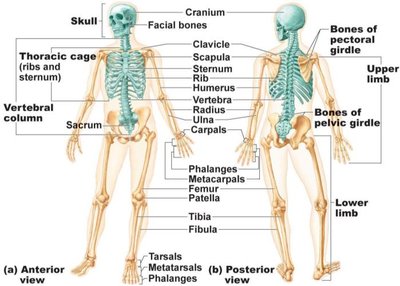
The human skeleton is a structural framework that supports the body, protects vital organs, and facilitates movement. It is divided into two main regions: the axial skeleton and the appendicular skeleton.
Axial Skeleton: Composed of the skull, vertebral column, and thoracic (rib) cage. It forms the vertical axis of the body.
Appendicular Skeleton: Includes the upper and lower limbs, as well as the pectoral and pelvic girdles, which attach to the axial skeleton.
Total Bones: The adult human skeleton consists of 206 bones, accounting for approximately 20% of body weight.
The Skull
Structure and Function of the Skull
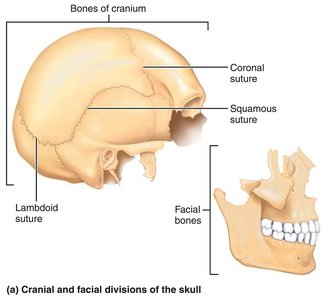
The skull is the most complex bony structure in the human body, formed by cranial and facial bones. It protects the brain and supports the structures of the face.
Total Bones: 22 bones (8 cranial, 14 facial)
Cranium: Surrounds and protects the brain and organs of hearing/balance; provides attachment sites for head and neck muscles.
Facial Bones: Form the framework of the face, contain cavities for special sense organs, provide openings for air and food, secure teeth, and anchor facial muscles of expression.
Cranial Vault and Base
The cranium is divided into two main parts: the cranial vault (calvaria) and the cranial base.
Cranial Vault: Forms the superior, lateral, and posterior portions of the skull, including the forehead.
Cranial Base: Forms the inferior aspect of the skull, divided internally into three fossae (anterior, middle, posterior) that house the brain.
Cranial Cavity: The space enclosed by the cranial vault and base, containing the brain.
Major Cavities of the Skull
The skull contains several important cavities that serve various functions.
Ear Cavities: Middle and internal ear cavities are involved in hearing and balance.
Nasal Cavity: Passageway for air; involved in olfaction.
Orbits: House the eyeballs.
Sinuses: Air-filled cavities that lighten the skull and contribute to voice resonance.
Openings: The skull has 85 named openings for passage of the spinal cord, major blood vessels, and the 12 cranial nerves.
Major Cranial Bones
The cranial bones are specialized for protection and support of the brain and sensory organs.
Frontal Bone: Forms the anterior portion of the cranium, including the forehead.
Parietal Bones: Paired bones forming most of the superior and lateral aspects of the skull.
Occipital Bone: Single bone at the base of the skull.
Temporal Bones: Paired bones forming the inferior and lateral aspects of the skull and parts of the cranial base; house the middle and inner ear cavities.
Sphenoid Bone: Bat-shaped, complex bone that articulates with all other cranial bones.
Ethmoid Bone: Cube-shaped bone lying deep between the orbits and nasal cavities.
Major Cranial Sutures
Sutures are immovable joints that firmly unite the bones of the adult skull. There are four main cranial sutures:
Coronal Suture: Connects the frontal bone and two parietal bones.
Squamous Suture: Connects the parietal bone and temporal bone.
Lambdoid Suture: Connects the occipital bone and two parietal bones.
Sagittal Suture: Connects the two parietal bones.
Facial Bones
The facial skeleton consists of 14 bones, with only the mandible and vomer unpaired. The paired bones include the maxillae, zygomatics, nasals, lacrimals, palatines, and inferior nasal conchae.
Mandible: The lower jawbone; strongest and largest bone of the face.
Vomer: Unpaired bone forming part of the nasal septum.
The Hyoid Bone
The hyoid bone is unique in the human body.
Location: Not a bone of the skull; only bone that does not articulate directly with any other bone.
Function: Anchored by ligaments; acts as a movable base for the tongue and site of attachment for muscles involved in swallowing and speech.
Shape: Horseshoe-shaped.
Clinical Note: Strangulation can break the hyoid bone.
Paranasal Sinuses
Paranasal sinuses are air-filled spaces within the bones of the skull.
Functions: Lighten the skull, humidify/moisturize and warm inhaled air, and contribute to voice resonance.
Practice Questions
The number of bones in the human body is: a) 201 b) 602 c) 262 d) 206
The number of openings in the skull is: a) 4 b) 77 c) 85 d) 206
What is the false statement about the skull: a) There are 85 named openings for nerves, blood vessels etc. b) There are 4 main cranial sutures c) Ethmoid bone is said to be bat shaped d) There are 14 facial bones
