 Indietro
The Urinary System: Structure, Function, and Physiology
Guida di studio - Note intelligenti
 Appunti personalizzati basati sui tuoi materiali, ampliati con definizioni chiave, esempi e contesto.
The Urinary System
Overview and Components
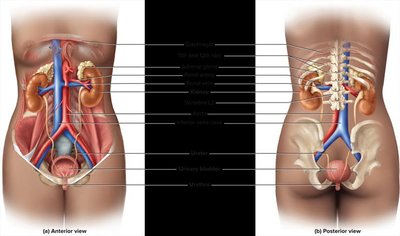
The urinary system is essential for filtering blood, removing waste, and maintaining homeostasis in the body. It consists of several organs that work together to produce, transport, store, and eliminate urine.
Kidneys (2): Filter blood and form urine.
Ureters (2): Transport urine from kidneys to the bladder.
Urinary bladder: Stores urine until excretion.
Urethra: Conducts urine out of the body.
Functions of the Urinary System
Filtration of blood plasma to remove metabolic wastes.
Regulation of blood volume, pressure, and osmolarity.
Electrolyte and acid-base balance of body fluids.
Secretion of erythropoietin to stimulate red blood cell production.
Activation of vitamin D (calcitriol).
Detoxification of some drugs and toxins.
Excretion and Types of Wastes
Definitions and Types
Excretion: The process of separating and eliminating wastes from body fluids.
Waste: Any substance that is useless or in excess of the body's needs.
Metabolic waste: Waste produced by metabolic processes.
Nitrogenous wastes: Highly toxic metabolic wastes, including urea (50%), uric acid, and creatinine.
Nephrons: The Functional Unit of the Kidney
Structure and Function
Nephrons are microscopic structures in the kidneys responsible for filtering blood and forming urine. Each kidney contains about one million nephrons, each consisting of two main parts:
Renal corpuscle
Renal tubule
Renal Corpuscle
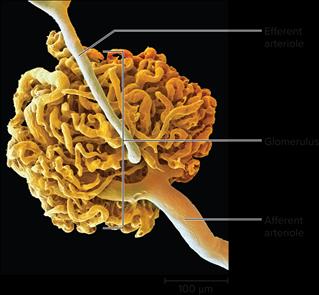
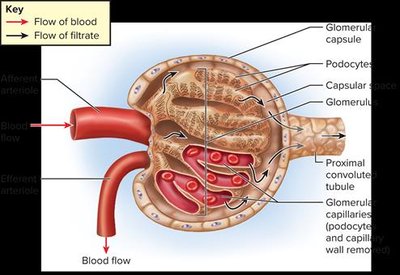
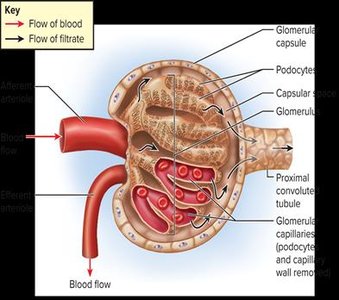
The renal corpuscle is where blood filtration begins. It is composed of:
Glomerulus: A ball of capillaries.
Glomerular (Bowman's) capsule: A two-layered capsule surrounding the glomerulus, with a capsular space between the layers.
Blood enters via the afferent arteriole and exits via the efferent arteriole.
Renal Tubule
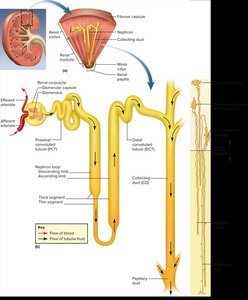
The renal tubule processes the filtrate into urine through several regions, each with specialized functions:
Proximal convoluted tubule (PCT): Reabsorbs nutrients like glucose, amino acids, and small peptides; lined with cuboidal epithelium with microvilli.
Nephron loop (Loop of Henle): U-shaped; descending limb is permeable to water, ascending limb actively transports ions.
Distal convoluted tubule (DCT): Mainly reabsorbs sodium and chloride.
Collecting duct (CD): Receives fluid from multiple nephrons; reabsorbs water; fluid is officially urine here.
Urine Formation
Stages of Urine Formation
The kidneys convert blood plasma to urine in four main stages:
Glomerular filtration
Tubular reabsorption
Tubular secretion
Water conservation
As fluid moves through these stages, its composition changes and it is referred to as glomerular filtrate, tubular fluid, or urine depending on its location.
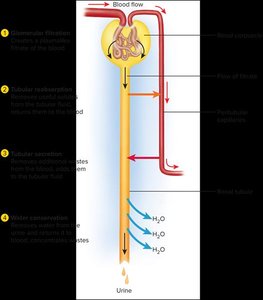
Glomerular Filtration
Glomerular filtration is the first step in urine formation, where water and small solutes are filtered from the blood into the capsular space. The filtration membrane consists of:
Fenestrated endothelium: Allows passage of small molecules but not blood cells.
Basement membrane: Blocks large proteins.
Filtration slits: Formed by podocytes, further restricting passage of large molecules.
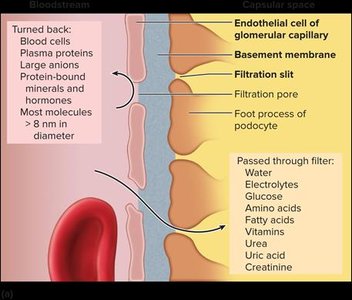
Filtration Pressure
Filtration is driven by high blood pressure in the glomerulus, which is higher than in other capillaries due to the larger diameter of the afferent arteriole compared to the efferent arteriole. This pressure can make the kidneys vulnerable to hypertension, potentially leading to capillary rupture and renal failure.
Glomerular Filtration Rate (GFR)
GFR is the amount of filtrate formed per minute by both kidneys. Typical values:
Females: ~105 mL/min (150 L/day)
Males: ~125 mL/min (180 L/day)
Only 1–2 L/day is excreted as urine; 99% is reabsorbed.
Regulation of GFR
GFR must be tightly regulated to maintain fluid and electrolyte balance:
Too high: Leads to dehydration and electrolyte loss.
Too low: Causes retention of wastes.
Regulation mechanisms include:
Neural control: Sympathetic stimulation constricts afferent arterioles, conserving water and redirecting blood flow.
Hormonal control: The renin-angiotensin-aldosterone system (RAAS) increases blood pressure and maintains GFR during low BP.
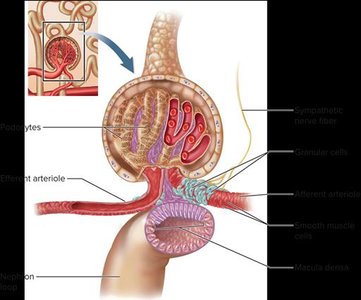
Renal autoregulation: Nephrons adjust their own GFR via the juxtaglomerular apparatus, which senses flow rate and osmolarity.
Summary Table: Main Components and Functions of the Urinary System
Component | Main Function |
|---|---|
Kidneys | Filtration of blood, formation of urine, regulation of fluid/electrolyte balance |
Ureters | Transport urine from kidneys to bladder |
Urinary bladder | Temporary storage of urine |
Urethra | Elimination of urine from the body |
Key Terms and Concepts
Glomerulus: Capillary network in the renal corpuscle where filtration occurs.
Podocytes: Specialized cells in the glomerular capsule that form filtration slits.
Renin: Enzyme secreted by the kidneys to regulate blood pressure.
Juxtaglomerular apparatus: Structure that monitors and regulates GFR.
Equations
Glomerular Filtration Rate (GFR):
Additional info: The marker is often inulin or creatinine, which are freely filtered and not reabsorbed or secreted.
