 Indietro
The Urinary System: Structure, Function, and Regulation
Guida di studio - Note intelligenti
 Appunti personalizzati basati sui tuoi materiali, ampliati con definizioni chiave, esempi e contesto.
The Urinary System
Components and Functions of the Urinary System
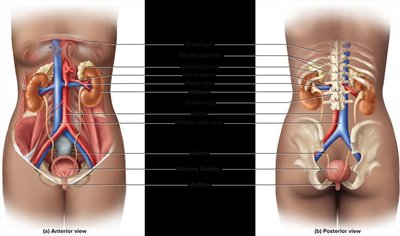
The urinary system is essential for maintaining homeostasis by filtering blood, removing wastes, and regulating fluid and electrolyte balance. It consists of several organs that work together to produce, store, and eliminate urine.
Key Components:
2 kidneys
2 ureters
Urinary bladder
Urethra
Main Functions:
Filter blood plasma and excrete toxic metabolic wastes
Regulate blood volume, pressure, and osmolarity
Regulate electrolyte and acid-base balance
Secrete erythropoietin to stimulate red blood cell production
Synthesize the hormone calcitriol (vitamin D)
Detoxify some drugs
Excretion and Types of Wastes
Excretion is the process of separating and eliminating wastes from body fluids. The urinary system is responsible for removing metabolic wastes, especially nitrogenous wastes, which are highly toxic.
Waste: Any substance that is useless or in excess of the body’s needs
Metabolic Waste: Produced by the body’s metabolic processes
Nitrogenous Wastes:
Urea (50%)
Uric acid and creatinine (other 50%)
Nephrons: The Functional Unit of the Kidney
Structure and Function of Nephrons
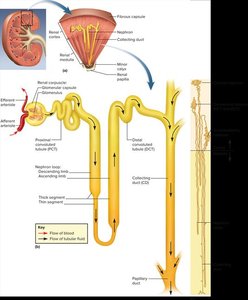
Nephrons are the microscopic functional units of the kidney, responsible for filtering blood and forming urine. Each nephron consists of two main parts: the renal corpuscle and the renal tubule.
Renal Corpuscle: Site of blood filtration
Renal Tubule: Processes filtrate into urine
Renal Corpuscle
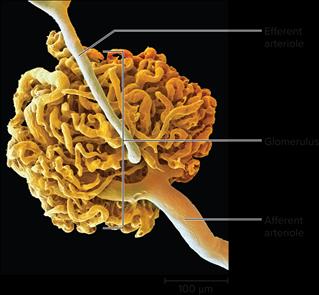
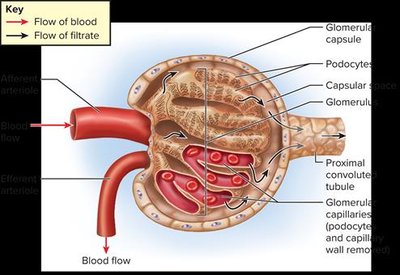
The renal corpuscle is composed of a ball of capillaries called the glomerulus, surrounded by a two-layered glomerular capsule.
Glomerulus: Capillary network where filtration occurs
Glomerular Capsule: Two layers separated by capsular space
Afferent Arteriole: Brings blood into the glomerulus (larger diameter)
Efferent Arteriole: Takes blood away from the glomerulus (smaller diameter)
High Pressure: Drives filtration
Renal Tubule
The renal tubule is divided into four regions, each with unique properties and roles in urine production.
Proximal Convoluted Tubule (PCT):
Lined with simple cuboidal epithelium with microvilli
Absorbs nutrients like glucose, amino acids, and small peptides
Nephron Loop (Loop of Henle):
U-shaped; descending and ascending limbs
Thick segments: simple cuboidal, active ion transport
Thin segments: simple squamous, permeable to water
Distal Convoluted Tubule (DCT):
Shorter, less coiled
Mainly responsible for sodium and chloride reabsorption
Collecting Duct (CD):
Receives fluid from DCTs of several nephrons
Mainly reabsorbs water
Urine is officially formed in the CD
Urine Formation: Processes and Stages
Stages of Urine Formation
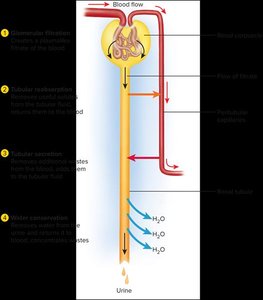
The kidneys convert blood plasma to urine in four stages, each involving specific processes and changes in fluid composition.
Glomerular Filtration: Water and solutes are filtered from blood into the capsular space
Tubular Reabsorption: Useful substances are reabsorbed from the tubule back into the blood
Tubular Secretion: Additional wastes are secreted into the tubule
Water Conservation: Water is reabsorbed to concentrate urine
Glomerular Filtration
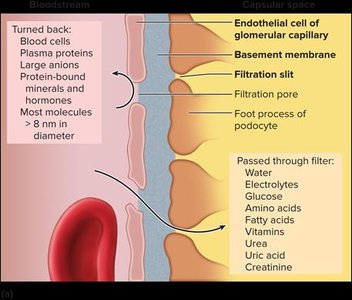
Glomerular filtration is the first step in urine formation, where water and solutes are filtered from the glomerulus into the capsular space.
Filtration Membrane:
Endothelium of capillary (fenestrated, blocks blood cells)
Basement membrane (glycoprotein gel, blocks large proteins)
Filtration slits (formed by podocytes, block large molecules)
Filtrate: Contains water, electrolytes, glucose, amino acids, fatty acids, vitamins, urea, uric acid, creatinine
Glomerular Filtration Rate (GFR)
GFR is the amount of filtrate formed per minute by both kidneys. It is a critical parameter for kidney function.
Normal Values:
Females: ~105 mL/min (150 L/day)
Males: ~125 mL/min (180 L/day)
Urine Output: Only 1-2 L/day is excreted; 99% of filtrate is reabsorbed
Regulation of GFR
GFR must be precisely controlled to maintain homeostasis.
Too High: Dehydration and electrolyte depletion
Too Low: Wastes are reabsorbed instead of eliminated
Regulation Mechanisms:
Neural control (sympathetic constriction of afferent arterioles)
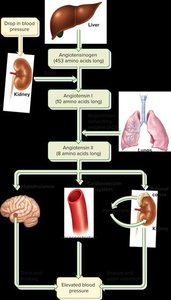
Hormonal control (renin-angiotensin-aldosterone system)
Local control (renal autoregulation via juxtaglomerular apparatus)
Renal Autoregulation
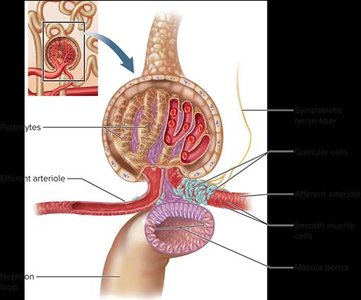
Nephrons can independently regulate their own GFR through the juxtaglomerular apparatus, which monitors flow rate and osmolarity.
Juxtaglomerular Apparatus:
Macula densa: sensory cells in DCT
Granular cells: secrete renin
Summary Table: Components and Functions of the Urinary System
Component | Main Function |
|---|---|
Kidneys | Filter blood, produce urine, regulate fluid/electrolyte balance |
Ureters | Transport urine from kidneys to bladder |
Urinary Bladder | Stores urine |
Urethra | Eliminates urine from the body |
Key Terms and Concepts
Nephron: Functional unit of the kidney
Glomerulus: Capillary network for filtration
Glomerular Capsule: Surrounds glomerulus
Proximal Convoluted Tubule (PCT): Reabsorbs nutrients
Nephron Loop: Concentrates urine
Distal Convoluted Tubule (DCT): Reabsorbs sodium and chloride
Collecting Duct (CD): Final urine formation
Glomerular Filtration Rate (GFR): Rate of filtrate formation
Juxtaglomerular Apparatus: Regulates GFR
Relevant Equations
Glomerular Filtration Rate (GFR): where is the filtration coefficient.
Example: Clinical Relevance
Hypertension: High blood pressure can damage glomerular capillaries, leading to renal failure.
Diabetes: Can affect filtration and reabsorption, leading to kidney disease.
Additional info:
Hormonal regulation involves the renin-angiotensin-aldosterone system, which increases blood pressure and maintains GFR during low blood pressure.
Nephrons are highly specialized for selective reabsorption and secretion, ensuring waste removal and conservation of essential substances.
