 Indietro
The Urinary System: Tubular Reabsorption, Secretion, and Water Conservation
Guida di studio - Note intelligenti
 Appunti personalizzati basati sui tuoi materiali, ampliati con definizioni chiave, esempi e contesto.
The Urinary System: Tubular Reabsorption, Secretion, and Water Conservation
Overview of Renal Processes
The urinary system is responsible for filtering blood, removing waste, and regulating water and electrolyte balance. The nephron, the functional unit of the kidney, performs these tasks through glomerular filtration, tubular reabsorption, tubular secretion, and water conservation.
Glomerular Filtration: Driven by high blood pressure in glomerular capillaries, allowing water and most solutes to enter the capsular space while retaining blood cells and large proteins in the bloodstream.
Tubular Reabsorption: The process by which useful substances are reclaimed from the filtrate and returned to the blood.
Tubular Secretion: The addition of wastes and excess substances from the blood into the tubular fluid.
Water Conservation: Adjusts water reabsorption to maintain body fluid balance.
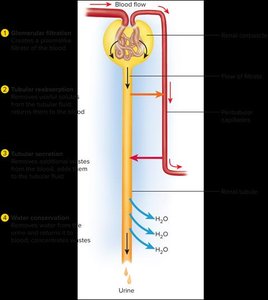
Tubular Reabsorption and Secretion
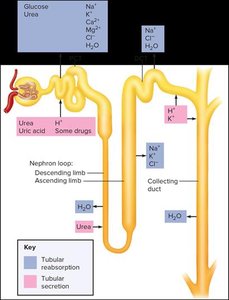
Tubular reabsorption and secretion occur throughout the nephron, including the proximal convoluted tubule (PCT), nephron loop, and distal convoluted tubule (DCT). These processes are essential for maintaining homeostasis and removing wastes.
PCT: Reabsorbs about 65% of tubular fluid, including electrolytes, glucose, water, and some nitrogenous wastes. Also adds wastes from blood to the filtrate.
Nephron Loop: Generates an osmotic gradient for water reabsorption and reabsorbs water and salts. The thin segment is permeable to water, while the thick segment actively transports salts.
DCT: Regulates reabsorption of water and salts, influenced by hormones such as aldosterone and natriuretic peptides.
Tubular Secretion: Removes wastes, drugs, and excess ions from blood, contributing to acid-base balance.
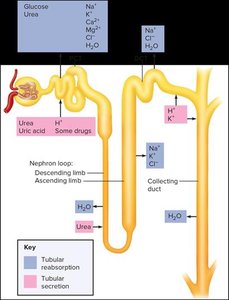
Proximal Convoluted Tubule (PCT)
The PCT is the primary site for reabsorption of most solutes and water from the filtrate. It also secretes certain wastes into the tubular fluid.
Electrolytes: Sodium is the most important ion, reabsorbed via transport proteins and sodium-potassium pumps. Chloride follows sodium by electrical attraction. Other ions such as potassium, magnesium, calcium, and phosphate are also reabsorbed.
Glucose: Reabsorbed by co-transport with sodium.
Water: About two-thirds of water is reabsorbed in the PCT.
Nitrogenous Wastes: Most are excreted in urine, but some are reabsorbed.
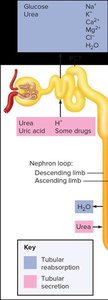
Nephron Loop (Loop of Henle)
The nephron loop is crucial for creating the osmotic gradient necessary for water conservation. It also reabsorbs water and salts.
Thin Segment: Permeable to water, allowing water to be reabsorbed.
Thick Segment: Contains active transporters for salts, contributing to the medullary osmotic gradient.
Countercurrent Multiplier: Recaptures salt and returns it to deep medullary tissue, making the medulla salty and facilitating water reabsorption in the collecting duct.
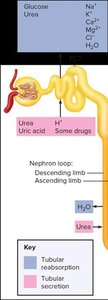
Distal Convoluted Tubule (DCT)
The DCT fine-tunes the reabsorption of water and salts, regulated by hormones.
Aldosterone: Increases sodium reabsorption when sodium is low, potassium is high, or blood pressure is low.
Natriuretic Peptides: Promote sodium and water excretion when blood pressure is high.
Fluid Composition: Fluid arriving at the DCT contains about 20% of water and 7% of salts from the original filtrate.
Tubular Secretion
Tubular secretion is the process of removing additional wastes and excess ions from the blood and adding them to the tubular fluid. This occurs mainly in the PCT and nephron loop.
Acid-Base Balance: Secretion of hydrogen and bicarbonate ions helps regulate blood pH.
Waste Removal: Removes metabolic wastes such as urea, uric acid, and drugs.
Drug Clearance: Many drugs are secreted into the tubular fluid for excretion.
Summary of Tubular Reabsorption and Secretion
Each segment of the nephron plays a distinct role in reabsorption and secretion, contributing to the overall function of the urinary system.
PCT: Reabsorbs 65% of filtrate.
Nephron Loop: Reabsorbs 25% of filtrate.
DCT: Reabsorbs additional sodium, chloride, and water.
Hormonal Control: Aldosterone and natriuretic peptides regulate reabsorption.
Secretion: Drugs, wastes, and other solutes are secreted into tubular fluid.
Collecting Duct and Water Conservation
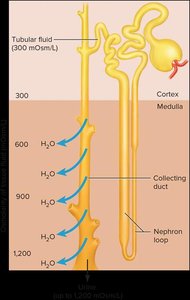
The collecting duct receives fluid from multiple nephrons and is responsible for concentrating urine by reabsorbing water. The osmolarity of the surrounding tissue and hormonal signals determine the amount of water reabsorbed.
Osmolarity: The medullary portion of the collecting duct is more permeable to water, allowing water to be reabsorbed as the tissue osmolarity increases.
Countercurrent Multiplier: The nephron loop continuously recaptures salt, maintaining a high osmolarity in the deep medulla.
Control of Water Loss
The concentration of urine is regulated by the body's hydration state and the hormone antidiuretic hormone (ADH).
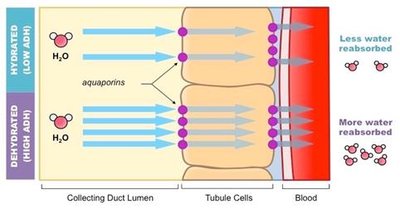
Dehydration: Increased blood osmolarity stimulates ADH release, causing collecting duct cells to produce aquaporins and reabsorb more water, resulting in concentrated urine.
Hydration: Low blood osmolarity inhibits ADH secretion, reducing aquaporin production and water reabsorption, resulting in dilute urine.
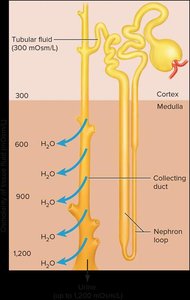
Summary of Water Conservation
The collecting duct adjusts water reabsorption based on the body's needs, regulated by ADH and the osmotic gradient created by the nephron loop.
Hydrated State: ADH is not secreted, less water is reabsorbed.
Dehydrated State: ADH is secreted, more water is reabsorbed.
Water Movement: Water moves via osmosis, driven by the medullary osmotic gradient.
Voiding Urine (Micturition)
Urine is transported from the kidneys to the bladder via the ureters. The process of urination, or micturition, is initiated by the micturition reflex.
Micturition Reflex: Filling of the bladder activates stretch receptors, sending signals to the micturition center in the pons.
Integration: The pons can integrate information from the cerebral cortex, allowing voluntary control over urination.
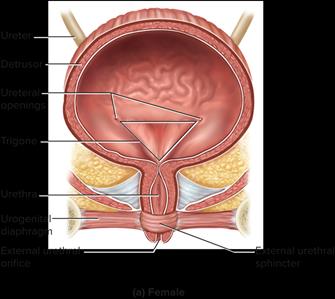
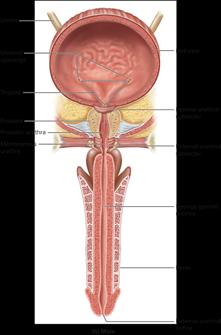
Bladder Anatomy: Includes the detrusor muscle, urethra, and sphincters.
Key Terms and Concepts
Glomerular Filtration Rate (GFR): The rate at which blood is filtered in the glomerulus, maintained by neural, hormonal, and local mechanisms.
Aldosterone: Hormone that increases sodium reabsorption in the DCT and collecting duct.
Antidiuretic Hormone (ADH): Hormone that increases water reabsorption in the collecting duct by promoting aquaporin production.
Countercurrent Multiplier: Mechanism in the nephron loop that maintains a high osmolarity in the medulla, facilitating water reabsorption.
Micturition: The act of urinating, controlled by reflex and voluntary mechanisms.
Relevant Equations
Osmosis: Water movement across a semipermeable membrane is driven by osmotic gradients.
Glomerular Filtration Rate (GFR): Where: = Filtration coefficient = Glomerular capillary hydrostatic pressure = Bowman's space hydrostatic pressure = Glomerular capillary oncotic pressure
Additional info: Academic context and explanations have been expanded for clarity and completeness.
