 Indietro
The Urinary System: Tubular Reabsorption, Secretion, and Water Conservation
Guida di studio - Note intelligenti
 Appunti personalizzati basati sui tuoi materiali, ampliati con definizioni chiave, esempi e contesto.
The Urinary System: Tubular Reabsorption, Secretion, and Water Conservation
Overview of Renal Processes
The urinary system is responsible for filtering blood, removing waste, and regulating water and electrolyte balance. The nephron, the functional unit of the kidney, performs these tasks through glomerular filtration, tubular reabsorption, tubular secretion, and water conservation.
Glomerular Filtration: Driven by high blood pressure in glomerular capillaries, allowing water and most solutes to enter the capsular space while retaining blood cells and large proteins in the bloodstream.
Tubular Reabsorption: The process by which useful substances are reclaimed from the filtrate and returned to the blood.
Tubular Secretion: The addition of waste and excess substances from the blood into the tubular fluid.
Water Conservation: Adjusts water reabsorption to maintain body fluid balance.
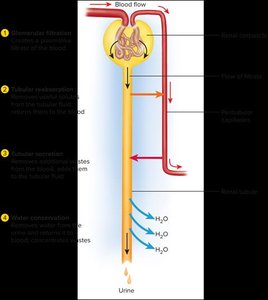
Tubular Reabsorption and Secretion
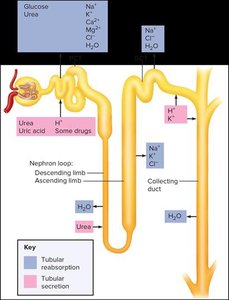
Tubular reabsorption and secretion occur throughout the nephron, including the proximal convoluted tubule (PCT), nephron loop, and distal convoluted tubule (DCT). These processes are essential for maintaining homeostasis and removing waste.
PCT: Reabsorbs about 65% of tubular fluid, including electrolytes, glucose, water, and some nitrogenous wastes. Also adds wastes from blood to the filtrate.
Nephron Loop: Generates an osmotic gradient for water reabsorption and reabsorbs water and salts. The thin segment is permeable to water, while the thick segment actively transports salts.
DCT: Regulates reabsorption of water and salts, influenced by hormones such as aldosterone and natriuretic peptides.
Tubular Secretion: Removes wastes, drugs, and excess ions from blood, contributing to acid-base balance.
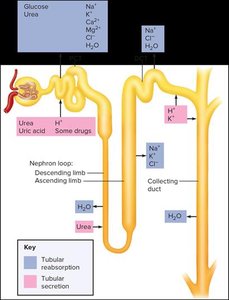
Proximal Convoluted Tubule (PCT)
The PCT is the primary site for reabsorption of most solutes and water from the filtrate. It also secretes certain wastes into the tubular fluid.
Electrolytes: Sodium is key, with transport proteins facilitating uptake. Sodium-potassium pumps move sodium into the extracellular fluid, and chloride follows by electrical attraction. Other ions such as potassium, magnesium, calcium, and phosphate are reabsorbed by transport proteins.
Glucose: Co-transported with sodium.
Water: About two-thirds reabsorbed by the PCT.
Nitrogenous Wastes: Most are excreted in urine, but some are reabsorbed.
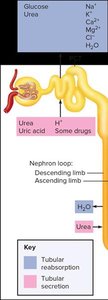
Nephron Loop (Loop of Henle)
The nephron loop is crucial for creating the osmotic gradient necessary for water conservation. It consists of descending and ascending limbs with distinct permeability characteristics.
Descending Limb: Permeable to water, allowing water to be reabsorbed.
Ascending Limb: Actively transports salts into the medullary tissue, contributing to the osmotic gradient.
Countercurrent Multiplier: The loop continuously recaptures salt and returns it to deep medullary tissue, making the medulla salty and facilitating water reabsorption in the collecting duct.
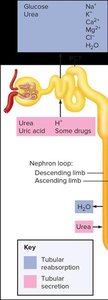
Distal Convoluted Tubule (DCT)
The DCT fine-tunes the reabsorption of water and salts, under hormonal control.
Aldosterone: Increases sodium reabsorption when sodium is low, potassium is high, or blood pressure is low.
Natriuretic Peptides: Promote sodium and water excretion when blood pressure is high.
Fluid Composition: Fluid arriving at the DCT contains about 20% of water and 7% of salts from the original filtrate.
Tubular Secretion
Tubular secretion is the process of removing additional wastes and excess ions from the blood and adding them to the tubular fluid. This occurs mainly in the PCT and nephron loop.
Acid-Base Balance: Secretion of hydrogen and bicarbonate ions helps regulate blood pH.
Waste Removal: Removes metabolic wastes such as urea, uric acid, and drugs.
Drug Clearance: Many drugs are secreted into the tubular fluid for excretion.
Summary of Tubular Reabsorption and Secretion
Each segment of the nephron plays a distinct role in reabsorption and secretion, ensuring efficient waste removal and homeostasis.
PCT: Reabsorbs 65% of filtrate.
Nephron Loop: Reabsorbs 25% of filtrate.
DCT: Reabsorbs additional sodium, chloride, and water.
Hormonal Control: Aldosterone and natriuretic peptides regulate reabsorption.
Secretion: Drugs, wastes, and other solutes are secreted into tubular fluid.
Collecting Duct and Water Conservation
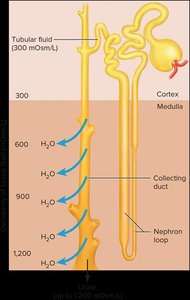
The collecting duct receives fluid from multiple nephrons and is responsible for concentrating urine by reabsorbing water. The osmolarity of the surrounding medullary tissue is higher, driving water reabsorption.
Osmolarity: Tubular fluid enters the collecting duct at ~300 mOsm/L. The medullary portion is more permeable to water than solutes.
Countercurrent Multiplier: The nephron loop maintains a high salt concentration in the deep medulla, facilitating water reabsorption.
Control of Water Loss
The concentration of urine depends on the body's hydration state and is regulated by antidiuretic hormone (ADH).
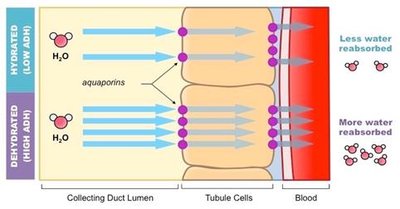
Dehydration: Increased blood osmolarity stimulates ADH release, causing collecting duct cells to produce aquaporins and reabsorb more water, resulting in concentrated urine.
Hydration: Low blood osmolarity inhibits ADH secretion, reducing aquaporin production and water reabsorption, resulting in dilute urine.
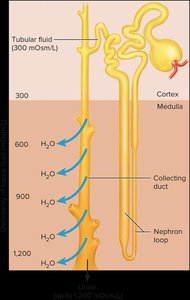
Summary of Water Conservation
The collecting duct adjusts water reabsorption based on the body's needs, with water moving via osmosis. The deep medulla's high salt concentration, maintained by the countercurrent multiplier, is essential for water conservation.
Hydrated State: ADH is not secreted; less water is reabsorbed.
Dehydrated State: ADH is secreted; more water is reabsorbed.
Voiding Urine (Micturition)
Urine is transported to the bladder via the ureters. Micturition, or urination, is initiated by the micturition reflex, which is triggered by stretch receptors in the bladder wall.
Micturition Reflex: Filling of the bladder excites stretch receptors, sending signals to the micturition center in the pons.
Integration: The pons can integrate information from the cerebral cortex, allowing voluntary control over urination.
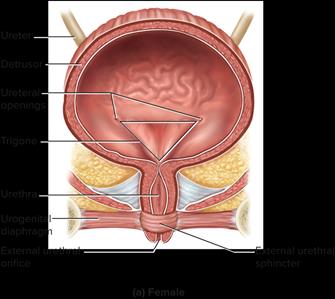
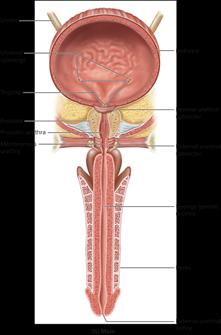
Bladder Anatomy: Includes the detrusor muscle, ureteral openings, trigone, urethra, and sphincters.
Key Terms and Concepts
Glomerular Filtration Rate (GFR): The rate at which blood is filtered in the glomerulus, maintained by neural, hormonal, and local mechanisms.
Aldosterone: Hormone that increases sodium and water reabsorption.
Antidiuretic Hormone (ADH): Hormone that increases water reabsorption in the collecting duct.
Countercurrent Multiplier: Mechanism in the nephron loop that maintains a high salt concentration in the medulla.
Micturition: The act of urinating, controlled by reflex and voluntary mechanisms.
Relevant Equations
Osmosis: Water movement across a semipermeable membrane is driven by osmotic gradients.
Glomerular Filtration Rate (GFR): Where: = Filtration coefficient = Glomerular capillary hydrostatic pressure = Bowman's space hydrostatic pressure = Glomerular capillary oncotic pressure
Additional info: Academic context was added to clarify the roles of nephron segments, hormonal regulation, and the mechanisms of water conservation and micturition.
