 Indietro
The Urinary System: Tubular Reabsorption, Secretion, Water Conservation, and Voiding
Guida di studio - Note intelligenti
 Appunti personalizzati basati sui tuoi materiali, ampliati con definizioni chiave, esempi e contesto.
The Urinary System: Tubular Reabsorption, Secretion, Water Conservation, and Voiding
Overview of Renal Processes
The urinary system is essential for maintaining homeostasis by filtering blood, reabsorbing necessary substances, secreting wastes, and regulating water balance. The nephron is the functional unit responsible for these processes.
Glomerular Filtration: Driven by high blood pressure in glomerular capillaries, allowing water and most solutes to enter the capsular space while retaining blood cells and large proteins in the bloodstream.
Tubular Reabsorption: Movement of substances from the filtrate back into the blood.
Tubular Secretion: Addition of wastes and other substances from blood into the filtrate.
Water Conservation: Regulation of water reabsorption to concentrate urine.
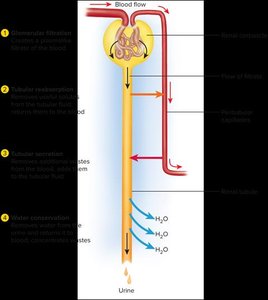
Tubular Reabsorption and Secretion
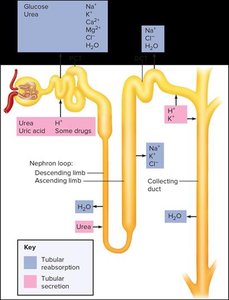
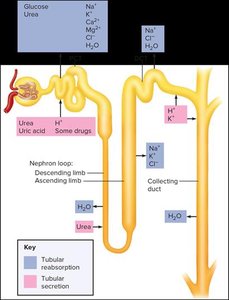
Tubular reabsorption and secretion occur throughout the nephron, including the proximal convoluted tubule (PCT), nephron loop, and distal convoluted tubule (DCT). These processes are vital for adjusting the composition of urine and maintaining internal balance.
Tubular Reabsorption: Substances such as electrolytes, glucose, water, and some nitrogenous wastes are reabsorbed into the blood.
Tubular Secretion: Wastes, drugs, and excess ions are secreted from the blood into the tubular fluid. Taking things out and throwing them away!
Both processes: Occur simultaneously and are regulated by transport proteins and hormonal signals.
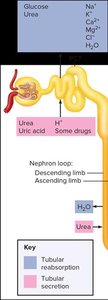
Proximal Convoluted Tubule (PCT)
The PCT reabsorbs about 65% of the filtrate and is a major site for the reabsorption of electrolytes, glucose, water, and some nitrogenous wastes. It also adds wastes from the blood to the filtrate at the same time. This is why it is so long and contains microvilli (for absorption).
It reabsorbs:
Electrolytes: Sodium is key; transport proteins facilitate sodium uptake, and sodium-potassium pumps move sodium into the extracellular fluid (EFC). Chloride follows sodium by electrical attraction. Other ions (K+, Mg2+, Ca2+, phosphate) are reabsorbed by specific transport proteins.
Glucose: Co-transported with sodium. Glucose should NOT be present in urine.
Water: About two-thirds reabsorbed by the PCT.
Nitrogenous wastes: Most are excreted in urine, but some are reabsorbed. Waste is kept at a safe level.
Nephron Loop (Loop of Henle)
The nephron loop generates an osmotic gradient that enables the collecting duct to reabsorb water.
It also reabsorbs water and salts, with the thin segment permeable to water and the thick segment actively transporting salts.
Descending limb: Permeable to water, allowing water reabsorption. This segment is thin.
Ascending limb: Active transport of salts into medullary tissue, contributing to the osmotic gradient. There are lots of mitochondria present here to keep the medulla salty.
Distal Convoluted Tubule (DCT)
Fluid arriving at the DCT contains about 20% of water and 7% of salts from the original filtrate. The DCT is regulated by hormones such as aldosterone and natriuretic peptides.
Aldosterone: Increases sodium reabsorption when sodium is low, potassium is high, or blood pressure is low.
Natriuretic peptides: Promote sodium excretion when blood pressure is high. Opposite effects of aldosterone.
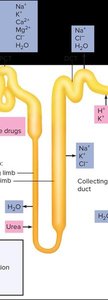
Tubular Secretion
Tubular secretion extracts wastes from the blood and adds them to the tubular filtrate, primarily in the PCT and nephron loop. This process serves three main purposes:
Acid-base balance: Secretion of hydrogen and bicarbonate ions helps regulate blood pH.
Waste removal: Removes metabolic wastes and toxins.
Drug clearance: Eliminates drugs and other foreign substances. This is why we have to take some drugs more frequently.
Summary of Tubular Reabsorption and Secretion
PCT reabsorbs 65% of glomerular filtrate and returns it to the blood.
Nephron loop reabsorbs another 25% of filtrate.
DCT reabsorbs more Na+, Cl-, and water, regulated by hormones.
Drugs, wastes, and other solutes are secreted into tubular fluid.
Collecting Duct and Water Conservation
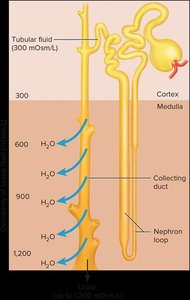
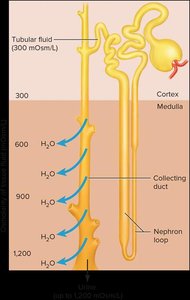
The collecting duct receives tubular fluid from multiple nephrons and is responsible for reabsorbing water and concentrating urine. The osmolarity of the surrounding tissue is higher, especially in the deep medulla, which drives water reabsorption.
Osmolarity: The medullary portion of the collecting duct is more permeable to water than solutes, allowing water to be reabsorbed by osmosis.
Countercurrent multiplier: The nephron loop continuously recaptures salt and returns it to deep medullary tissue, maintaining the osmotic gradient.
Control of Water Loss
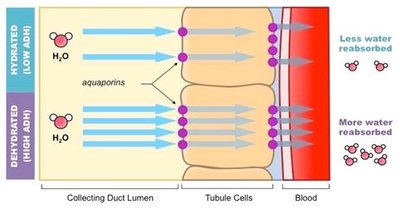
The concentration of urine depends on the body's hydration state. Antidiuretic hormone (ADH) plays a key role in regulating water reabsorption in the collecting duct.
Dehydration: Increased blood osmolarity stimulates ADH release, causing cells of the collecting duct to produce aquaporins, which increase water reabsorption and concentrate urine.
Hydration: Low blood osmolarity inhibits ADH secretion, reducing aquaporin production, resulting in less water reabsorption and more dilute urine.
Summary of Water Conservation
The collecting duct adjusts water reabsorption based on the body's needs.
ADH is secreted when dehydrated, increasing water reabsorption.
ADH is not secreted when hydrated, decreasing water reabsorption.
Water moves via osmosis, and the deep medulla is salty due to the countercurrent multiplier.
Voiding Urine (Micturition)
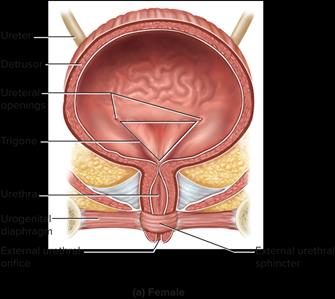
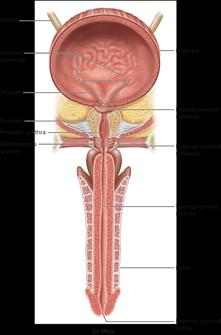
Urine is carried to the bladder via the ureters. Micturition, or urination, is initiated by the micturition reflex. Filling of the bladder excites stretch receptors in the bladder wall, which send signals to the micturition center in the pons. The process can be influenced by voluntary control from the cerebral cortex.
Bladder anatomy: Includes the detrusor muscle, ureteral openings, trigone, urethra, and sphincters.
Micturition reflex: Integrates signals from stretch receptors and the brain to control urination.
Key Terms and Concepts
Glomerular Filtration Rate (GFR): The rate at which blood is filtered in the glomerulus, maintained by neural, hormonal, and local mechanisms.
Aldosterone: Hormone that increases sodium and water reabsorption.
Natriuretic Peptides: Hormones that promote sodium excretion.
Antidiuretic Hormone (ADH): Hormone that increases water reabsorption in the collecting duct.
Aquaporins: Water channels in collecting duct cells regulated by ADH.
Micturition: The act of urinating, controlled by reflex and voluntary mechanisms.
Summary Table: Tubular Reabsorption and Secretion
Nephron Segment | Reabsorbed Substances | Secreted Substances |
|---|---|---|
PCT | Na+, Cl-, K+, Mg2+, Ca2+, Phosphate, Glucose, Water | H+, Urea, Drugs |
Nephron Loop | Water (descending), Na+, Cl- (ascending) | Urea |
DCT | Na+, Cl-, Water (regulated by hormones) | K+, H+ |
Collecting Duct | Water (regulated by ADH) | K+, H+ |
Equations
Osmosis: Water movement across membranes is driven by osmotic gradients.
Glomerular Filtration Rate (GFR): Where is the filtration coefficient, is glomerular capillary pressure, is Bowman's space pressure, and is glomerular capillary oncotic pressure.
Additional info: Academic context was added to clarify the mechanisms of hormone regulation, osmotic gradients, and the anatomy of the bladder for completeness.
