 Indietro
Transport Mechanisms and Diffusion in Cells – Guided Study
Guida di studio - Note intelligenti
 Appunti personalizzati basati sui tuoi materiali, ampliati con definizioni chiave, esempi e contesto.
Q1a. In what units might the rate of diffusion be measured?
Background
Topic: Membrane Transport & Diffusion
This question is testing your understanding of how the rate of diffusion is quantified in biological systems, particularly in the context of molecules moving across a membrane.
Key Terms:
Rate of diffusion: The amount of substance moving per unit time across a membrane.
Concentration gradient: The difference in concentration of a substance across a space or membrane.
Step-by-Step Guidance
Think about what is being measured: the amount of glucose entering the cell over a certain period.
Consider the typical units for amount (e.g., moles, molecules, grams) and for time (e.g., seconds, minutes).
Combine these to form a rate (amount per unit time).
Try solving on your own before revealing the answer!
Final Answer:
The rate of diffusion is typically measured in units such as moles per second (), molecules per second, or mass per second (). Sometimes, it may also be expressed as amount per unit area per unit time (e.g., ) if surface area is considered.
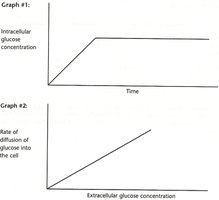
Q1b. Is glucose moving into the artificial cell by diffusion or by protein-mediated transport or can you tell from these graphs? If it is mediated transport, is it active or passive?
Background
Topic: Types of Membrane Transport
This question asks you to interpret experimental data to determine the mechanism by which glucose enters the cell, and whether energy is required for this process.
Key Terms:
Simple diffusion: Movement of molecules directly through the lipid bilayer, down their concentration gradient, without assistance.
Facilitated diffusion: Movement of molecules across a membrane via protein channels or carriers, down their concentration gradient, without energy input.
Active transport: Movement of molecules against their concentration gradient, requiring energy (usually ATP).
Step-by-Step Guidance
Examine Graph #1: Notice how the intracellular glucose concentration increases and then levels off over time.
Examine Graph #2: Observe how the rate of diffusion increases linearly with extracellular glucose concentration.
Recall that simple diffusion typically shows a linear increase in rate with concentration, while protein-mediated transport (especially facilitated diffusion) can show saturation at high concentrations.
Consider whether the data suggest a limit to the rate of glucose entry (saturation), which would indicate protein-mediated transport.
Try solving on your own before revealing the answer!
Final Answer:
Based on the graphs, glucose appears to be moving into the cell by simple diffusion. The rate of diffusion increases linearly with extracellular concentration (Graph #2), which is characteristic of simple diffusion, not protein-mediated transport (which would show a plateau due to saturation). Therefore, it is not mediated transport, and no energy input is required.
Q1c. Why does the line in graph #1 level off?
Background
Topic: Diffusion Equilibrium
This question tests your understanding of what happens when diffusion reaches equilibrium across a membrane.
Key Terms:
Equilibrium: The state where the concentration of a substance is equal on both sides of the membrane, so there is no net movement.
Net movement: The overall movement of molecules from one side to the other.
Step-by-Step Guidance
Recall that diffusion continues until the concentration of glucose is equal inside and outside the cell.
Once equilibrium is reached, the net movement of glucose stops, even though individual molecules may still move back and forth.
Think about how this would appear on a graph of intracellular glucose concentration over time.
Try solving on your own before revealing the answer!
Final Answer:
The line in graph #1 levels off because the system has reached equilibrium. At this point, the concentration of glucose inside the cell is equal to that outside, so there is no net movement of glucose into the cell.
Q2. Complete the table below for each transport method:
Background
Topic: Types of Membrane Transport Mechanisms
This question asks you to compare and contrast different types of membrane transport: simple diffusion, facilitated diffusion, primary active transport, and secondary active transport.
Key Terms and Concepts:
Simple diffusion: Passive movement through the lipid bilayer.
Facilitated diffusion: Passive movement via protein channels or carriers.
Primary active transport: Direct use of ATP to move substances against their gradient.
Secondary active transport: Uses the energy from another gradient (often created by primary active transport) to move substances.
Specificity, competition, saturation: Properties of protein-mediated transport.
Step-by-Step Guidance
For each method, identify whether movement is with or against the concentration gradient.
Determine the energy source (e.g., ATP, concentration gradient, none).
List factors that affect the rate (e.g., concentration gradient, number of transporters).
Decide if the method uses the membrane bilayer or a protein transporter.
Indicate whether the method exhibits specificity, competition, and saturation.
Provide a biological example for each method (e.g., O2 for simple diffusion, glucose for facilitated diffusion, Na+/K+ pump for primary active transport, glucose/Na+ cotransport for secondary active transport).
Try solving on your own before revealing the answer!
Final Answer:
Method | Movement Relate to Concentration Gradient | Energy Source | What Affects Rate? | Through Membrane Bilayer or Through Protein Transporter? | Exhibits Specificity? | Exhibits Competition? | Exhibits Saturation? | Example |
|---|---|---|---|---|---|---|---|---|
Simple Diffusion | Down gradient | None | Concentration gradient, membrane permeability | Bilayer | No | No | No | O2, CO2 |
Facilitated Diffusion | Down gradient | None | Concentration gradient, number of transporters | Protein transporter | Yes | Yes | Yes | Glucose transporters |
Primary Active Transport | Against gradient | ATP | Number of pumps, ATP availability | Protein transporter | Yes | Yes | Yes | Na+/K+ ATPase |
Secondary Active Transport | Against gradient (for one substance) | Energy from another gradient | Gradient of driving ion, number of transporters | Protein transporter | Yes | Yes | Yes | Glucose/Na+ cotransport |
