 Indietro
Tubular Reabsorption and Secretion in the Urinary System
Guida di studio - Note intelligenti
 Appunti personalizzati basati sui tuoi materiali, ampliati con definizioni chiave, esempi e contesto.
The Urinary System: Tubular Reabsorption and Secretion
Overview of Tubular Reabsorption
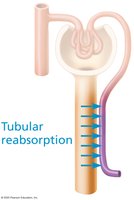
Tubular reabsorption is a critical process in the formation of urine, allowing the body to reclaim essential substances from the filtrate produced by the kidneys. This process ensures that nutrients, ions, and water are conserved, while waste products are excreted.
Tubular reabsorption occurs primarily in the renal tubules and collecting ducts.
It involves the movement of substances from the filtrate back into the blood.
Reabsorption is selective and can be active or passive.
Transcellular and Paracellular Routes of Reabsorption
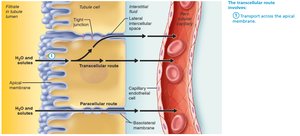
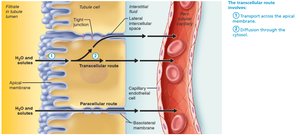
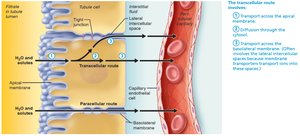
Substances can be reabsorbed by two main pathways: transcellular and paracellular. Each route involves distinct mechanisms and cellular structures.
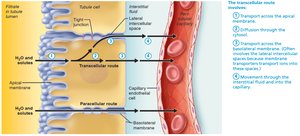
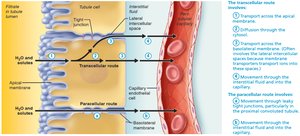
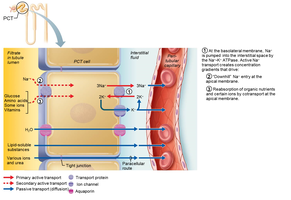
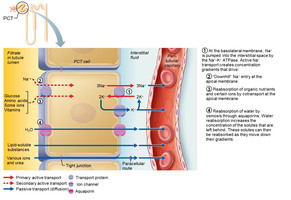
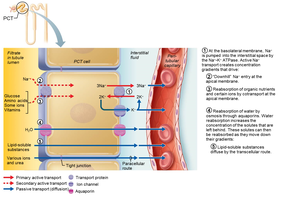
Transcellular route: Substances pass through the tubule cell, crossing both the apical and basolateral membranes.
Paracellular route: Substances move between tubule cells, typically through tight junctions.
Both routes ultimately deliver reabsorbed substances to the peritubular capillaries.
Tubular Reabsorption of Sodium
Sodium (Na+) is the most abundant cation in the filtrate and its reabsorption is essential for maintaining fluid and electrolyte balance.
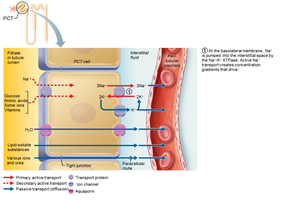
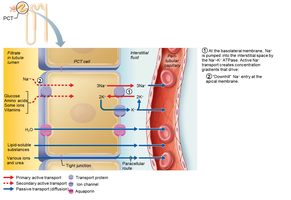
Primary active transport: Na+ is transported across the basolateral membrane of tubule cells by the Na+-K+ ATPase pump.
This creates a concentration gradient that drives the reabsorption of other substances.
Tubular Reabsorption of Nutrients, Water, and Ions
Reabsorption of nutrients, water, and ions occurs through both active and passive mechanisms. Water reabsorption is tightly regulated and involves specialized channels called aquaporins.
Passive tubular reabsorption of water: Water is reabsorbed by osmosis, facilitated by aquaporins.
Obligatory water reabsorption: Aquaporins are always present in the proximal convoluted tubule (PCT).
Facultative water reabsorption: Aquaporins are inserted in the collecting ducts only if antidiuretic hormone (ADH) is present.
Reabsorptive Capabilities of Renal Tubules and Collecting Ducts
Different segments of the renal tubules and collecting ducts have distinct reabsorptive capabilities, regulated by hormones and intrinsic properties.
Proximal convoluted tubule (PCT): Site of most reabsorption; all nutrients (glucose, amino acids), 65% of Na+ and water, and many ions are reabsorbed.
Nephron loop: Descending limb allows water to leave, but not solutes; ascending limb allows solutes to leave, but not water.
Distal convoluted tubule (DCT) and collecting duct: Reabsorption is hormonally regulated.
Hormonal Regulation
Antidiuretic hormone (ADH): Released by the posterior pituitary; increases water reabsorption by inserting aquaporins in collecting duct cells.
Aldosterone: Targets collecting ducts and DCT; increases Na+ reabsorption and K+ secretion, leading to increased blood pressure.
Atrial natriuretic peptide (ANP): Released by cardiac atrial cells when blood volume or pressure is elevated; reduces blood Na+, decreasing blood volume and pressure.
Parathyroid hormone (PTH): Acts on DCT to increase Ca2+ reabsorption.
Summary of Tubular Reabsorption
Tubular reabsorption is a complex, highly regulated process that ensures the conservation of essential substances and the maintenance of homeostasis.
Table: Reabsorption Capabilities of Different Segments of the Renal Tubules and Collecting Ducts
Segment | Substances Reabsorbed | Mechanism | Hormonal Regulation |
|---|---|---|---|
Proximal Convoluted Tubule (PCT) | Glucose, amino acids, Na+, water, ions | Active and passive transport | None |
Nephron Loop (Descending Limb) | Water | Passive (osmosis) | None |
Nephron Loop (Ascending Limb) | Na+, Cl-, K+ | Active transport | None |
Distal Convoluted Tubule (DCT) | Na+, Ca2+, water | Active and passive transport | Aldosterone, PTH, ADH |
Collecting Duct | Na+, water, urea | Active and passive transport | Aldosterone, ADH, ANP |
Tubular Secretion
Tubular secretion is the process by which substances are added to the filtrate from the blood, allowing for the removal of excess ions, metabolic wastes, and drugs.
Key substances secreted: H+, K+, NH4+, creatinine, and certain drugs.
Secretion helps regulate blood pH and eliminate unwanted substances.
Additional info:
Tubular secretion is essential for acid-base balance and the excretion of toxins.
It occurs mainly in the PCT, DCT, and collecting ducts.
