 Indietro
Urinary Physiology: Mechanisms of Urine Formation and Regulation (Module 8: Part 2)
Guida di studio - Note intelligenti
 Appunti personalizzati basati sui tuoi materiali, ampliati con definizioni chiave, esempi e contesto.
Urinary Physiology
Overview of Urine Formation
The urinary system is responsible for removing waste products from the blood and maintaining homeostasis of body fluids. The kidneys play a central role in filtering blood, reabsorbing useful substances, and excreting waste in the form of urine.
Waste Products: The main wastes removed include urea, creatinine, and uric acid.
Urine Concentration: Urine can be concentrated up to four times the solute concentration of blood, depending on the body's needs.
Reabsorption: The kidneys must reabsorb essential materials such as water, glucose, and ions to prevent their loss.
Steps of Urine Formation
Urine formation involves three main processes: filtration, reabsorption, and secretion.
Filtration: Blood is filtered at the glomerulus, producing glomerular filtrate.
Reabsorption: Useful substances are reabsorbed from the filtrate back into the blood.
Secretion: Additional wastes are secreted from the blood into the tubular fluid.
Filtration Mechanisms
Structure of the Filtration Membrane
The filtration membrane in the glomerulus consists of several layers that selectively allow passage of substances.
Glomerular Endothelium: Contains fenestrations (pores) for rapid filtration.
Dense Layer: Acts as a barrier to large molecules.
Filtration Slits: Formed by podocyte pedicels and slit membranes, further restricting passage.
Filtration Pressures and Glomerular Filtration Rate (GFR)
Filtration is driven by several pressures:
Glomerular Blood Hydrostatic Pressure (GHP): Promotes filtration.
Capsular Hydrostatic Pressure (CsHP): Opposes filtration.
Blood Colloid Osmotic Pressure (BCOP): Opposes filtration.
Net Filtration Pressure (NFP): Determines the overall filtration rate.
Glomerular Filtration Rate (GFR): The volume of filtrate produced per minute.
Equation:
Regulation of GFR
Autoregulation
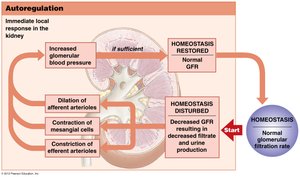
Autoregulation is the kidney's intrinsic ability to maintain a stable GFR despite fluctuations in blood pressure. It involves changes in the diameter of afferent and efferent arterioles and contraction of mesangial cells.
Myogenic Mechanism: Responds to changes in blood pressure by adjusting arteriole diameter.
Tubuloglomerular Feedback: Senses changes in flow and adjusts filtration accordingly.
Hormonal Regulation
Renin-Angiotensin-Aldosterone (RAA) System: Increases GFR and sodium reabsorption.
Atrial Natriuretic Peptide (ANP) & Brain Natriuretic Peptide (BNP): Decrease GFR and promote sodium excretion.
Neural Regulation
Sympathetic Nervous System: Can decrease GFR during stress or blood loss.
Reabsorption and Secretion Mechanisms
Types of Transport
Substances are reabsorbed or secreted via active and passive mechanisms:
Active Transport: Requires energy (ATP); includes primary and secondary active transport.
Passive Transport: Includes diffusion and osmosis.
Obligatory Reabsorption: Always occurs, regardless of body needs.
Facultative Reabsorption: Regulated by hormones, occurs as needed.
Transport Maximum (Tm): The maximum rate at which a substance can be reabsorbed.
Proximal Convoluted Tubule (PCT)
The PCT is the primary site for reabsorption of water, ions, and nutrients.
Na+ Transport: Occurs via symporters and antiporters.
Passive Processes: Diffusion and osmosis, facilitated by aquaporin-1 channels.
Nephron Loop and Distal Convoluted Tubule (DCT)
Further reabsorption and secretion occur in the nephron loop and DCT.
Nephron Loop: Water reabsorption via aquaporin-1; Na+-K+-2Cl- symporters.
DCT: Na+-Cl- symporters; Na+-K+, Na+-H+, and Na+-NH4+ antiporters.
Collecting Duct
The collecting duct is the final site for regulation of water and ion reabsorption.
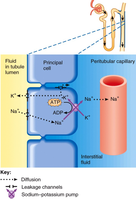
Na+ Leakage Channels: Allow passive movement of sodium.
Principal Cells: Regulate sodium and water reabsorption.
Intercalated Cells: Involved in acid-base balance.
Hormonal Regulation of Urine Formation
Key Hormones
RAA System: Increases sodium and water reabsorption.
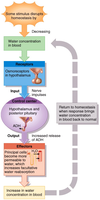
Antidiuretic Hormone (ADH): Increases water reabsorption via aquaporin-2 channels in the collecting duct.
ANP & BNP: Promote excretion of sodium and water, reducing blood volume.
Dilute and Concentrated Urine
Dilute Urine
Dilute urine is produced when the body needs to excrete excess water. The collecting duct becomes less permeable to water, resulting in low urine concentration.
Concentrated Urine
Concentrated urine is produced when the body needs to conserve water. This process relies on the osmotic gradient in the renal medulla, permeability changes, and the countercurrent multiplier mechanism.
Osmotic Gradient: Created by Na+, Cl-, and urea in the medulla.
Countercurrent Multiplier: Enhances the concentration of urine by creating a gradient for water reabsorption.
Example: During dehydration, ADH increases, making the collecting duct more permeable to water, resulting in concentrated urine.
Additional info: Academic context was added to clarify mechanisms and provide definitions for key terms, as well as to ensure completeness for exam preparation.
