 Indietro
Urinary System: Filtration, Secretion, Concentration, and Elimination
Guida di studio - Note intelligenti
 Appunti personalizzati basati sui tuoi materiali, ampliati con definizioni chiave, esempi e contesto.
Urine Composition
Overview of Urine Constituents
Urine is a waste product formed by the kidneys and consists primarily of water and dissolved solutes. Its composition reflects both normal metabolic processes and the health of the urinary system.
Water: Makes up about 95% of urine volume.
Nitrogenous wastes: Includes urea (from amino acid breakdown via the urea cycle in the liver), uric acid (from nucleic acid metabolism), and creatinine (from creatine phosphate metabolism in muscles).
Ions: Sodium (Na+), potassium (K+), phosphate (PO43–), sulfate (SO42–), calcium (Ca2+), magnesium (Mg2+), and bicarbonate (HCO3–).
Abnormal constituents: Presence of blood proteins, white blood cells, or abnormally high concentrations of any solute may indicate pathology.
Creatinine and Kidney Function
Creatinine is a breakdown product of creatine phosphate, which is synthesized in the liver, kidneys, and pancreas and transported to skeletal muscles for energy.
Creatinine: Filtered by the kidneys and used clinically to assess kidney function.
Tubular Secretion
Definition and Process
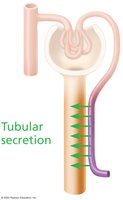
Tubular secretion is the process by which substances are transported from the peritubular capillaries into the renal tubule, effectively removing them from the blood and adding them to the filtrate for excretion.
Occurs mainly in: Proximal convoluted tubule (PCT).
Mechanism: Reabsorption in reverse; substances move from blood through tubule cells into filtrate.
Functions of Tubular Secretion
Tubular secretion is essential for maintaining homeostasis and removing unwanted substances.
Drug disposal: Eliminates drugs and metabolites.
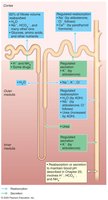
Removal of wastes: Urea and uric acid are secreted.
Potassium regulation: Excess K+ is secreted under the influence of aldosterone.
Blood pH control: Adjusts H+ and HCO3– levels in urine to regulate pH.
Regulation of Urine Concentration and Volume
Countercurrent Mechanisms
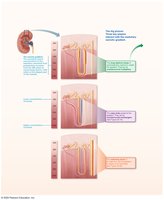
The kidneys use countercurrent mechanisms to create and maintain a medullary osmotic gradient, which is crucial for concentrating urine.
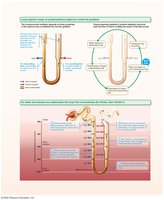
Countercurrent multiplier: Creates the gradient in the loop of Henle.
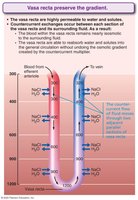
Countercurrent exchanger: Preserves the gradient via the vasa recta.
Collecting ducts: Use the gradient to adjust urine concentration.
Medullary Osmotic Gradient
The medullary osmotic gradient is established by the differential permeability and active transport of solutes in the nephron.
Descending limb: Permeable to water, not solutes.
Ascending limb: Permeable to solutes, not water.
Result: Increasing osmolarity deeper in the medulla.
Countercurrent Exchange
The vasa recta preserves the medullary gradient by exchanging water and solutes without dissipating the gradient.
Highly permeable: Allows for efficient exchange.
Maintains osmolarity: Prevents washout of the gradient.
Mechanisms for Forming Dilute and Concentrated Urine
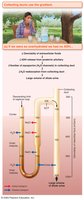
Dilute Urine Formation
When the body needs to excrete excess water, the kidneys produce dilute urine.
Low ADH: Collecting ducts remain impermeable to water.
Large volume: Water is not reabsorbed, resulting in dilute urine.
Concentrated Urine Formation
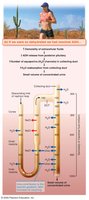
When water conservation is necessary, the kidneys produce concentrated urine.
High ADH: Collecting ducts become permeable to water.
Small volume: Water is reabsorbed, resulting in concentrated urine.
Diuretics
Definition and Types
Diuretics are chemicals that increase urinary output by affecting kidney function.
ADH inhibitors: Alcohol reduces ADH, increasing urine output.
Na+ reabsorption inhibitors: Caffeine and certain drugs inhibit sodium and water reabsorption.
Clinical use: Used to treat hypertension and edema.
Abnormal Urinary Constituents
Table: Abnormal Urinary Constituents
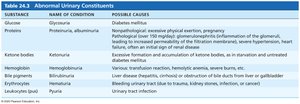
The presence of abnormal substances in urine can indicate various pathological conditions.
Substance | Name of Condition | Possible Causes |
|---|---|---|
Glucose | Glycosuria | Diabetes mellitus |
Proteins | Proteinuria, albuminuria | Physical exertion, pregnancy, kidney disease, hypertension, heart failure |
Ketone bodies | Ketonuria | Starvation, diabetes mellitus |
Hemoglobin | Hemoglobinuria | Transfusion reaction, hemolysis, burns |
Bile pigments | Bilirubinuria | Liver disease, obstruction of bile ducts |
Erythrocytes | Hematuria | Bleeding urinary tract, trauma, infection, cancer |
Leukocytes | Pyuria | Urinary tract infection |
Transport, Storage, and Elimination of Urine
Urinary Bladder Anatomy
The urinary bladder is a muscular sac that temporarily stores urine before elimination.
Muscular layer: Detrusor muscle (smooth muscle).
Rugae: Folds that appear when the bladder is empty.
Expansion: Bladder expands and rises superiorly during filling.
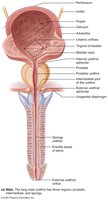
Urethra and Sphincters
The urethra is a muscular tube that drains urine from the bladder.
Internal sphincter: Involuntary, smooth muscle at bladder-urethra junction.
External sphincter: Voluntary, skeletal muscle surrounding urethra.
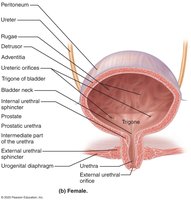
Micturition (Urination)
Process and Control
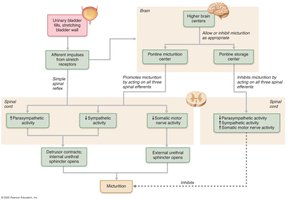
Micturition is the act of voiding urine from the bladder. It involves both involuntary and voluntary neural control.
Bladder distension: Activates stretch receptors.
Detrusor contraction: Controlled by the autonomic nervous system (ANS).
Internal sphincter opening: ANS control.
External sphincter opening: Somatic nervous system control.
Neural Control of Micturition
The micturition reflex is regulated by spinal and higher brain centers.
Spinal cord: Integrates basic reflex.
Higher brain centers: Can inhibit or promote micturition.
Summary
Key Concepts
The urinary system maintains homeostasis by filtering blood, secreting wastes, regulating urine concentration, and controlling elimination.
Abnormal urine constituents can indicate disease.
Urine formation and elimination involve complex anatomical and physiological processes.
Example
Clinical assessment of creatinine levels is used to evaluate kidney function.
Presence of glucose in urine is a diagnostic indicator for diabetes mellitus.
Additional info: Expanded explanations and context were added to ensure completeness and academic quality.
