 Indietro
Whole Muscle Physiology: Skeletal Muscle Contraction and Mechanics
Guida di studio - Note intelligenti
 Appunti personalizzati basati sui tuoi materiali, ampliati con definizioni chiave, esempi e contesto.
Muscle Contraction and ATP Utilization
Key Proteins Using ATP in Muscle Contraction and Relaxation
Skeletal muscle contraction and relaxation require a continuous supply of ATP, which is utilized by several key proteins:
Myosin ATPase: Catalyzes ATP hydrolysis during muscle contraction, powering the myosin head movement.
SERCA Pump (Ca2+ ATPase): Transports calcium ions back into the sarcoplasmic reticulum during relaxation, using ATP.
Sodium-Potassium Pump (Na+/K+ ATPase): Restores ion gradients across the muscle cell membrane after action potentials, maintaining cellular excitability.
Sources of ATP in Skeletal Muscle
Muscle fibers utilize several metabolic pathways to generate ATP:
Phosphocreatine: Provides immediate, high-speed energy without requiring oxygen. It rapidly donates phosphate groups to ADP to form ATP.
Anaerobic Glycolysis: Breaks down glucose without oxygen, producing ATP quickly but less efficiently. Lactic acid is a byproduct.
Aerobic Respiration (Oxidative Phosphorylation): Occurs in mitochondria, requires oxygen, and produces large amounts of ATP over longer periods.
Muscle Fatigue
Definition and Types of Fatigue
Fatigue is the inability of a muscle to maintain its expected power output. It can be classified as:
Central Fatigue: Originates in the central nervous system (CNS), often due to psychological factors or protective reflexes. It reduces the CNS signal to muscles.
Peripheral Fatigue: Occurs locally within the muscle fiber or neuromuscular junction, often due to depletion of ATP, ions (K+, Ca2+), or glycogen.
Both types of fatigue limit muscle performance and require rest for recovery.
Muscle Fiber Types
Classification and Characteristics
Muscle fibers are classified based on their contraction speed, metabolic properties, and fatigue resistance:
Type I (Slow-Twitch / Slow Oxidative): Small motor units, recruited first, low force, high fatigue resistance, suited for sustained activities.
Type IIa (Fast-Twitch / Fast Oxidative-Glycolytic): Medium motor units, recruited second, moderate force and fatigue resistance, used for intermediate efforts.
Type IIx/IIb (Fast-Twitch / Fast Glycolytic): Large motor units, recruited last, high force, low fatigue resistance, used for explosive, short-duration activities.
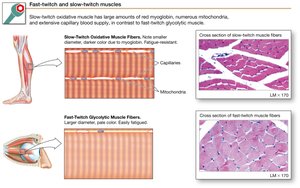
Myoglobin
Myoglobin is an oxygen-binding pigment found in muscle fibers. It facilitates oxygen transport from the cell membrane to mitochondria, supporting aerobic metabolism.
Muscle Contraction Patterns
Summation and Tetanus
Muscle fibers can exhibit different contraction patterns depending on stimulation frequency:
Wave Summation: Occurs when a second stimulus arrives before the muscle has fully relaxed, resulting in a stronger contraction due to residual Ca2+.
Tetanus: Sustained contraction from high-frequency stimulation. Can be incomplete/unfused (moderate frequency, partial relaxation) or complete/fused (very high frequency, no relaxation).
Motor Units and Recruitment
Motor Unit Definition
A motor unit consists of a single motor neuron and all the skeletal muscle fibers it innervates. It is the basic functional unit for muscle contraction.
Motor Unit Recruitment
To increase contraction strength, the nervous system recruits additional motor units in a specific order:
Type I (slow-twitch) units are recruited first.
Type IIa (fast-twitch oxidative-glycolytic) units are recruited second.
Type IIx/IIb (fast-twitch glycolytic) units are recruited last.
Asynchronous recruitment refers to alternating active motor units to prevent fatigue during sustained contractions.
Mechanics of Body Movement
Isotonic and Isometric Contractions
Muscle contractions can be classified based on whether they produce movement:
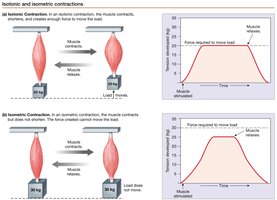
Isotonic Contraction: Muscle changes length and moves a load. Includes concentric (muscle shortens) and eccentric (muscle lengthens) contractions.
Isometric Contraction: Muscle generates force without changing length or moving a load.
Concentric vs. Eccentric Isotonic Contractions
Concentric: Muscle shortens, force exceeds resistance, used for acceleration and movement initiation. Example: Lifting a dumbbell in a biceps curl.
Eccentric: Muscle lengthens under tension, force is less than resistance, used for deceleration and shock absorption. Example: Lowering a dumbbell in a biceps curl.
Series Elastic Elements (SEEs)
Series elastic elements are elastic fibers within muscle that stretch during isometric contraction. They:
Absorb slack during the latent period
Enable isometric contractions
Transmit force smoothly and prevent injury
Store and release elastic energy
Summary Table: Muscle Fiber Types
Fiber Type | Motor Unit Size | Force | Fatigue Resistance | Metabolism | Example Activity |
|---|---|---|---|---|---|
Type I (Slow-Twitch) | Small | Low | High | Oxidative | Posture, walking |
Type IIa (Fast-Twitch Oxidative-Glycolytic) | Medium | Moderate | Moderate | Oxidative & Glycolytic | Jogging, moderate resistance |
Type IIx/IIb (Fast-Twitch Glycolytic) | Large | High | Low | Glycolytic | Sprinting, heavy lifting |
Key Equations
ATP hydrolysis:
Phosphocreatine reaction:
