 Indietro
Whole Skeletal Muscle Contraction: Structure, Function, and Energy in Muscle Physiology
Guida di studio - Note intelligenti
 Appunti personalizzati basati sui tuoi materiali, ampliati con definizioni chiave, esempi e contesto.
Whole Muscle Contraction
Principles of Muscle Contraction
Muscle contraction is a fundamental process in human physiology, producing muscle tension—the force exerted on a load or object. The contraction may or may not result in muscle shortening, depending on the type of contraction. The force and duration of contraction vary in response to different frequencies and intensities of stimuli.
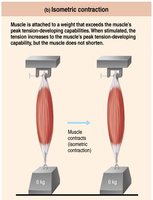
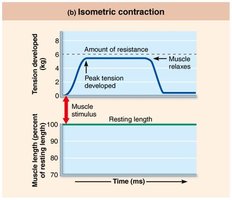
Isometric contraction: Muscle tension increases but does not exceed the load, so the muscle does not shorten.
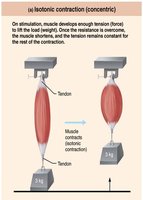
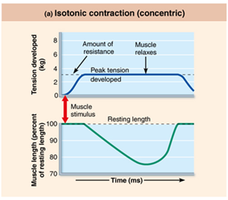
Isotonic contraction: Muscle shortens because muscle tension exceeds the load.
Motor unit: The functional unit consisting of a motor neuron and all the muscle fibers it supplies.
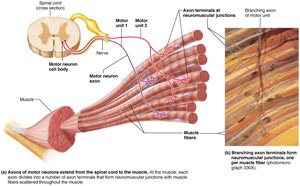
Motor Unit
A motor unit is composed of a motor neuron and the muscle fibers it innervates. The number of fibers per motor unit varies, affecting the precision of muscle control. Fibers from a motor unit are distributed throughout the muscle, so stimulation of a single unit causes only a weak contraction of the entire muscle.
Fine control: Achieved with smaller motor units.
Motor nerve: Contains axons of many motor neurons, each forming neuromuscular junctions with muscle fibers.
The Muscle Twitch
Phases of Muscle Twitch
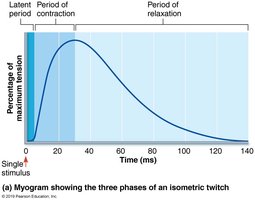
A muscle twitch is the simplest contraction, resulting from a muscle fiber's response to a single action potential. It consists of three phases:
Latent period: Excitation-contraction coupling occurs; no visible tension.
Period of contraction: Cross-bridge formation; tension increases.
Period of relaxation: Ca2+ reentry into the sarcoplasmic reticulum; tension declines.
Different muscles exhibit variations in twitch strength and duration due to metabolic properties and enzyme differences.
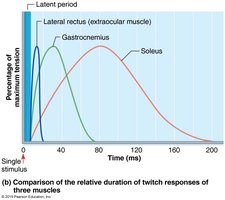
Graded Muscle Responses
Muscle Response to Stimulus Frequency
Normal muscle contraction is smooth and strength varies with demand. Graded responses are achieved by changing the frequency and strength of stimulation.
Single stimulus: Produces a single twitch.
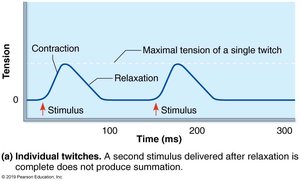
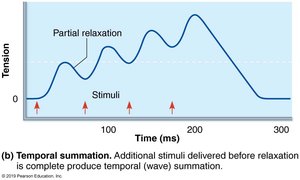
Wave (temporal) summation: Occurs when stimuli are delivered in rapid succession, increasing force as twitches build upon each other.
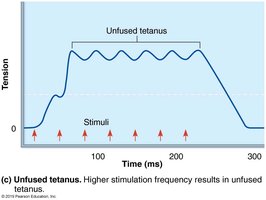
Unfused (incomplete) tetanus: Higher frequency results in sustained, quivering contractions.
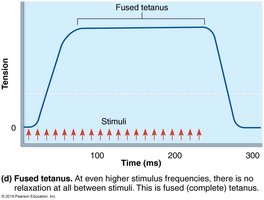
Fused (complete) tetanus: Even higher frequency causes contractions to fuse into a smooth plateau.
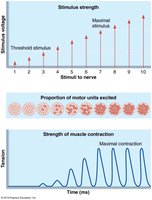
Recruitment and Stimulus Strength
Recruitment refers to the activation of additional motor units to increase contraction strength. Types of stimulus include:
Subthreshold stimulus: Not strong enough to cause contraction.
Threshold stimulus: First observable contraction.
Maximal stimulus: Activates all motor units for maximum force.
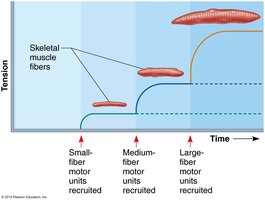
Muscle Tone
Muscle tone is the constant, slightly contracted state of all muscles, maintained by spinal reflexes. It keeps muscles firm, healthy, and ready to respond.
Types of Muscle Contractions
Isotonic and Isometric Contractions
Muscle contractions are classified as isotonic or isometric:
Isotonic contractions: Muscle changes length and moves a load. Can be concentric (muscle shortens) or eccentric (muscle lengthens).
Isometric contractions: Muscle tension increases but muscle does not change length.
Energy for Muscle Contraction
ATP and Its Regeneration
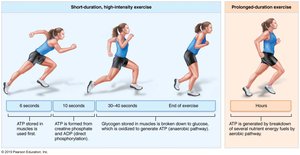
ATP is the sole energy source for muscle contraction, required for cross-bridge movement, calcium pumping, and restoring ion gradients. ATP stores are depleted quickly and must be regenerated by:
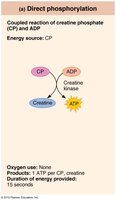
Direct phosphorylation: Creatine phosphate (CP) donates a phosphate to ADP to form ATP.
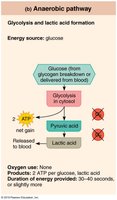
Anaerobic pathway: Glycolysis and lactic acid formation, producing ATP without oxygen.
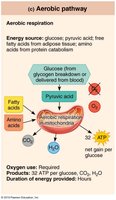
Aerobic pathway: Cellular respiration in mitochondria, producing most ATP during rest and moderate exercise.
Energy Systems During Exercise
Muscles use different energy systems depending on exercise duration and intensity:
Aerobic endurance: Duration muscle contracts using aerobic pathways.
Anaerobic threshold: Point where metabolism shifts to anaerobic pathway.
Muscle Fatigue
Causes and Recovery
Muscle fatigue is the inability to contract despite continued stimulation. Causes include ionic imbalances, increased inorganic phosphate, decreased ATP, increased magnesium, and decreased glycogen. Recovery requires replenishing oxygen, reconverting lactic acid, restoring glycogen, and resynthesizing ATP and CP, a process known as excess postexercise oxygen consumption (EPOC).
Factors Affecting Muscle Contraction
Force of Contraction
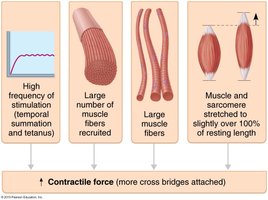
The force generated by a muscle depends on:
Number of fibers stimulated (recruitment): More motor units recruited increases force.
Relative size of fibers: Larger muscles generate more tension.
Frequency of stimulation: Higher frequency increases force.
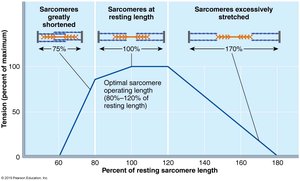
Degree of muscle stretch: Optimal sarcomere length (80–120% of resting length) maximizes force.
Velocity and Duration of Contraction
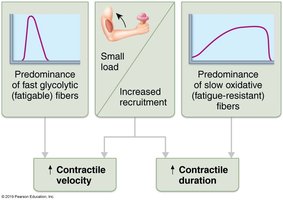
How fast and how long a muscle contracts depends on:
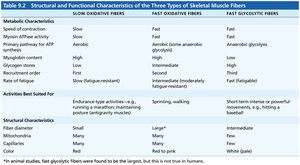
Muscle fiber type: Slow oxidative, fast oxidative, or fast glycolytic fibers.
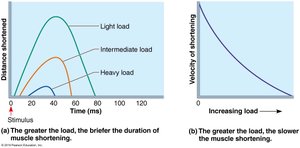
Load: Muscles contract faster and longer with less load.
Recruitment: More motor units increase speed and duration.
Types of Skeletal Muscle Fibers
Skeletal muscle fibers are classified based on contraction speed and metabolic pathway:
Slow oxidative fibers: Endurance, fatigue-resistant, aerobic metabolism.
Fast oxidative fibers: Medium intensity, aerobic and anaerobic metabolism.
Fast glycolytic fibers: Short-term, powerful, anaerobic glycolysis.
Characteristic | Slow Oxidative | Fast Oxidative | Fast Glycolytic |
|---|---|---|---|
Speed of Contraction | Slow | Fast | Fast |
Primary ATP Source | Aerobic | Aerobic (some anaerobic) | Anaerobic glycolysis |
Fatigue Resistance | High | Moderate | Low |
Best Suited For | Endurance | Sprinting, walking | Short-term intense activity |
Color | Red | Red to pink | White |
Load and Recruitment
The greater the load, the shorter and slower the contraction. Increased recruitment of motor units enhances contractile speed and duration.
Adaptation to Exercise
Aerobic and Resistance Exercise
Exercise induces adaptations in muscle:
Aerobic exercise: Increases capillaries, mitochondria, and myoglobin, enhancing endurance and fatigue resistance.
Resistance exercise: Causes muscle hypertrophy, increasing strength and size through greater fiber size, mitochondria, myofilaments, glycogen, and connective tissue.
Example: Jogging, swimming, and biking improve endurance, while weight lifting increases muscle mass and strength.
