Indietro
Beginning Algebra: Word Problems, Linear Equations, Percents, Geometry, and Inequalities
Guida di studio - Note intelligenti
 Appunti personalizzati basati sui tuoi materiali, ampliati con definizioni chiave, esempi e contesto.
Word Problems and Problem Solving
Translating and Solving Word Problems
Word problems require translating real-world situations into algebraic equations. The key is to define variables, set up equations based on the problem statement, and solve for the unknowns.
Key Point 1: Assign a variable (e.g., let x be the unknown number).
Key Point 2: Translate phrases like "less than," "sum of," or "difference" into mathematical operations.
Key Point 3: Set up and solve the equation to find the value of the variable.
Example: "15 less than a number is 41" translates to .
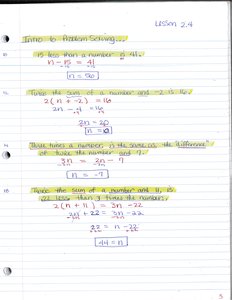
Additional info: Practice with a variety of word problems helps build skill in recognizing patterns and common phrases.
Consecutive Integer Problems
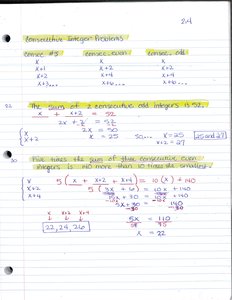
Problems involving consecutive integers often require expressing each integer in terms of a variable and setting up an equation based on their relationships.
Key Point 1: Consecutive integers: x, x+1, x+2, ...
Key Point 2: Consecutive even/odd integers: x, x+2, x+4, ...
Example: "The sum of 2 consecutive odd integers is 52" becomes .
Linear Equations
Solving Linear Equations from Word Problems
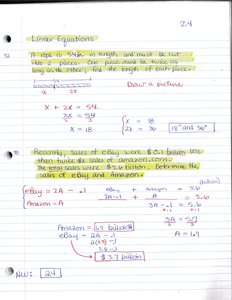
Linear equations can be used to model and solve a variety of real-life problems, such as dividing lengths or comparing sales.
Key Point 1: Define variables for unknown quantities.
Key Point 2: Write an equation based on the relationships described.
Key Point 3: Solve for the variable using algebraic methods.
Example: "A rope is 54 in. long and must be cut into 3 pieces..." leads to .
Applications Involving Percents
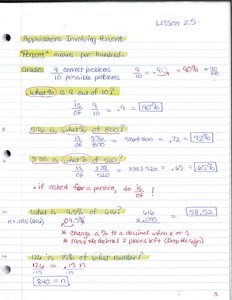
Understanding and Calculating Percents
Percents are used to express ratios, proportions, and comparisons. They are essential in many real-world applications, such as grades, discounts, and statistics.
Key Point 1: Percent means "per hundred." To convert a percent to a decimal, divide by 100.
Key Point 2: To find a percent of a number: .
Key Point 3: To find what percent one number is of another: .
Example: "What is 8% of 120?" .
Sales Tax, Percent Increase, and Simple Interest
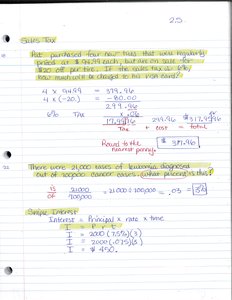
Percent applications include calculating sales tax, percent increase, and simple interest in financial contexts.
Key Point 1: Sales Tax:
Key Point 2: Simple Interest: where P is principal, r is rate, t is time.
Example: "Find the interest on I = 2000 \times 0.075 \times 3 = 450$.
Geometry Formulas and Applications
Solving for Variables in Geometry Formulas
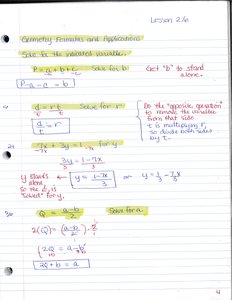
Many geometry problems require solving for a specific variable in a formula. This involves isolating the variable using algebraic operations.
Key Point 1: Rearranging formulas is called "solving for a variable."
Key Point 2: Use inverse operations to isolate the desired variable.
Example: Solve for b: .
Geometry Applications: Perimeter, Angles, and Circumference
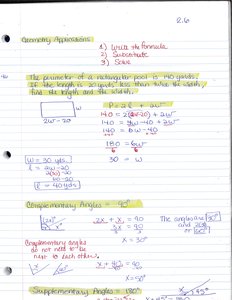
Geometry applications often involve using formulas to solve for unknown lengths, angles, or other measurements.
Key Point 1: Perimeter of a rectangle:
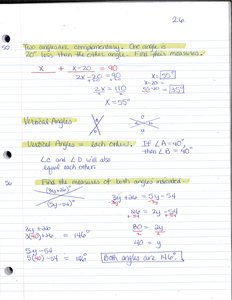
Key Point 2: Complementary angles: Two angles whose sum is .
Key Point 3: Supplementary angles: Two angles whose sum is .
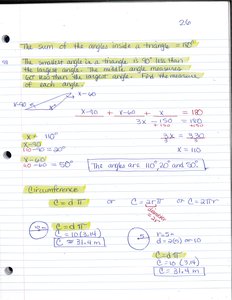
Key Point 4: Circumference of a circle: or
Example: "The sum of the angles inside a triangle is ."
Applications: Mixture and Distance Problems
Mixture Problems
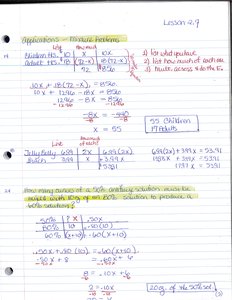
Mixture problems involve combining two or more quantities with different concentrations or values to achieve a desired mixture.
Key Point 1: Set up an equation based on the total amount and the total value or concentration.
Key Point 2: Use the formula:
Example: "How many ounces of a 10% solution should be mixed with 72 oz of a 5% solution to produce an 8% solution?"
Distance, Rate, and Time Problems
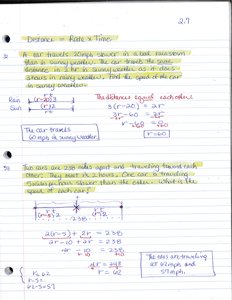
Distance problems use the formula , where d is distance, r is rate (speed), and t is time. These problems often involve objects moving toward or away from each other.
Key Point 1: Identify what is being asked (distance, rate, or time).
Key Point 2: Set up equations based on the relationships described in the problem.
Example: "A car travels 60 mph slower than a train. Both travel the same distance..."
Linear Inequalities
Graphing and Solving Linear Inequalities
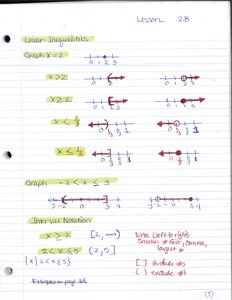
Linear inequalities are similar to equations but use inequality symbols (<, >, ≤, ≥). Solutions are often represented on a number line.
Key Point 1: To solve, isolate the variable as with equations.
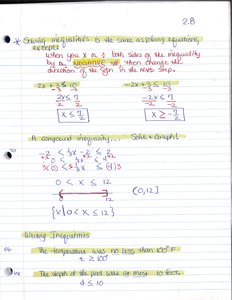
Key Point 2: When multiplying or dividing both sides by a negative number, reverse the inequality sign.
Key Point 3: Graph solutions on a number line, using open or closed circles to indicate inclusion or exclusion of endpoints.
Key Point 4: Interval notation is used to describe solution sets, e.g., (2, 5] means greater than 2 and less than or equal to 5.
Solving and Interpreting Compound Inequalities
Compound inequalities involve two inequalities joined by "and" or "or." The solution is the intersection or union of the individual solution sets.
Key Point 1: Solve each part of the compound inequality separately, then combine the solutions.
Key Point 2: Express the solution in interval notation or as a graph.
Example: is written as (0, 12].
Applications of Inequalities
Inequalities are used to model real-world constraints, such as minimum or maximum values in practical situations.
Key Point 1: Translate the problem into an inequality.
Key Point 2: Solve for the variable and interpret the result in context.
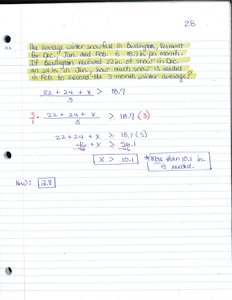
Example: "The average snowfall must be more than 10.1 inches..."