Indietro
Rational Expressions and Equations: Beginning Algebra Study Guide
Guida di studio - Note intelligenti
 Appunti personalizzati basati sui tuoi materiali, ampliati con definizioni chiave, esempi e contesto.
Rational Expressions
Definition and Domain
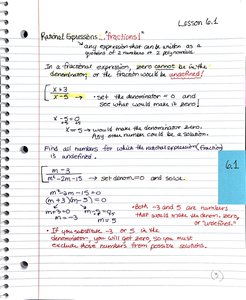
Rational expressions are fractions where the numerator and denominator are polynomials. The domain of a rational expression excludes values that make the denominator zero, as division by zero is undefined.
Rational Expression: Any expression that can be written as a quotient of two polynomials.
Undefined Values: Set the denominator equal to zero and solve to find values that must be excluded from the domain.
Example: For , makes the denominator zero, so is excluded.
Simplifying Rational Expressions
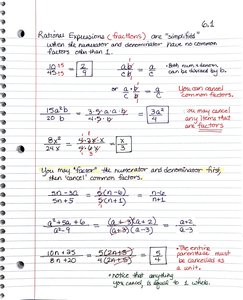
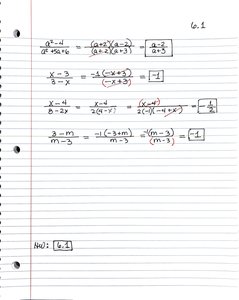
A rational expression is simplified when the numerator and denominator have no common factors other than 1. Cancel common factors to simplify.
Canceling Factors: Both numerator and denominator must be factored completely before canceling.
Example: after dividing by 5.
Factoring: Factor first, then cancel common factors.
Equivalent Rational Expressions
Two rational expressions are equivalent if they simplify to the same form. Negative signs can be factored out and expressions rearranged.
Example: because and are opposites.
Multiplication and Division of Rational Expressions
Multiplying Rational Expressions
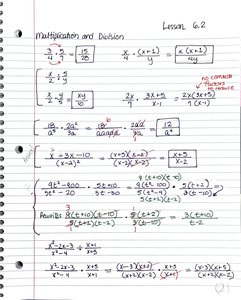
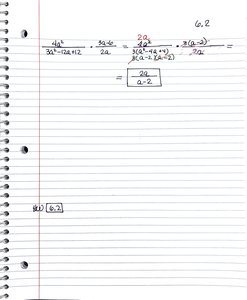
Multiply the numerators and denominators, then simplify by factoring and canceling common factors.
Formula:
Example:
Dividing Rational Expressions
To divide, multiply by the reciprocal of the second expression. Factor and cancel common factors.
Formula:
Example:
Addition and Subtraction of Rational Expressions
When Denominators Are the Same
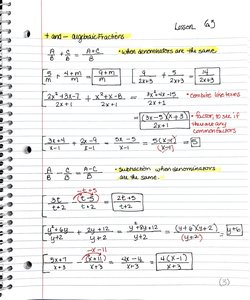
Add or subtract numerators directly when denominators are identical. Combine like terms and simplify.
Formula:
Example:
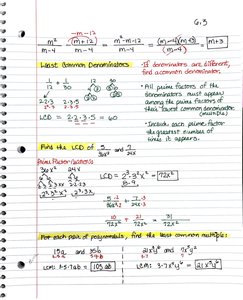
When Denominators Are Different: Least Common Denominator (LCD)
If denominators differ, find the least common denominator (LCD) and rewrite each expression with the LCD. Add or subtract numerators and simplify.
Finding LCD: Include all prime factors from each denominator.
Example: LCD of and is .
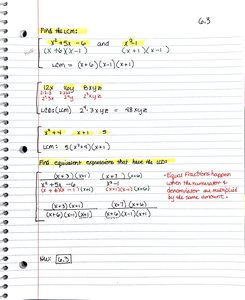
Finding Equivalent Expressions with LCD
Rewrite each fraction so the denominator is the LCD, then add or subtract.
Example: and , LCD is .
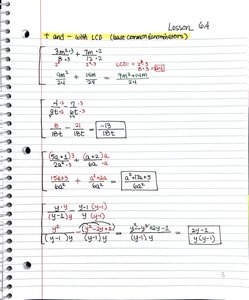
Addition and Subtraction with LCD
Adding and Subtracting with LCD
Once all fractions have the LCD, combine numerators and simplify.
Example: and , LCD is .
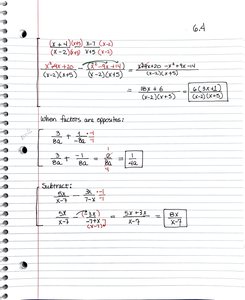
When Factors Are Opposites
If denominators are opposites, factor out a negative sign to make them the same.
Example:
Complex Fractions
Definition and Simplification
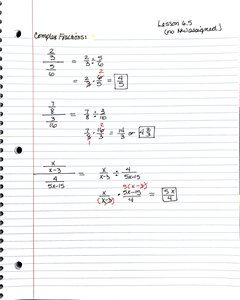
Complex fractions have fractions in the numerator, denominator, or both. Simplify by multiplying numerator and denominator by the LCD of all inner fractions.
Example:
Solving Rational Equations
Solving Steps
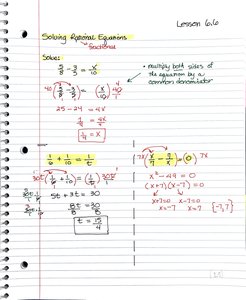
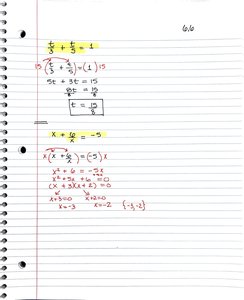
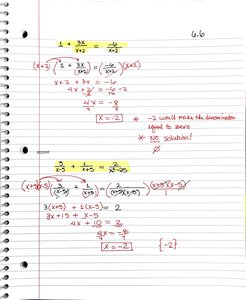
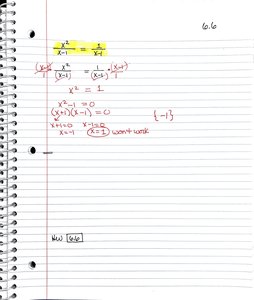
To solve rational equations, multiply both sides by the LCD to clear denominators, then solve the resulting equation. Check for extraneous solutions that make any denominator zero.
Example: , multiply both sides by .
Extraneous Solutions: Always check that solutions do not make any denominator zero.
Applications of Rational Equations
Problems Involving Work
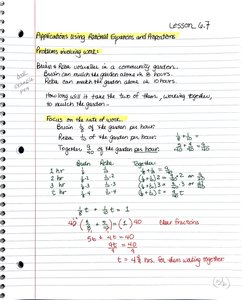
Work problems use rational equations to model combined rates. The sum of individual rates equals the combined rate.
Formula: , where and are individual times, is combined time.
Example: Two people working together to complete a task.
The Work Principle
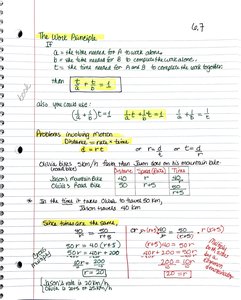
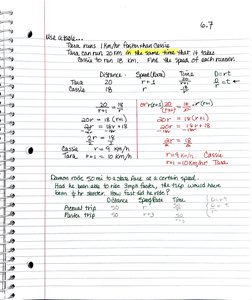
The work principle states that the sum of rates equals the total rate. Used for problems involving motion and distance.
Formula:
Distance Formula:
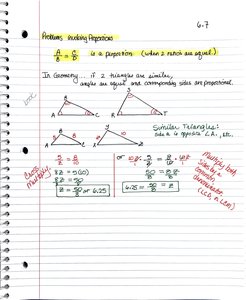
Problems Involving Proportions
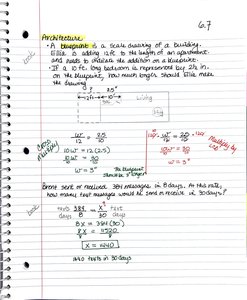
Proportions are equations stating two ratios are equal. Used in geometry for similar triangles and in real-world applications.
Formula:
Example: Similar triangles have corresponding sides in proportion.
Applications in Architecture and Population
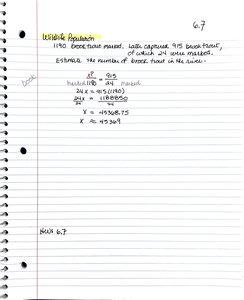
Proportions are used in scale drawings and population estimates. Set up ratios and solve for unknowns.
Example: Scale drawing of a building, estimating population using ratios.