Indietro
Linear Equations: Solutions, Equalities, and Applications
Guida di studio - Note intelligenti
 Appunti personalizzati basati sui tuoi materiali, ampliati con definizioni chiave, esempi e contesto.
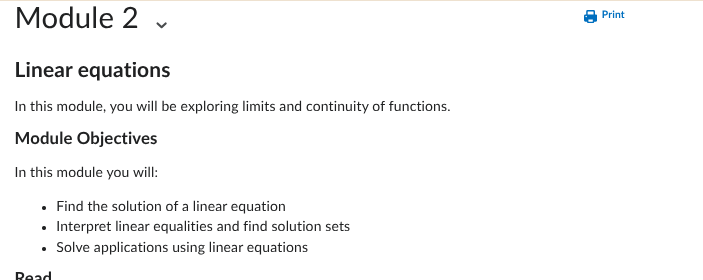
Linear Equations
Introduction to Linear Equations
Linear equations are fundamental in algebra and are used to model relationships between variables. A linear equation in one variable has the general form ax + b = 0, where a and b are real numbers and x is the variable. Solving linear equations is essential for understanding more advanced mathematical concepts and for solving real-world problems.
Finding the Solution of a Linear Equation
To solve a linear equation, the goal is to isolate the variable on one side of the equation. This process involves using properties of equality and arithmetic operations.
Step 1: Simplify both sides of the equation if necessary.
Step 2: Use addition or subtraction to move terms containing the variable to one side and constants to the other.
Step 3: Use multiplication or division to solve for the variable.
Example: Solve Subtract 5 from both sides: Divide both sides by 2:
Interpreting Linear Equalities and Finding Solution Sets
Linear equalities (inequalities) involve expressions such as ax + b < c, ax + b > c, ax + b c, or ax + b c. The solution set is the collection of all values of the variable that make the inequality true.
Solving Inequalities: Use similar steps as solving equations, but remember to reverse the inequality sign when multiplying or dividing by a negative number.
Solution Set: Express the answer using interval notation or a number line.
Example: Solve Add 4 to both sides: Divide by 3: Solution set:
Solving Applications Using Linear Equations
Linear equations are used to solve a variety of real-world problems, such as calculating costs, determining distances, and analyzing relationships between quantities.
Identify the unknown: Assign a variable to represent the unknown quantity.
Translate the problem: Write an equation based on the information given.
Solve the equation: Use algebraic methods to find the value of the variable.
Interpret the solution: Check that the solution makes sense in the context of the problem.
Example: If a movie ticket costs dollars and you buy 4 tickets for Divide by 4: Each ticket costs $9.
Additional info:
The module also mentions limits and continuity of functions, which are not part of the beginning-intermediate-algebra curriculum. The focus here is strictly on linear equations and related applications.