 Indietro
Study Guide: Number Types, Radicals, Exponents, and Polynomials in Algebra
Guida di studio - Note intelligenti
 Appunti personalizzati basati sui tuoi materiali, ampliati con definizioni chiave, esempi e contesto.
Number Types in Algebra
Classification of Numbers
Understanding the different types of numbers is fundamental in algebra. Each type has unique properties and applications.
Simple Number: General term for any number.
Complex Number: Includes real and imaginary numbers.
Real Number: All numbers that can be placed on a number line, including rational and irrational numbers. Examples: 5, -7, 3/4, π, 0.
Imaginary Number: Numbers that result in a negative number when squared (e.g., i where i2 = -1).
Integer: Whole numbers and their negatives; excludes fractions, decimals, and irrationals.
Natural Number: Positive whole numbers starting from 1; used for counting.
Whole Number: All natural numbers plus zero.
Irrational Number: Cannot be written as a simple fraction; decimal never repeats or terminates (e.g., π, √2).
Rational Number: Can be expressed as a fraction of two integers (denominator ≠ 0).
Decimal: Contains a decimal point, representing parts of a whole.
Fraction: Written as one integer divided by another (nonzero denominator).
Composite Number: Has more than two factors; can be broken down into prime factors.
Prime Number: Has exactly two factors: 1 and itself.
Radicals and Their Properties
Understanding Radicals
Radicals are expressions involving roots. They are essential for simplifying and solving equations involving roots.
Radical: Expression including the root symbol (√).
Radicand: The number or expression inside the radical sign.
Index: Indicates which root to take (e.g., square root, cube root).
Perfect Square: Integer multiplied by itself (e.g., 1, 4, 9, 16).
Perfect Cube: Integer multiplied by itself three times (e.g., 1, 8, 27, 64).
Perfect Root: Root that results in a whole number.
Irrational Radical: Root that does not result in a whole number and is usually irrational.
Properties of Radicals
Product Property: The n-th root of a product equals the product of the n-th roots of each factor.
Quotient Property: The n-th root of a quotient equals the quotient of the n-th roots.
Square Root: The number multiplied by itself to get the original number. Cannot find the square root of a negative number unless the negative is outside the root.
Exponents and Their Properties
Basic Concepts
Exponents are used to represent repeated multiplication. Understanding their properties is crucial for simplifying algebraic expressions.
Base: The number being raised to a power.
Exponent: Indicates how many times the base is multiplied by itself.
Rational Exponents: Exponents that are fractions, representing roots.
Power: An expression with a base and exponent.
Expanded Form: Repeated multiplication equal to a power.
Special Exponents: Squared, cubed, zero, and negative exponents.
Negative Exponent Rule: Indicates a reciprocal.
Zero Exponent Rule: Any nonzero number raised to 0 equals 1.
Exponent Properties
These properties help simplify expressions involving exponents.
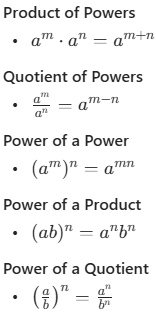
Product of Powers:
Quotient of Powers:
Power of a Power:
Power of a Product:
Power of a Quotient:
Polynomials in Algebra
Definition and Structure
A polynomial is an algebraic expression made up of variables, coefficients, and whole number exponents. Polynomials are classified by their terms and degree.
Term: A single part of a polynomial separated by + or −.
Coefficient: Numerical factor of a term.
Variable: Letter representing an unknown value.
Constant: Term without a variable.
Degree (Term): Exponent of the variable in a term.
Degree (Polynomial): Highest exponent in the polynomial.
Like Terms: Same variables raised to the same powers.
Standard Form: Terms ordered from highest degree to lowest.
Types of Polynomials
Monomial: One term.
Binomial: Two terms.
Trinomial: Three terms.
Classification by Degree
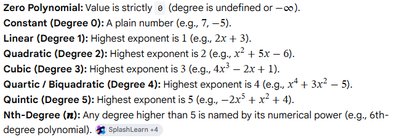
Type | Degree | Example |
|---|---|---|
Zero Polynomial | Undefined or -∞ | 0 |
Constant | 0 | 7, -5 |
Linear | 1 | 2x + 3 |
Quadratic | 2 | x2 + 5x - 6 |
Cubic | 3 | 4x3 - 2x + 1 |
Quartic/Biquadratic | 4 | x4 + 3x2 - 5 |
Quintic | 5 | -2x5 + x2 + 4 |
Nth-Degree | n > 5 | 6th-degree polynomial |
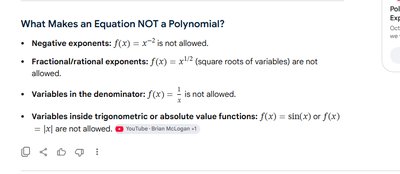
What Makes an Equation NOT a Polynomial?
Negative exponents: is not allowed.
Fractional/rational exponents: (square roots of variables) are not allowed.
Variables in the denominator: is not allowed.
Variables inside trigonometric or absolute value functions: or are not allowed.
Polynomial Forms and Operations
Standard Form: Highest degree to lowest.
Vertex Form: Used for quadratic polynomials.
Expanded Form: Fully multiplied out.
Factored Form: Written as a product of factors.
Factoring and Multiplying Polynomials
Factoring: Factor out the greatest common factor (GCF) first, then use methods such as grouping or special products.
Multiplying Polynomials: Use distributive property or FOIL for binomials.
Power Rule: To simplify, apply exponent rules.
Examples
Example of a Monomial:
Example of a Binomial:
Example of a Trinomial:
Example of Factoring:
Additional info: Expanded explanations and examples were added for completeness and clarity.
