 Indietro
Anaerobic Metabolism and Energy Production in Glycolysis: Study Notes
Guida di studio - Note intelligenti
 Appunti personalizzati basati sui tuoi materiali, ampliati con definizioni chiave, esempi e contesto.
Anaerobic Metabolism of Pyruvate
Introduction to Anaerobic Metabolism
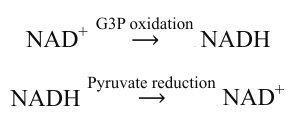
Glycolysis is the metabolic pathway that converts glucose into pyruvate, producing ATP and NADH. Under anaerobic conditions, cells must regenerate NAD+ to allow glycolysis to continue, as NAD+ is the electron acceptor in the glyceraldehyde-3-phosphate dehydrogenase reaction.
NAD+ regeneration is essential for continued glycolytic ATP production in the absence of oxygen.
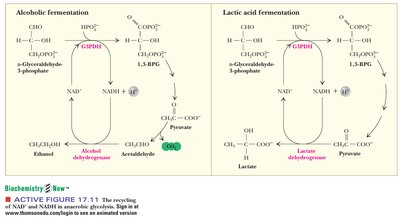
Two main anaerobic pathways: lactate fermentation and alcoholic fermentation.
Both pathways serve to oxidize NADH back to NAD+.
Central Principle of Fermentation
Fermentation does not generate additional ATP beyond glycolysis. Its primary function is to regenerate NAD+ so glycolysis can continue under anaerobic conditions.
Fermentation = NAD+ regeneration, not extra ATP production.
Lactate Fermentation
Conversion of Pyruvate to Lactate
In actively metabolizing muscle, pyruvate is reduced to lactate by lactate dehydrogenase (LDH):
Reaction:
Enzyme: Lactate dehydrogenase (LDH)
Type: Oxidation–reduction reaction
Pyruvate gains electrons (reduced), NADH loses electrons (oxidized).
Occurs twice per glucose molecule.
Chemical Changes in Lactate Formation
Pyruvate's carbonyl group is converted to a hydroxyl group.
No carbon dioxide is released; both pyruvate and lactate have three carbons.
NAD+ is regenerated for glycolysis.
Half-Reactions for Lactate Formation
Reduction:
Oxidation:
Combined:
Importance of NAD+ Regeneration
NAD+ is reduced during glycolysis (G3P oxidation).
If not regenerated, glycolysis halts due to NAD+ depletion.
Lactate formation recycles NAD+ for continued glycolysis.
Net Redox Balance
For each glucose: 2 NAD+ reduced to NADH, then 2 NADH oxidized back to NAD+ during lactate formation.
No net change in NAD+/NADH pool.
Lactate as a Metabolic End Point and Recycling
Lactate is a metabolic dead end in muscle but can be transported to the liver.
In the liver: lactate is oxidized to pyruvate, then converted to glucose (gluconeogenesis).

Lactate Dehydrogenase (LDH) Isozymes
LDH Structure and Isozymes
LDH is a tetrameric enzyme with two major subunit types: M (muscle) and H (heart). Five isozymes are formed from different combinations of these subunits.
Isozyme Composition | Common Designation | Predominant Association |
|---|---|---|
H4 | LDH 1 | Heart |
H3M | LDH 2 | Heterogeneous |
H2M2 | LDH 3 | Heterogeneous |
HM3 | LDH 4 | Heterogeneous |
M4 | LDH 5 | Skeletal muscle |
Isozymes differ in kinetic properties and tissue distribution.
M4 (LDH 5) is predominant in skeletal muscle; H4 (LDH 1) in heart.
Alcoholic Fermentation
Pathway Overview
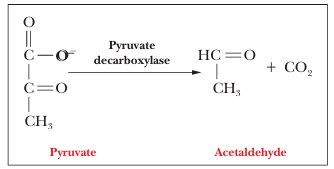
In yeast and some microorganisms, pyruvate is converted to ethanol via two reactions:
Decarboxylation of pyruvate to acetaldehyde (enzyme: pyruvate decarboxylase, requires Mg2+ and TPP).
Reduction of acetaldehyde to ethanol (enzyme: alcohol dehydrogenase).
Mechanism of Pyruvate Decarboxylase
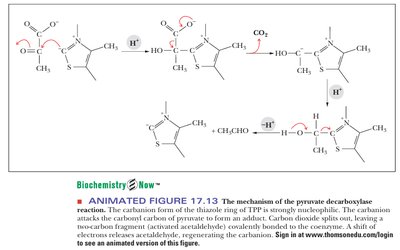
TPP (thiamine pyrophosphate) forms a carbanion, which attacks pyruvate's carbonyl carbon.
Decarboxylation releases CO2, leaving a two-carbon fragment (acetaldehyde) attached to TPP.
Acetaldehyde is released, and TPP is regenerated.
Reduction of Acetaldehyde to Ethanol
Acetaldehyde + NADH + H+ → Ethanol + NAD+
Alcohol dehydrogenase catalyzes this oxidation–reduction reaction.
NAD+ is regenerated, allowing glycolysis to continue.
Comparison of Lactate and Alcoholic Fermentation
Feature | Lactate Fermentation | Alcoholic Fermentation |
|---|---|---|
Initial substrate | Pyruvate | Pyruvate |
Number of post-glycolytic reactions | One | Two |
Intermediate | None | Acetaldehyde |
Final organic product | Lactate | Ethanol |
CO2 produced | No | Yes |
Enzyme for NAD+ regeneration | Lactate dehydrogenase | Alcohol dehydrogenase |
Net ATP per glucose | Two | Two |
Main function | Regeneration of NAD+ | Regeneration of NAD+ |
Clinical Connections
Anaerobic Metabolism and Dental Plaque
Dental caries are linked to anaerobic metabolism by oral bacteria in plaque.
Bacteria metabolize sugars anaerobically, producing acids (lactate, pyruvate) that damage tooth enamel.
Fluoride strengthens enamel; flossing disrupts plaque and reduces anaerobic conditions.
Fetal Alcohol Syndrome
Maternal ethanol consumption leads to acetaldehyde accumulation in the fetal liver.
Acetaldehyde is toxic and contributes to fetal alcohol syndrome.
Energy Accounting in Glycolysis
ATP Bookkeeping
ATP is consumed in two reactions (hexokinase and phosphofructokinase): 2 ATP used.
ATP is produced in two reactions (phosphoglycerate kinase and pyruvate kinase): 4 ATP produced.
Net ATP yield: 2 ATP per glucose.
Reaction | ATP Change per Glucose |
|---|---|
Hexokinase | -1 |
Phosphofructokinase | -1 |
Phosphoglycerate kinase | +2 |
Pyruvate kinase | +2 |
Net ATP yield | +2 |
NADH and Pyruvate Bookkeeping
2 NADH produced per glucose.
2 pyruvate produced per glucose.
Under anaerobic conditions, NADH is used to regenerate NAD+ via fermentation.
Overall Glycolytic Reaction
Simplified:
Free-Energy Changes and Efficiency
Overall glycolysis is exergonic:
ATP synthesis is endergonic:
Glucose-to-lactate conversion releases
Efficiency of anaerobic glycolysis:
About one-third of energy is conserved in ATP; remainder is released as heat.
Standard vs. Physiological Free-Energy Changes
Standard free-energy changes () assume defined conditions; actual cellular conditions () vary.
Some reactions with positive proceed forward in cells due to concentration differences.
Overall pathway remains exergonic under physiological conditions.
Complete Molecular Accounting for Glycolysis
Per Molecule of Glucose
Reactants: 1 glucose, 2 ATP, 4 ADP, 2 NAD+, 2 inorganic phosphate
Gross products: 2 pyruvate, 4 ATP, 2 NADH, 2 H+, 2 H2O
Net products: 2 pyruvate, 2 net ATP, 2 NADH, 2 H+, 2 H2O
Carbon, ATP, and Redox Balances
Carbon: 1 glucose (6C) → 2 pyruvate (3C each)
ATP: 2 consumed, 4 produced, 2 net gain
Redox: 2 NAD+ → 2 NADH (glycolysis); 2 NADH → 2 NAD+ (fermentation)
Summary
Glycolysis and fermentation allow cells to produce ATP under anaerobic conditions by regenerating NAD+. Lactate and alcoholic fermentation pathways differ in their final products and intermediate steps but share the essential function of NAD+ regeneration. Energy released from glucose breakdown is partially conserved in ATP, with the remainder dissipated as heat.
Key Equations
Lactate fermentation:
Alcoholic fermentation:
Overall glycolysis:
Additional info:
TPP is a coenzyme derived from vitamin B1 and is essential for decarboxylation reactions.
Isozymes allow adaptation of the same reaction to different tissue requirements.
