 Indietro
Biochemistry I: Introduction, Biochemical Terminology, and Non-Covalent Interactions
Guida di studio - Note intelligenti
 Appunti personalizzati basati sui tuoi materiali, ampliati con definizioni chiave, esempi e contesto.
Introduction to Biochemistry
Overview of Biochemistry I
Biochemistry I is a foundational course that explores the molecular basis of life, focusing on the structure-function relationships of biomolecules. The course covers proteins, lipids, carbohydrates, and nucleic acids, as well as the chemical reactions and interactions that underpin cellular processes.
Molecular Perspective: Emphasizes how molecular structure determines biological function.
Major Biomolecules: Proteins, lipids, carbohydrates, nucleic acids.
Chemistry of Life: Includes enzyme catalysis and metabolism.
Central Dogma: Framework for understanding genetic information flow and its impact on disease.
Quantification Methods: Techniques to study biomolecular interactions and regulation.
Course Structure and Syllabus
The course is organized into lectures and recitations, with a focus on problem-solving and group learning. Exams and quizzes assess understanding of key concepts.
Lectures: Cover core biochemistry topics.
Recitations: Mandatory, peer-led sessions with quizzes and group work.
Textbook: Miesfeld & McEvoy, Biochemistry, 2nd edition
Grading: Based on exams, quizzes, and participation.
Biochemical Hierarchy and Terminology
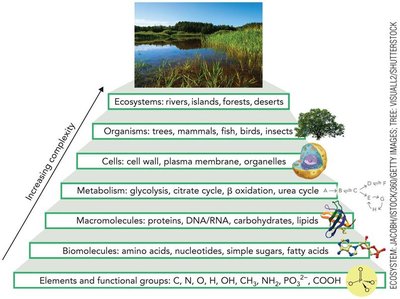
Levels of Biochemical Organization
Biochemical systems are organized hierarchically, from elements and functional groups to ecosystems. Understanding this hierarchy is essential for grasping the complexity of biological systems.
Elements and Functional Groups: C, N, O, H, OH, CH3, NH2, PO32-, COOH
Biomolecules: Amino acids, nucleotides, simple sugars, fatty acids
Macromolecules: Proteins, DNA/RNA, carbohydrates, lipids
Cells and Organisms: Higher levels of complexity
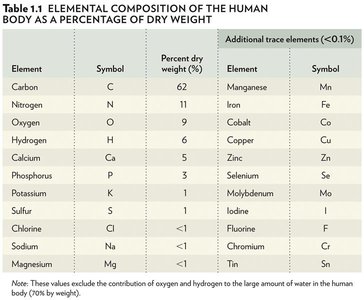
Elemental Composition of Biomolecules
Most organisms are composed primarily of six elements, which form the backbone of biomolecules.
Element | Symbol | Percent dry weight (%) |
|---|---|---|
Carbon | C | 62 |
Nitrogen | N | 11 |
Oxygen | O | 6 |
Hydrogen | H | 6 |
Phosphorus | P | 3 |
Calcium | Ca | 1 |
Potassium | K | 1 |
Sulfur | S | 1 |
Chlorine | Cl | <1 |
Sodium | Na | <1 |
Magnesium | Mg | <1 |
Common Functional Groups in Biomolecules
Six chemical groups are frequently found in biomolecules, each contributing specific chemical properties.
Amino (–NH2)
Hydroxyl (–OH)
Sulfhydryl (–SH)
Phosphoryl (–PO32-)
Carboxyl (–COOH)
Methyl (–CH3)

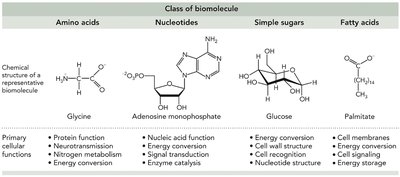
Major Classes of Biomolecules
Cells contain four major classes of biomolecules, each with distinct structures and functions.
Class | Example Structure | Primary Functions |
|---|---|---|
Amino acids | Glycine | Protein function, neurotransmission, nitrogen metabolism, energy conversion |
Nucleotides | Adenosine monophosphate | Nucleic acid function, energy conversion, signal transduction, enzyme catalysis |
Simple sugars | Glucose | Energy conversion, cell wall structure, cell recognition, nucleotide structure |
Fatty acids | Palmitate | Cell membranes, energy conversion, cell signaling, energy storage |
Macromolecules as Polymers
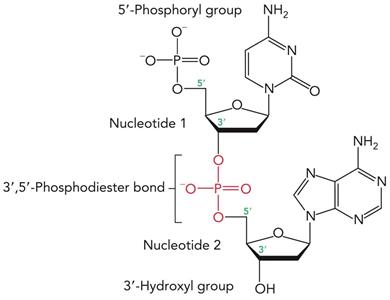
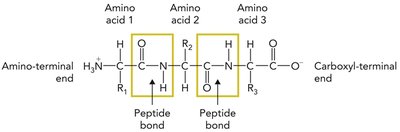
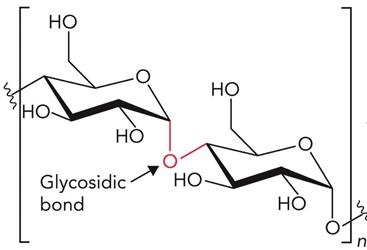
Macromolecules are polymers formed from smaller subunits. The three main types are nucleic acids, proteins, and polysaccharides.
Nucleic acids: Polymers of nucleotides
Proteins: Polymers of amino acids
Polysaccharides: Polymers of sugars
The Central Dogma of Molecular Biology
Information Flow in Cells
The Central Dogma describes the flow of genetic information from DNA to RNA to protein. This framework is fundamental to understanding molecular biology and biochemistry.
Replication: DNA copies itself
Transcription: DNA is transcribed to RNA
Translation: RNA is translated to protein
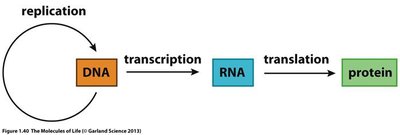
Key Principle: Sequential information cannot be transferred from protein to nucleic acid or another protein.
Structure-Function Relationships
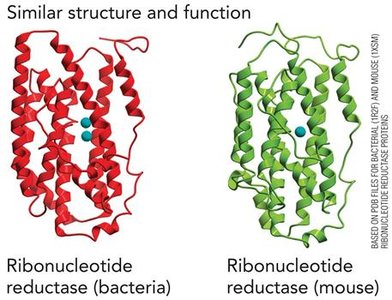
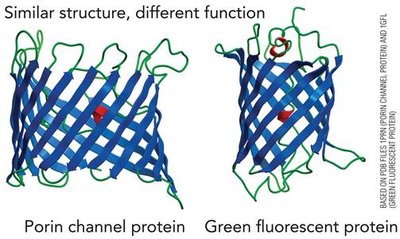
The sequence of a polymer determines its three-dimensional structure, which in turn dictates its function. This concept is central to biochemistry.
Sequence → Structure → Function: Specific amino acid sequences encode particular 3D structures.
Examples: Similar structures can have similar or different functions, as seen in ribonucleotide reductase and porin channel proteins.
Non-Covalent Interactions in Biochemistry
Types of Non-Covalent Interactions
Non-covalent interactions are individually weak but collectively crucial for the stability and function of biomolecules. They facilitate transient and reversible interactions.
Hydrogen bonds: Dipole-dipole interactions involving a hydrogen atom bonded to an electronegative atom.
Ion pairs (salt bridges): Electrostatic interactions between charged groups.
Van der Waals forces: Interactions between neutral atoms due to transient dipoles.
Aromatic interactions: Stacking of aromatic rings.
Hydrophobic effect: Clustering of nonpolar groups to minimize ordered water molecules.
Covalent vs Non-Covalent Bonds
Covalent bonds are much stronger than non-covalent interactions and form the backbone of macromolecules. Non-covalent interactions define the 3D architecture and stability.
Covalent bond energies: Range from 305 to 745 kJ/mol.
Non-covalent bond energies: Typically less than 20 kJ/mol.
Hydrogen Bonds
Hydrogen bonds are essential for the folding and stability of biomolecular structures, including proteins and nucleic acids.
Donor: Atom bearing hydrogen
Acceptor: Electronegative atom with lone pairs
Optimal distance: 2.4–2.7 Å
Angle: 180° provides strongest interaction
Van der Waals Interactions
These interactions occur between neutral atoms and are important for molecular packing and steric effects.
Types: Dipole-dipole, dipole-induced dipole, London dispersion forces
Van der Waals radius: Defines optimal contact distance
Steric effects: Repulsion at short distances constrains 3D structure
Electrostatic Interactions (Ion Pairs)
Ion pairs are formed by close proximity of oppositely charged ions. Their strength is influenced by the environment, especially water (shielding effect).
Coulomb's Law:
Shielding: Water weakens electrostatic interactions
Location: Charged groups often found on protein surfaces
Hydrophobic Effect
Hydrophobic interactions are driven by entropy, not by intrinsic attraction between nonpolar groups. They minimize the number of ordered water molecules around hydrophobic regions.
Amphipathic molecules: Contain both polar and nonpolar regions
Hydrophilic regions: Dissolve in water
Hydrophobic regions: Cluster together
Entropy maximization: Drives hydrophobic effect
Conclusions
Four major classes of biomolecules: amino acids, nucleotides, simple sugars, fatty acids
The central dogma defines relationships between DNA, RNA, and proteins
Structures of macromolecules relate to their functions
Non-covalent interactions are weak but essential for transient and reversible molecular interactions
Additional info: These notes are based on the introductory lecture and syllabus for Biochemistry I, covering foundational concepts that will be expanded upon in subsequent lectures.
