 Indietro
Carbohydrates: Structure, Classification, and Biological Importance
Guida di studio - Note intelligenti
 Appunti personalizzati basati sui tuoi materiali, ampliati con definizioni chiave, esempi e contesto.
Carbohydrates
Introduction to Carbohydrates
Carbohydrates are one of the four major classes of biomolecules essential for life. They serve as the primary energy source for most organisms and play structural and functional roles in cells. Chemically, carbohydrates are polyhydroxy aldehydes or ketones, or compounds that yield these upon hydrolysis. Their general empirical formula is , but not all compounds fitting this formula are carbohydrates.
Key Elements: Carbon, hydrogen, and oxygen (typically in a 1:2:1 ratio).
Main Functions: Energy storage, structural support, and cellular communication.
Examples: Glucose, starch, cellulose.

Chemical Nature and Structure
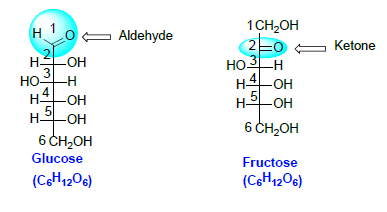
Carbohydrates are classified based on their functional groups and the number of carbon atoms. They may contain an aldehyde group (aldose) or a ketone group (ketose).
Aldose: Contains an aldehyde group (e.g., glucose).
Ketose: Contains a ketone group (e.g., fructose).
General Formula:
Classification of Carbohydrates
Carbohydrates are classified into monosaccharides, disaccharides, oligosaccharides, and polysaccharides based on the number of sugar units.
Monosaccharides: Single sugar units (e.g., glucose, fructose, galactose).
Disaccharides: Two monosaccharide units (e.g., sucrose, lactose, maltose).
Oligosaccharides: 3–10 monosaccharide units (e.g., raffinose, stachyose).
Polysaccharides: More than 10 monosaccharide units (e.g., starch, glycogen, cellulose).
Monosaccharides
Structure and Properties
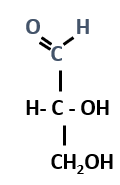
Monosaccharides are the simplest carbohydrates and cannot be hydrolyzed into smaller units. They are colorless, crystalline solids, soluble in water, and insoluble in nonpolar solvents. The smallest monosaccharides have three carbon atoms (trioses).
General Formula:
Examples: Glucose, fructose, ribose, galactose.
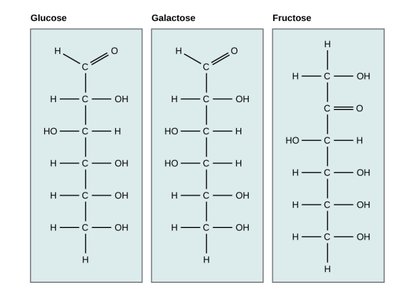
Isomerism: Monosaccharides with the same formula but different structures (e.g., glucose, galactose, and fructose all have ).
Ring and Linear Forms
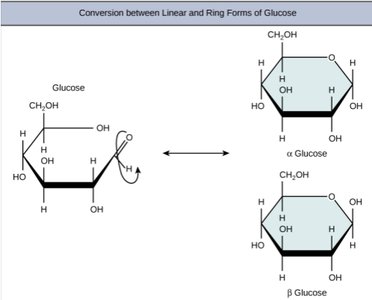
Monosaccharides can exist in both linear and cyclic (ring) forms. The ring formation involves the reaction of a carbonyl group with a hydroxyl group, creating a new chiral center at the anomeric carbon. The orientation of the hydroxyl group at this carbon determines the alpha (α) or beta (β) anomer.
α-Anomer: OH group is below the plane of the ring (in Haworth projection).
β-Anomer: OH group is above the plane of the ring.
Classification by Carbon Number and Functional Group
Monosaccharides are further classified by the number of carbon atoms and the type of carbonyl group present.
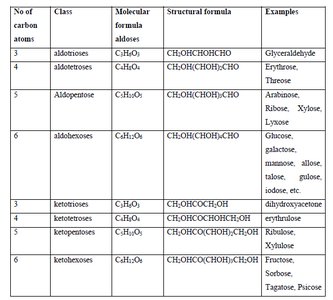
No of carbon atoms | Class | Molecular formula aldoses | Structural formula | Examples |
|---|---|---|---|---|
3 | aldotrioses | C3H6O3 | CH2OH(CHOH)CHO | Glyceraldehyde |
4 | aldotetroses | C4H8O4 | CH2OH(CHOH)2CHO | Erythrose, Threose |
5 | aldopentoses | C5H10O5 | CH2OH(CHOH)3CHO | Arabinose, Ribose, Xylose, Lyxose |
6 | aldohexoses | C6H12O6 | CH2OH(CHOH)4CHO | Glucose, galactose, mannose, allose, talose, gulose, idose, etc. |
3 | ketotrioses | C3H6O3 | CH2OHCOCH2OH | Dihydroxyacetone |
5 | ketopentoses | C5H10O5 | CH2OH(CHOH)2COCH2OH | Ribulose, Xylulose |
6 | ketohexoses | C6H12O6 | CH2OH(CHOH)3COCH2OH | Fructose, Sorbose, Tagatose, Psicose |
Biological Functions of Monosaccharides
Glucose: Main energy source for cells; stored as starch in plants and glycogen in animals.
Galactose: Component of lactose in milk.
Fructose: Found in fruits and honey; sweetest natural sugar.
Ribose: Component of RNA and some coenzymes.
Mannose: Important in glycoproteins and mucoproteins.
Disaccharides
Structure and Formation
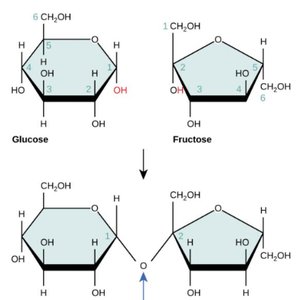
Disaccharides are composed of two monosaccharide units joined by a glycosidic bond, formed via a dehydration (condensation) reaction. The general formula is .
Glycosidic Bond: Covalent bond formed between the anomeric carbon of one sugar and a hydroxyl group of another, releasing water.
Examples: Sucrose (glucose + fructose), lactose (galactose + glucose), maltose (glucose + glucose).
Reducing and Non-Reducing Disaccharides
Disaccharides are classified based on their ability to act as reducing agents:
Reducing Sugars: Have a free hemiacetal group (e.g., maltose, lactose).
Non-Reducing Sugars: Both anomeric carbons are involved in the glycosidic bond, so no free hemiacetal group (e.g., sucrose, trehalose).
Functions of Disaccharides
Sucrose: Main transport sugar in plants; product of photosynthesis.
Lactose: Major sugar in milk; energy source for mammals.
Maltose: Intermediate in starch and glycogen digestion.
Trehalose: Energy source in insects.
Cellobiose: Important in carbohydrate metabolism.
Gentiobiose: Found in plant glycosides and some polysaccharides.
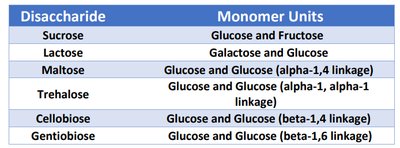
Disaccharide | Monomer Units |
|---|---|
Sucrose | Glucose and Fructose |
Lactose | Galactose and Glucose |
Maltose | Glucose and Glucose (alpha-1,4 linkage) |
Trehalose | Glucose and Glucose (alpha-1,1, alpha-1 linkage) |
Cellobiose | Glucose and Glucose (beta-1,4 linkage) |
Gentiobiose | Glucose and Glucose (beta-1,6 linkage) |
Polysaccharides
Structure and Types
Polysaccharides are large molecules composed of many monosaccharide units linked by glycosidic bonds. They serve as energy storage or structural components in cells.
General Formula:
Examples: Starch, glycogen, cellulose, pectin.
Functions of Polysaccharides
Starch: Main storage polysaccharide in plants.
Glycogen: Main storage polysaccharide in animals.
Cellulose: Structural component of plant cell walls.
Pectin: Used in plant cell walls and in food industry (e.g., jam making).
Nomenclature and Stereochemistry
Naming Conventions
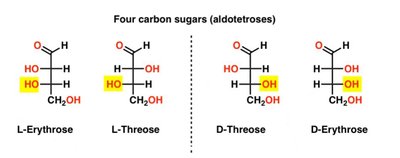
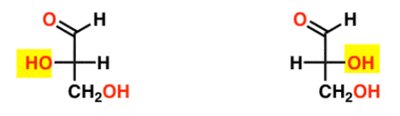
Carbohydrates are named based on the number of carbon atoms and the type of functional group. The suffix "-ose" is used for sugars, with prefixes such as "tri-", "penta-", or "hexa-" indicating the number of carbons. Stereochemistry is indicated by D- or L- prefixes, based on the orientation of the hydroxyl group on the highest-numbered chiral center in the Fischer projection.
D-Sugars: –OH on the right side.
L-Sugars: –OH on the left side.
Cyclic Structures and Anomers
Monosaccharides often form cyclic structures in solution. Five-membered rings are called furanoses, and six-membered rings are pyranoses. The orientation of the OH group at the anomeric carbon creates α- and β-anomers.
Furanose: 5-membered ring.
Pyranose: 6-membered ring.
α-Anomer: OH down (Haworth projection).
β-Anomer: OH up (Haworth projection).
Summary Table: Representative Monosaccharides
Name | Type | Structure |
|---|---|---|
Glucose | Aldohexose | See image_15 |
Fructose | Ketohexose | See image_15 |
Galactose | Aldohexose | See image_15 |
Ribose | Aldopentose | See image_17 |
Conclusion
Carbohydrates are vital biomolecules with diverse roles in energy storage, structure, and cellular communication. Understanding their classification, structure, and function is fundamental to biochemistry and molecular biology.
