 Indietro
Carbohydrates: Structure, Isomerism, and Metabolic Roles
Guida di studio - Note intelligenti
 Appunti personalizzati basati sui tuoi materiali, ampliati con definizioni chiave, esempi e contesto.
Carbohydrates and Metabolism
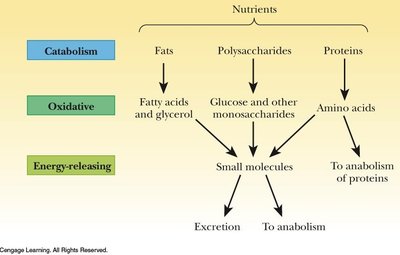
Overview of Metabolic Entry Points
Carbohydrates, fats, and proteins are the primary macronutrients that enter cellular metabolism through distinct breakdown products. These products are further processed to release energy, be excreted, or serve as precursors for biosynthesis.
Fats are broken down into fatty acids and glycerol.
Polysaccharides are broken down into glucose and other monosaccharides.
Proteins are broken down into amino acids.
These breakdown products feed into metabolism as small molecules.
Classification of Carbohydrates
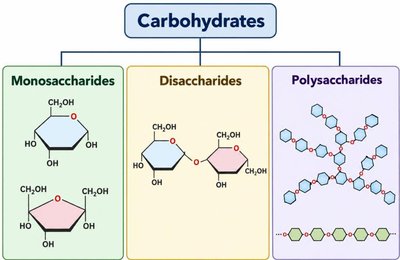
Carbohydrates are classified based on their complexity and structure:
Monosaccharides: Single sugar units (e.g., glucose, fructose).
Disaccharides: Two monosaccharides joined by a glycosidic bond (e.g., sucrose, lactose).
Polysaccharides: Long chains of monosaccharide units (e.g., starch, glycogen).
Carbon Chemistry and Carbohydrate Diversity
Carbon Bonding and Functional Groups
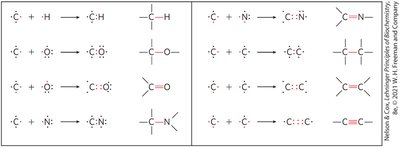
The versatility of carbon allows for the formation of diverse carbohydrate structures.
Carbon forms stable covalent bonds with other carbons, hydrogen, oxygen, and nitrogen.
Carbohydrate skeletons carry multiple hydroxyl groups and one carbonyl group.
Small differences in group arrangement create different sugars.
Monosaccharides: Aldoses and Ketoses
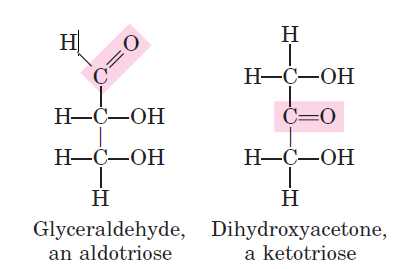
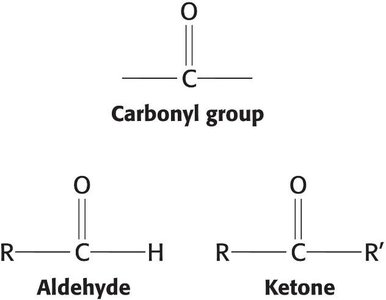
Monosaccharides are classified by the position of their carbonyl group:
Aldoses: Carbonyl group at the end (aldehyde).
Ketoses: Carbonyl group within the chain (ketone).
Common Monosaccharides
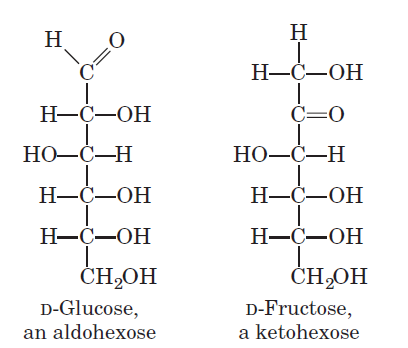
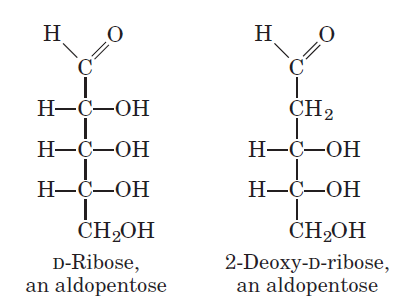
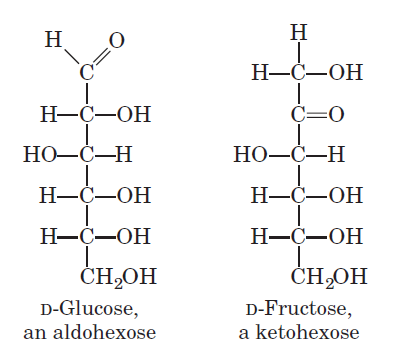
Monosaccharides are classified by carbon number (triose, pentose, hexose).
Examples: D-glucose (aldohexose), D-fructose (ketohexose), D-ribose (aldopentose).
Isomerism in Sugars
Structural Isomers
Structural isomers have the same molecular formula but different connectivity.
Glucose and fructose are structural isomers (C6H12O6).
Stereoisomers
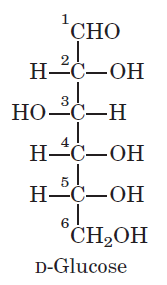
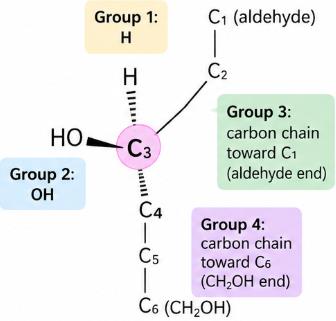
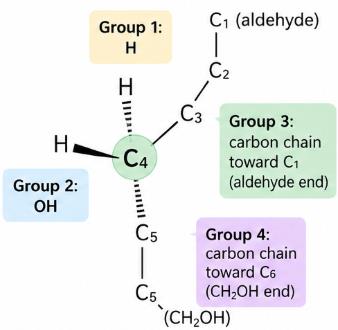
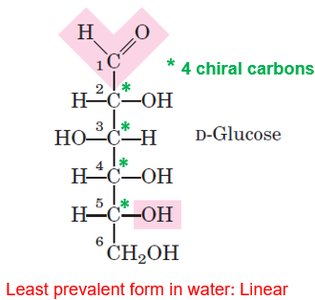
Stereoisomers have the same connectivity but differ in the 3D arrangement of groups around chiral carbons.
Chiral carbons are attached to four different groups.
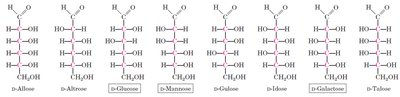
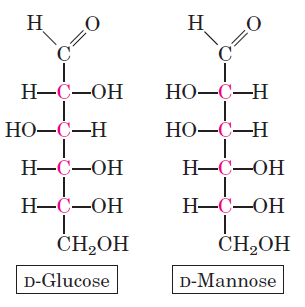
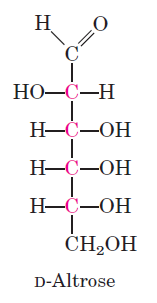
Examples: D-glucose, D-mannose, D-galactose, D-allose.
Biological Importance of Chirality
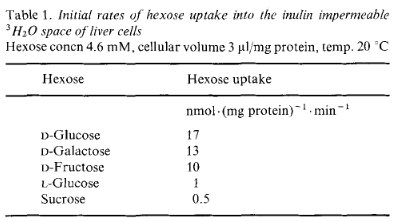
Enzymes and transporters are chiral and can distinguish D- and L-forms.
Small changes in sugar stereochemistry affect recognition, transport, and metabolism.
Types of Stereoisomers
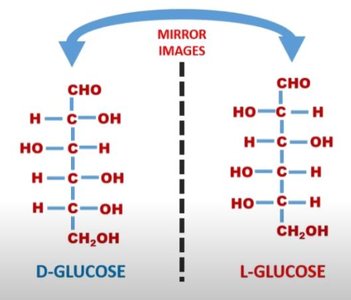
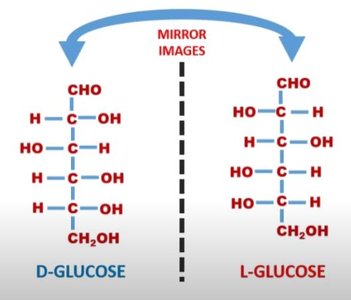
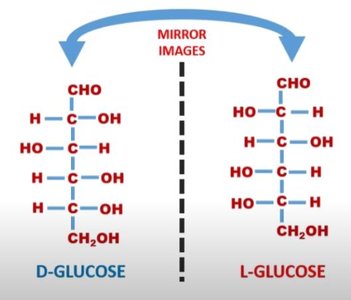
Enantiomers: Mirror images, differ at all chiral centers (e.g., D-glucose vs L-glucose).
Diastereomers: Not mirror images, differ at one or more (but not all) chiral centers.
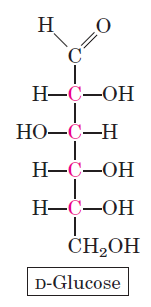
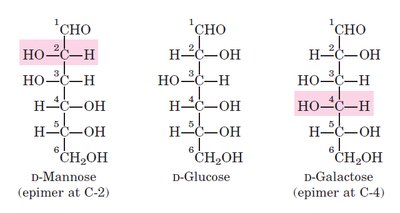
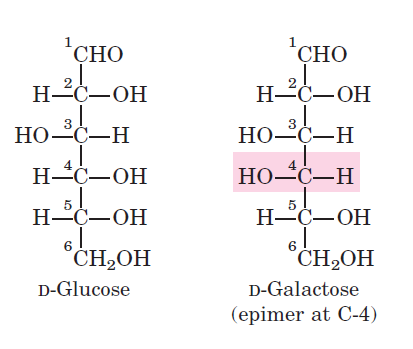
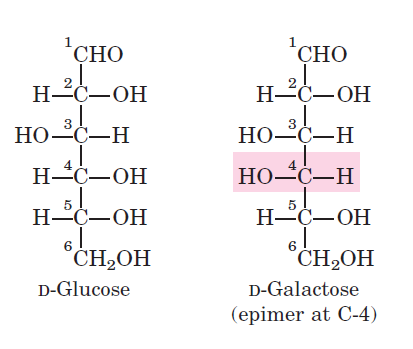
Epimers: Differ at exactly one chiral center.
Anomers: Differ specifically at the anomeric carbon (formed during cyclization).
Epimers
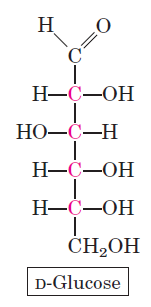
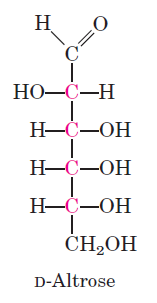
D-mannose is the C-2 epimer of D-glucose.
D-galactose is the C-4 epimer of D-glucose.
Cyclization and Anomers
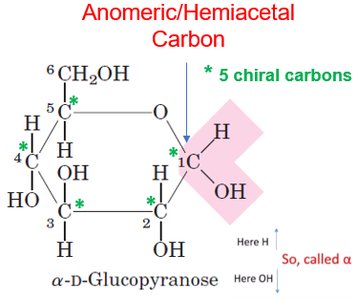
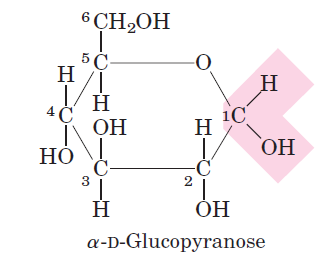
Glucose cyclizes in water, forming a new chiral center at C1 (anomeric carbon).
α-D-glucose: Anomeric OH is down.
β-D-glucose: Anomeric OH is up.
α and β forms interconvert via mutarotation.
Reducing and Nonreducing Sugars
Reducing Sugars
Reducing sugars have a free anomeric carbon and can open to a reactive linear form.
They can be oxidized and react with amino groups on proteins (e.g., HbA1c formation).
Disaccharides and Glycosidic Bonds
Disaccharides are formed by condensation of two cyclic monosaccharides via a glycosidic bond.
If a disaccharide has a free anomeric carbon, it is reducing; if both are locked, it is nonreducing.
Maltose and lactose are reducing; sucrose is nonreducing.
Glycosylation and Polysaccharides
Glycosylation of Proteins
Sugars can be covalently attached to proteins, forming glycoproteins.
O-linked glycosylation: Sugar attaches to Ser/Thr OH group.
N-linked glycosylation: Sugar attaches to Asn amide nitrogen.
Glycans affect protein folding, localization, signaling, and cell-cell recognition.
Polysaccharides: Starch and Glycogen
Starch (amylose and amylopectin) is a storage polysaccharide of D-glucose.
Amylose: Linear (α1-4 linkages).
Amylopectin: Branched (α1-4 and α1-6 linkages).
More branches → more nonreducing ends → faster glucose release.
Carbohydrates as Metabolic Fuel
Central Role of Glucose
Glucose is a central metabolic hub in cells.
Oxidized by glycolysis to produce pyruvate and capture energy.
Stored as glycogen or starch.
Enters the pentose phosphate pathway to make ribose 5-phosphate.
Used to build structural polysaccharides (e.g., proteoglycans, cellulose).
Aerobic Catabolism of Glucose
Complete oxidation of glucose to CO2 and H2O releases large amounts of free energy.
Cells oxidize glucose stepwise through cellular respiration, capturing energy in ATP and NADH.
ATP and Energy Coupling
ATP Hydrolysis and Free Energy
ATP hydrolysis has a large negative ΔG, making it an effective energy currency.
ATP hydrolysis relieves electrostatic repulsion and stabilizes products by resonance and hydration.
Cells couple ATP hydrolysis to unfavorable reactions to make them energetically favorable.
Other High-Energy Phosphorylated Compounds
Compounds like phosphoenolpyruvate (PEP) can regenerate ATP or directly drive unfavorable reactions.
Summary of Key Concepts
Carbohydrates enter metabolism as glucose and other monosaccharides.
Monosaccharides are classified by carbon number and by aldehyde/ketone group.
Sugar stereochemistry matters: enzymes/transporters distinguish D- and L-sugars.
Enantiomers = mirror images; epimers = differ at one chiral carbon; anomers = differ at anomeric carbon.
Cyclization creates the anomeric carbon: α- and β-glucose are anomers and interconvert by mutarotation.
Reducing sugars have a free anomeric carbon and can open to a reactive linear form.
Glycosidic bonds join sugars to form disaccharides and polysaccharides.
Cells harvest energy from sugars gradually and store it in usable chemical forms.
ATP coupling drives unfavorable reactions: ATP hydrolysis has a negative ΔG and can make an overall reaction energetically favorable.
