 Indietro
Carbohydrates: Structure, Stereochemistry, and Biological Roles
Guida di studio - Note intelligenti
 Appunti personalizzati basati sui tuoi materiali, ampliati con definizioni chiave, esempi e contesto.
Carbohydrates: Terminology and Classification
Definitions and Basic Concepts
Carbohydrates are essential biomolecules with the general formula (CH2O)n, where n ranges from 3 to 9 for sugars. They are classified based on their complexity and structure:
Monosaccharides: Simple sugars with 3–9 carbon atoms.
Oligosaccharides: Compounds formed by linking several monosaccharides (e.g., disaccharides).
Polysaccharides: Polymers formed from multiple saccharide units; can be homopolysaccharides or heteropolysaccharides.
Glycan: Generic term for oligosaccharides and polysaccharides.
Sugar: Non-derivatized monosaccharides and small oligosaccharides.
Example: Glucose is a monosaccharide, maltose is a disaccharide, and amylose is a polysaccharide.
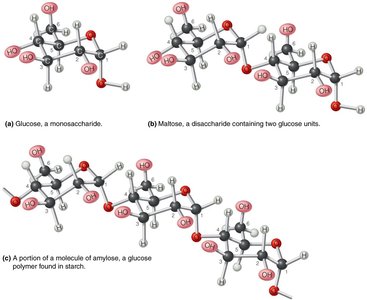
Carbohydrate Functions in Biology
Diverse Roles
Carbohydrates serve multiple functions in living organisms:
Metabolism and Energy Storage: Glucose, glycogen, and starch are central to energy generation and storage.
Molecular Recognition: Important in immune system signaling.
Cellular Protection: Structural components of bacterial and plant cell walls.
Cell Adhesion: Glycoproteins facilitate cell-cell interactions.
Biological Lubrication: Glycosaminoglycans lubricate joints and tissues.
Maintenance of Structure: Cellulose and chitin provide rigidity and support.
Monosaccharide Structure and Stereochemistry
Aldoses and Ketoses
Monosaccharides are classified as aldoses (with an aldehyde group) or ketoses (with a ketone group). The simplest aldose is glyceraldehyde, and the simplest ketose is dihydroxyacetone.
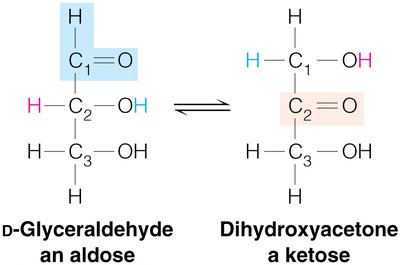
Chirality and Stereochemistry
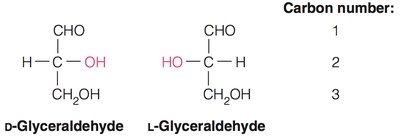
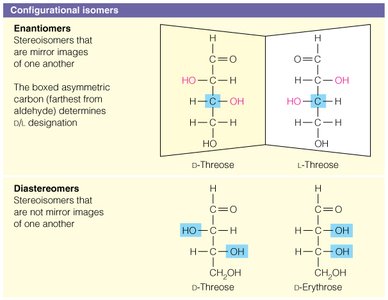
Glyceraldehyde is a chiral molecule, and its configuration can be described using the R/S convention. Enantiomers are mirror-image optical isomers, while diastereomers are not mirror images.
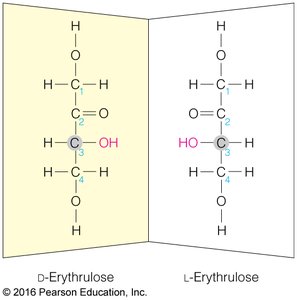
D- and L- Isomers: Determined by the orientation of the –OH group on the chiral carbon furthest from the carbonyl group in a Fischer projection.
Fischer Projections: Compact way to represent stereochemistry; horizontal bonds point toward the viewer, vertical bonds away.
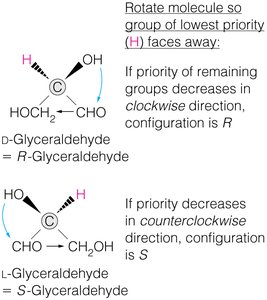
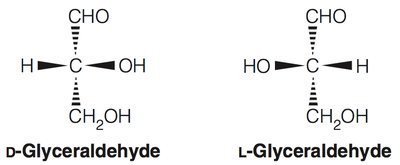
Identifying D- and L- Sugars
On a Fischer projection, the D isomer has the –OH group on the right, and the L isomer has it on the left. The carbonyl carbon is always numbered as 1.
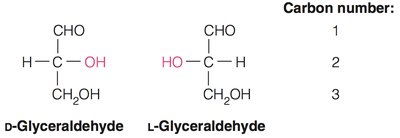
Enantiomers and Diastereomers
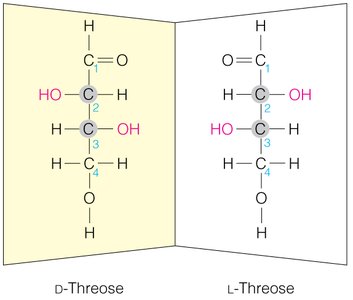
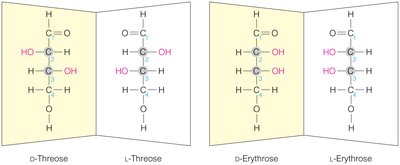
Compounds with more than one asymmetric carbon may be enantiomers or diastereomers. For example, D-threose and D-erythrose are diastereomers.
Cyclization and Anomer Formation
Hemiacetal Formation and Ring Structures
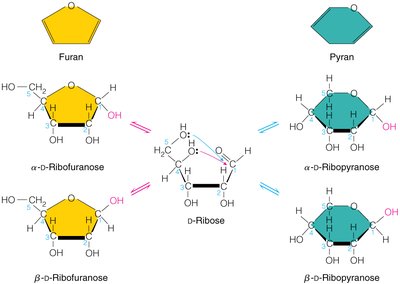
Five- and six-carbon sugars tend to form cyclic hemiacetals, resulting in furanose (five-membered) and pyranose (six-membered) rings. Cyclization creates a new asymmetric center called the anomeric center, designated as α or β. Anomers interconvert by mutarotation.
Epimers and Anomers
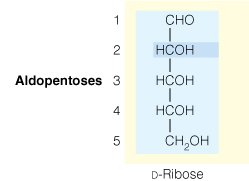
Epimers are isomers differing only in configuration about one carbon other than the anomeric carbon. Anomers differ at the anomeric carbon.
Conformational Isomers
Ring Conformations
Conformational isomers have the same stereochemical configuration but differ in three-dimensional conformation due to bond rotation. The chair form is the most stable for six-membered rings.
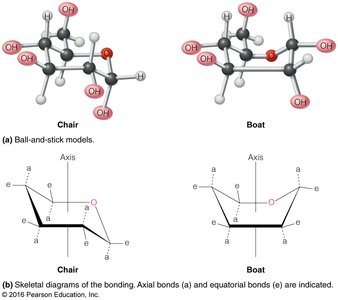
Phosphate Esters and Sugar Phosphates
Metabolic Importance
Sugar phosphates are important intermediates in metabolism, functioning as activated compounds in biosynthetic pathways.
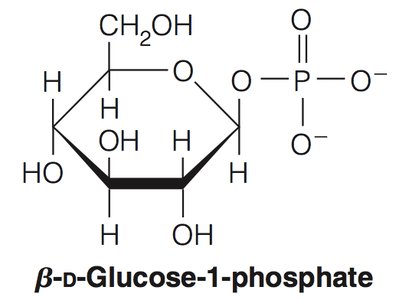
Reduction and Oxidation of Monosaccharides
Reduction
Reduction of the sugar carbonyl yields an alditol (sugar alcohol). For example, reduction of glucose yields D-glucitol (sorbitol), used as a sweetener and thickener.
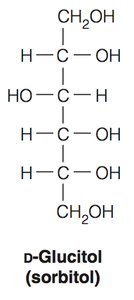
Oxidation
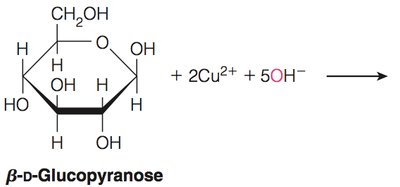
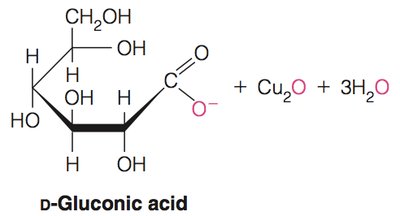
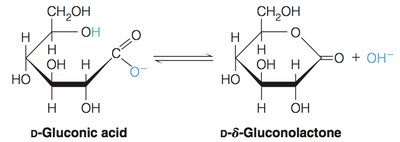
Oxidation at C1 forms an aldonic acid (e.g., D-gluconic acid), which is in equilibrium with its lactone form. Oxidation at C6 forms a uronic acid (e.g., β-D-glucuronic acid). Fehling’s, Benedict’s, and Tollen’s tests are used to detect reducing sugars.
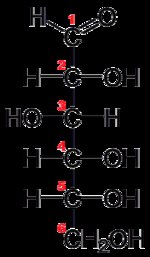
Glycosides and Glycosidic Bonds
Formation and Significance
The elimination of water between the hydroxyl group of the anomeric carbon of a cyclic saccharide and the hydroxyl group of another compound yields an O-glycoside. The newly formed bond is called a glycosidic bond.
Monosaccharides can form polysaccharides via glycosidic bonds, which are essential for the structure and function of complex carbohydrates.
Energy Storage Polysaccharides
Starch, Glycogen, and Cellulose
Starch (plants) contains both amylopectin (α(1→4) glucose polymer with α(1→6) branches) and amylose (α(1→4) unbranched polymer). Glycogen (animals/microbes) is similar to amylopectin but has higher molecular weight and more frequent branch points. Cellulose is a linear glucose polymer with β(1→4) linkages, providing structural support in plants.
Structural Polysaccharides and Glycans
Chitin and Glycosaminoglycans
Chitin is a homopolymer of N-acetyl-β-D-glucosamine, serving as a major structural component in arthropod exoskeletons. Glycosaminoglycans, such as heparin and hyaluronic acid, play structural and nonstructural roles in vertebrates.
Cell Wall Structure in Bacteria
Gram-Positive Cell Wall
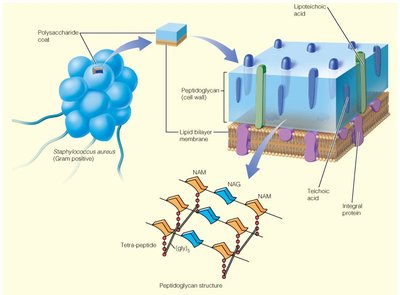
The gram-positive cell wall has a cross-linked, multilayered polysaccharide-peptide complex called peptidoglycan. This is the site of action for antibiotics like penicillin, which inhibit the crosslinking reaction in peptidoglycan synthesis.
Glycoproteins and Biological Recognition
N-linked and O-linked Glycoproteins
Glycoproteins are proteins with carbohydrate chains attached. N-linked glycoproteins have oligosaccharides attached to the nitrogen atom of asparagine, while O-linked glycoproteins are attached to the oxygen atom of serine or threonine. These modifications are crucial for cell recognition, immune response, and viral infection mechanisms.
Summary Table: Carbohydrate Stereochemistry Terminology
Term | Definition | Example |
|---|---|---|
Enantiomers | Stereoisomers that are mirror images | D- and L-glyceraldehyde |
Diastereomers | Stereoisomers that are not mirror images | D-threose and D-erythrose |
Anomers | Stereoisomers that differ at the anomeric carbon | α- and β-glucopyranose |
Epimers | Stereoisomers that differ at one carbon other than the anomeric carbon | Glucose and mannose |
Key Equations
General formula for carbohydrates:
Fehling's reaction (reducing sugar test):
