 Indietro
Citric Acid Cycle, Pyruvate Metabolism, and Oxidative Phosphorylation: Regulation and Biochemical Pathways
Guida di studio - Note intelligenti
 Appunti personalizzati basati sui tuoi materiali, ampliati con definizioni chiave, esempi e contesto.
CITRIC ACID CYCLE, PYRUVATE METABOLISM, AND OXIDATIVE PHOSPHORYLATION
Glycolysis vs. Gluconeogenesis
Glycolysis and gluconeogenesis are central metabolic pathways that regulate glucose levels in the body. Glycolysis breaks down glucose to pyruvate, generating ATP and NADH, while gluconeogenesis synthesizes glucose from non-carbohydrate precursors, especially during fasting.
Glycolysis: Converts glucose to 2 pyruvate, yielding a net 2 ATP and 2 NADH.
Gluconeogenesis: Occurs mainly in the liver and kidney cortex, using lactate, glycerol, and glucogenic amino acids as substrates. It is energy-consuming, requiring 4 ATP, 2 GTP, and 2 NADH per glucose synthesized.
Irreversible Steps: Steps 1, 3, and 10 of glycolysis are irreversible and require bypass reactions in gluconeogenesis.
Reciprocal Regulation: Fructose-2,6-bisphosphate activates PFK-1 (glycolysis) and inhibits FBPase-1 (gluconeogenesis).
Hormonal Control: Insulin promotes glycolysis; glucagon stimulates gluconeogenesis during fasting.
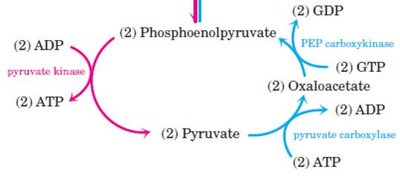
Bypass 3: Pyruvate to Phosphoenolpyruvate (PEP)
The conversion of pyruvate to PEP is a key bypass in gluconeogenesis, circumventing the irreversible pyruvate kinase step in glycolysis. This process involves two enzymes: pyruvate carboxylase and PEP carboxykinase.
Step 1 (Pyruvate Carboxylase): Pyruvate is converted to oxaloacetate (OAA) in the mitochondrial matrix, using ATP and bicarbonate (HCO3-).
Step 2 (PEP Carboxykinase): OAA is converted to PEP in the cytosol, using GTP and releasing CO2.
Energy Cost: 1 ATP + 1 GTP per pyruvate, or 2 ATP + 2 GTP per glucose.
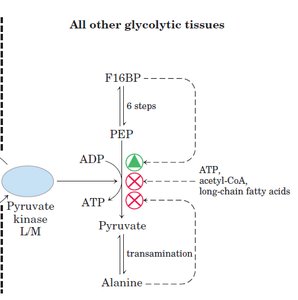
Regulation: ATP, acetyl-CoA, long-chain fatty acids, and alanine inhibit pyruvate kinase; fructose-1,6-bisphosphate activates it (feedforward activation).

Regulation of Pyruvate Kinase
Pyruvate kinase is regulated allosterically and by phosphorylation, especially in the liver. During fasting, glucagon activates PKA, which phosphorylates and inactivates pyruvate kinase, reducing glycolysis and favoring gluconeogenesis.
Allosteric Regulation: Skeletal muscle PKM1 is less sensitive; liver isoform is regulated by phosphorylation.
Hormonal Regulation: Glucagon → cAMP → PKA → phosphorylation → reduced glycolysis.
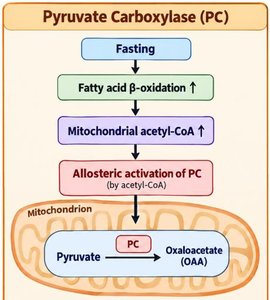
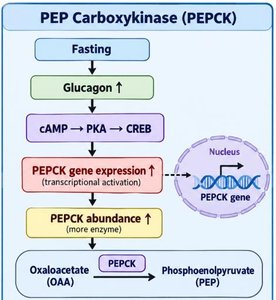
Pyruvate Carboxylase (PC) and PEP Carboxykinase (PEPCK) Regulation
PC and PEPCK are key regulatory enzymes in gluconeogenesis, responding to energy and hormonal signals.
Pyruvate Carboxylase: Allosterically activated by acetyl-CoA, especially during fatty acid β-oxidation.
PEP Carboxykinase: Regulated by gene expression; glucagon increases PEPCK transcription via cAMP-PKA-CREB pathway, while insulin suppresses it via PI3K-Akt-FOXO1.
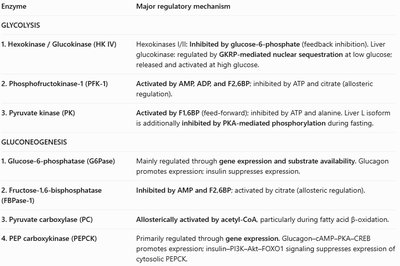
Summary Table: Regulation of Glycolysis and Gluconeogenesis
Enzyme | Major regulatory mechanism |
|---|---|
Hexokinase / Glucokinase | Feedback inhibition by glucose-6-phosphate; GKRP-mediated nuclear sequestration |
Phosphofructokinase-1 (PFK-1) | Activated by AMP, ADP, F2,6BP; inhibited by ATP and citrate |
Pyruvate kinase (PK) | Activated by F1,6BP; inhibited by ATP, alanine, acetyl-CoA; liver isoform inhibited by PKA-mediated phosphorylation |
Glucose-6-phosphatase (G6Pase) | Gene expression and substrate availability; glucagon promotes expression |
Fructose-1,6-bisphosphatase (FBPase-1) | Inhibited by AMP and F2,6BP |
Pyruvate carboxylase (PC) | Allosterically activated by acetyl-CoA |
PEP carboxykinase (PEPCK) | Gene expression; glucagon-cAMP-PKA-CREB promotes expression, insulin suppresses |
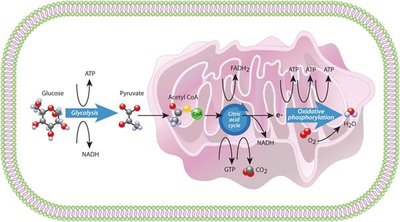
Overview: Glycolysis, Citric Acid Cycle, and Oxidative Phosphorylation
Glucose metabolism involves glycolysis, the citric acid cycle (TCA), and oxidative phosphorylation. Glycolysis produces pyruvate, which is converted to acetyl-CoA and enters the TCA cycle. The TCA cycle generates NADH and FADH2, which fuel oxidative phosphorylation for ATP synthesis.
Glycolysis: Glucose → pyruvate + ATP + NADH
TCA Cycle: Acetyl-CoA → CO2 + NADH + FADH2 + GTP
Oxidative Phosphorylation: NADH/FADH2 → ATP (via electron transport chain)
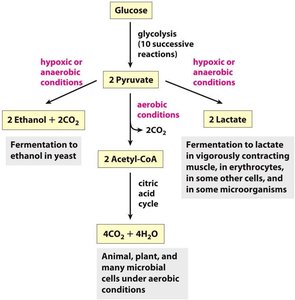
Fate of Pyruvate: Aerobic and Anaerobic Conditions
Pyruvate, the end product of glycolysis, can be metabolized differently depending on oxygen availability.
Aerobic: Pyruvate is converted to acetyl-CoA and enters the TCA cycle.
Anaerobic: Pyruvate is reduced to lactate (in animals) or ethanol (in yeast).
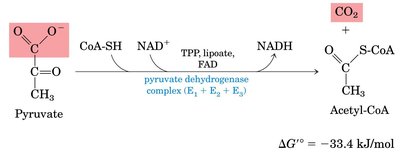
Pyruvate Dehydrogenase Complex (PDH): Bridging Glycolysis and TCA Cycle
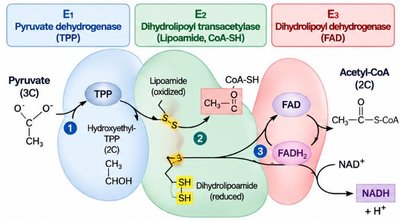
The PDH complex catalyzes the oxidative decarboxylation of pyruvate to acetyl-CoA, linking glycolysis to the TCA cycle. This reaction is irreversible and highly regulated.
Reaction: Pyruvate + CoA-SH + NAD+ → Acetyl-CoA + CO2 + NADH
ΔG°′: −33.4 kJ/mol
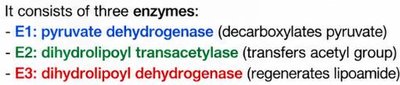
Enzyme Components: E1 (pyruvate dehydrogenase, TPP), E2 (dihydrolipoyl transacetylase, lipoamide), E3 (dihydrolipoyl dehydrogenase, FAD)
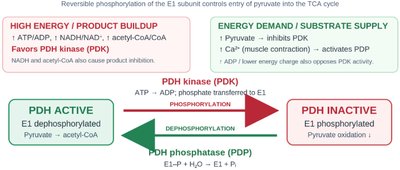
Regulation: PDH is active when dephosphorylated; phosphorylation by PDH kinase inactivates it.
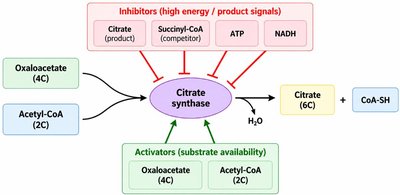
Citrate Synthase: First Step of the TCA Cycle
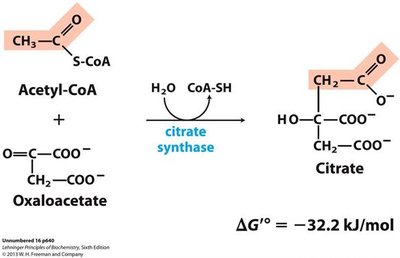
Citrate synthase catalyzes the condensation of acetyl-CoA and oxaloacetate to form citrate, the first intermediate of the TCA cycle. This reaction is irreversible and regulated by substrate availability and product inhibition.
Reaction: Acetyl-CoA + Oxaloacetate + H2O → Citrate + CoA-SH
ΔG°′: −32.2 kJ/mol
Regulation: Inhibited by citrate, succinyl-CoA, ATP, NADH; activated by substrate availability.
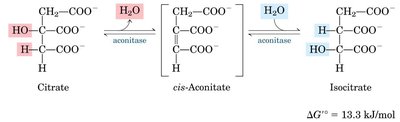
Aconitase: Citrate to Isocitrate
Aconitase catalyzes the reversible isomerization of citrate to isocitrate via cis-aconitate. This rearrangement is necessary because citrate's tertiary alcohol cannot be oxidized, while isocitrate's secondary alcohol can.
Reaction: Citrate → cis-aconitate → Isocitrate
ΔG°′: +13.3 kJ/mol (unfavorable, pulled forward by rapid consumption of isocitrate)
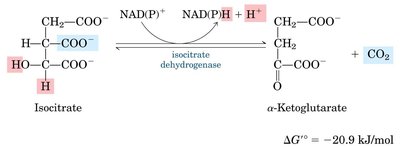
Isocitrate Dehydrogenase: Oxidative Decarboxylation
Isocitrate dehydrogenase catalyzes the conversion of isocitrate to α-ketoglutarate, producing NADH and CO2. This is a major regulatory step in the TCA cycle.
Reaction: Isocitrate + NAD+ → α-Ketoglutarate + CO2 + NADH
ΔG°′: −20.9 kJ/mol
Regulation: Activated by ADP and Ca2+; inhibited by ATP and NADH.
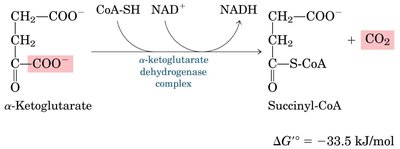
α-Ketoglutarate Dehydrogenase: Second Oxidative Decarboxylation
α-Ketoglutarate dehydrogenase converts α-ketoglutarate to succinyl-CoA, producing NADH and CO2. The enzyme is structurally similar to PDH and is regulated by product inhibition and Ca2+ activation.
Reaction: α-Ketoglutarate + CoA-SH + NAD+ → Succinyl-CoA + CO2 + NADH
ΔG°′: −33.5 kJ/mol
Regulation: Inhibited by NADH and succinyl-CoA; activated by Ca2+.
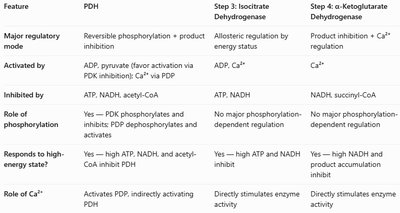
Summary Table: Regulation of PDH, Isocitrate Dehydrogenase, and α-Ketoglutarate Dehydrogenase
Feature | PDH | Isocitrate Dehydrogenase | α-Ketoglutarate Dehydrogenase |
|---|---|---|---|
Regulatory mode | Phosphorylation + product inhibition | Allosteric regulation | Product inhibition + Ca2+ regulation |
Activated by | ADP, pyruvate, Ca2+ | ADP, Ca2+ | Ca2+ |
Inhibited by | ATP, NADH, acetyl-CoA | ATP, NADH | NADH, succinyl-CoA |
Role of Ca2+ | Activates PDP | Directly stimulates activity | Directly stimulates activity |
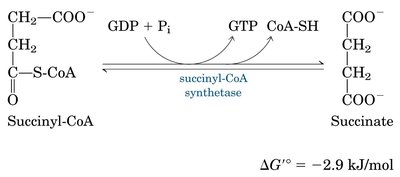
Succinyl-CoA Synthetase: Substrate-Level Phosphorylation
Succinyl-CoA synthetase catalyzes the conversion of succinyl-CoA to succinate, generating GTP (or ATP) via substrate-level phosphorylation. This is the only TCA cycle step that directly produces a nucleoside triphosphate.
Reaction: Succinyl-CoA + GDP + Pi → Succinate + GTP + CoA-SH
ΔG°′: −2.9 kJ/mol
Energy Coupling: Thioester hydrolysis drives GTP synthesis.
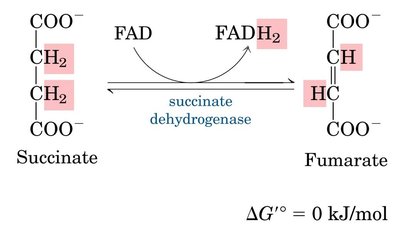
Succinate Dehydrogenase: Oxidation to Fumarate
Succinate dehydrogenase oxidizes succinate to fumarate, reducing FAD to FADH2. It is the only TCA cycle enzyme embedded in the inner mitochondrial membrane and also functions as Complex II of the electron transport chain.
Reaction: Succinate + FAD → Fumarate + FADH2
ΔG°′: 0 kJ/mol
Electron Transfer: FADH2 passes electrons to ubiquinone (Q), forming QH2.
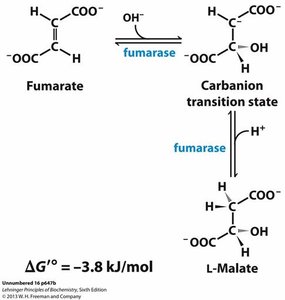
Fumarase: Hydration of Fumarate to L-Malate
Fumarase catalyzes the hydration of fumarate to L-malate, introducing an –OH group and a hydrogen atom. The reaction is stereospecific and slightly favorable.
Reaction: Fumarate + H2O → L-Malate
ΔG°′: −3.8 kJ/mol
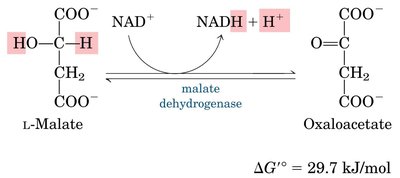
Malate Dehydrogenase: Oxidation to Oxaloacetate
Malate dehydrogenase catalyzes the oxidation of L-malate to oxaloacetate, producing NADH. This reaction is highly unfavorable under standard conditions, but is pulled forward by rapid consumption of oxaloacetate by citrate synthase.
Reaction: L-Malate + NAD+ → Oxaloacetate + NADH + H+
ΔG°′: +29.7 kJ/mol
Summary: TCA Cycle Regulation and Energy Yield
The TCA cycle is tightly regulated by cellular energy status, substrate availability, and product inhibition. Key regulatory enzymes include PDH, citrate synthase, isocitrate dehydrogenase, and α-ketoglutarate dehydrogenase.
Per Glucose: 6 NADH (15 ATP), 2 GTP (2 ATP), 2 FADH2 (3 ATP) → Total: 20 ATP
Regulation: PDH is regulated by phosphorylation; isocitrate dehydrogenase and α-KGDH by allosteric and product inhibition.
Anabolic Roles of the TCA Cycle
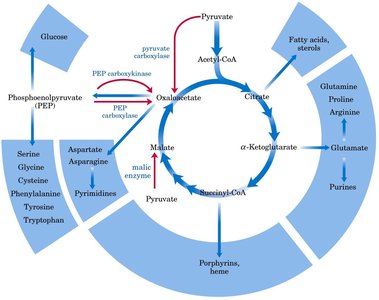
The TCA cycle provides intermediates for biosynthesis of amino acids, lipids, heme, and nucleotides. It is central to both catabolic and anabolic metabolism.
Electron Transport Chain (ETC) and Oxidative Phosphorylation
NADH and FADH2 generated by the TCA cycle carry high-energy electrons to the ETC in the inner mitochondrial membrane. Electron transfer through complexes I-IV pumps protons, creating a proton gradient that powers ATP synthase.
Complex I: NADH dehydrogenase; pumps 4 H+ per NADH oxidized.
Complex II: Succinate dehydrogenase; does not pump protons.
Complex III: Cytochrome bc1 complex; transfers electrons from QH2 to cytochrome c, pumps 4 H+.
Complex IV: Cytochrome c oxidase; transfers electrons to O2, pumps 4 H+ per O2 reduced.
Protein Complexes of the Respiratory Chain
Enzyme complex/protein | Mass (kDa) | Number of subunits | Prosthetic group(s) |
|---|---|---|---|
I NADH dehydrogenase | 850 | 45 (14) | FMN, Fe-S |
II Succinate dehydrogenase | 140 | 4 | FAD, Fe-S |
III Ubiquinone: cytochrome c oxidoreductase | 250 | 11 | Hemes, Fe-S |
Cytochrome c | 13 | 1 | Heme |
IV Cytochrome oxidase | 204 | 13 (3–4) | Hemes; CuA, CuB |
ATP Synthase: Chemiosmotic Coupling and Rotary Mechanism
ATP synthase uses the proton-motive force generated by the ETC to synthesize ATP from ADP and Pi. The enzyme consists of F0 (proton channel) and F1 (catalytic headpiece) components. Proton flow drives rotation, enabling ATP synthesis and release.
F0: Membrane-embedded proton channel with rotating c-ring.
F1: Catalytic headpiece with three β subunits cycling through conformational states.
Summary: Regulation of Glucose Breakdown Pathways
Gluconeogenesis: PC and PEPCK bypass pyruvate kinase, using ATP and GTP.
Pyruvate Oxidation: PDH converts pyruvate to acetyl-CoA, producing NADH and CO2.
TCA Cycle: Generates NADH, FADH2, GTP, and CO2; regulated by energy status.
Biosynthesis: TCA intermediates supply precursors for amino acids, lipids, heme, and nucleotides.
Electron Transport Chain: Complexes I-IV transfer electrons to O2; I, III, IV pump protons.
ATP Synthesis: Proton-motive force drives ATP synthase.
Additional info: The notes cover advanced regulation and integration of glycolysis, gluconeogenesis, TCA cycle, and oxidative phosphorylation, suitable for college-level biochemistry. All images included are directly relevant to the biochemical pathways and regulatory mechanisms discussed.
