 Indietro
Enzyme Function, Regulation, and Oxygen Transport: Biochemistry Study Guide
Guida di studio - Note intelligenti
 Appunti personalizzati basati sui tuoi materiali, ampliati con definizioni chiave, esempi e contesto.
Enzyme Classes and Catalytic Mechanisms
Major Classes of Enzymes
Enzymes are biological catalysts essential for metabolic processes, classified by the type of reaction they catalyze. Understanding these classes is fundamental for biochemistry students.
Oxidoreductases: Catalyze oxidation-reduction reactions, often using cofactors like NADH or FADH2.
Transferases: Transfer functional groups (e.g., glycosyl, methyl, phosphoryl) between molecules. Example: Aminotransferases.
Hydrolases: Catalyze hydrolytic cleavage of bonds (C–C, C–O, C–N) by adding water. Example: Chymotrypsin.
Lyases: Cleave bonds by atom elimination, generating double bonds. Example: Aldolase B in glycolysis.
Isomerases: Rearrange atoms within a molecule to form isomers.
Ligases: Join two molecules together, coupled to ATP hydrolysis.
Enzyme Catalytic Mechanisms
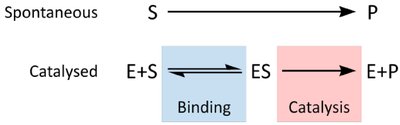
Enzymes accelerate reactions by lowering activation energy through several mechanisms:
Catalysis by Proximity: Enzymes bind substrates in the active site, increasing local concentration and orienting them for reaction.
Acid-Base Catalysis: Ionizable amino acid side chains act as acids or bases to facilitate reactions.
Catalysis by Strain: Enzymes bind substrates in a strained conformation, mimicking the transition state and weakening targeted bonds.
Covalent Catalysis: Formation of a covalent bond between enzyme and substrate, often involving nucleophilic amino acids (e.g., histidine, serine).
Cofactors, Coenzymes, and Prosthetic Groups
Enzyme activity often requires additional non-protein molecules:
Prosthetic Groups: Tightly bound, often covalently, to the enzyme (e.g., heme, FAD).
Cofactors: Inorganic ions (e.g., Mg2+, Zn2+) that associate transiently with enzymes.
Coenzymes: Organic molecules (e.g., NAD+, thiamine pyrophosphate) that bind reversibly and are required for catalysis.
Examples of Coenzymes and Prosthetic Groups
NAD/FAD: Redox reactions
Pantothenic acid (CoA): Acyl group carrier
Thiamine pyrophosphate: Decarboxylation
Pyridoxal phosphate: Transamination
Biotin: Carboxylation
Cobalamin: Carbon transfers
Heme: Oxygen transport
Enzyme Kinetics
Michaelis-Menten Kinetics
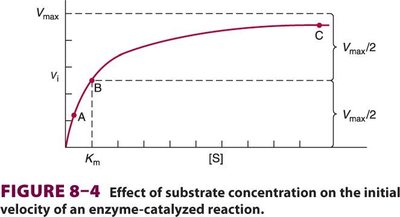
The Michaelis-Menten model describes the rate of enzyme-catalyzed reactions as a function of substrate concentration.
Vmax: Maximum reaction velocity
Km: Substrate concentration at which the reaction rate is half of Vmax
Vi: Initial velocity
Michaelis-Menten Equation:
The model assumes substrate binding is in equilibrium and product formation is irreversible.
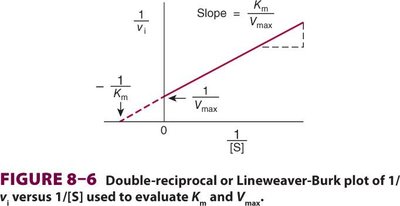
Lineweaver-Burk Plot
The Lineweaver-Burk plot is a double-reciprocal graph used to determine Km and Vmax:
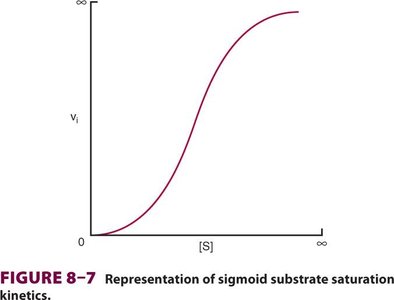
Hill Equation and Sigmoidal Kinetics
Some enzymes, especially allosteric ones, display sigmoidal substrate saturation kinetics, described by the Hill equation:
Enzyme Inhibition and Regulation
Types of Enzyme Inhibition
Enzyme activity can be regulated by inhibitors:
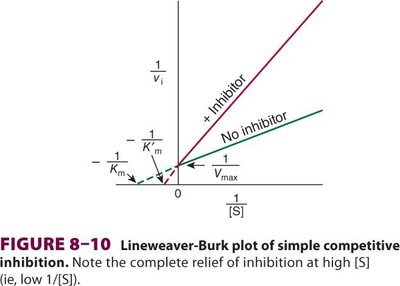
Competitive Inhibition: Inhibitor binds the active site, increasing apparent Km but not affecting Vmax.
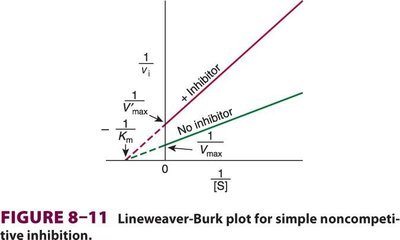
Noncompetitive Inhibition: Inhibitor binds elsewhere, decreasing Vmax without changing Km.
Allosteric Regulation and Covalent Modification
Enzyme activity can be rapidly regulated by allosteric effectors and covalent modifications:
Allosteric Regulation: Effectors bind at sites other than the active site, modifying enzyme activity (activation or inhibition).
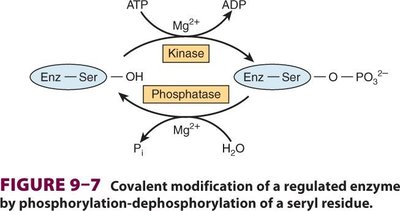
Covalent Modification: Includes phosphorylation, acetylation, and methylation, which can alter enzyme activity, location, or stability.
Example: Phosphorylation
Phosphorylation of serine, threonine, or tyrosine residues by kinases (using ATP) can activate or inhibit enzymes. Dephosphorylation by phosphatases reverses this effect.
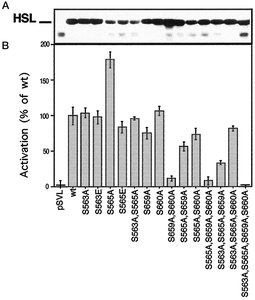
Example: Hormone-Sensitive Lipase Regulation
Mutations that remove phosphorylation sites can significantly reduce enzyme activity, as shown in experimental data.
Protein Function: Hemoglobin and Myoglobin
Structure and Function
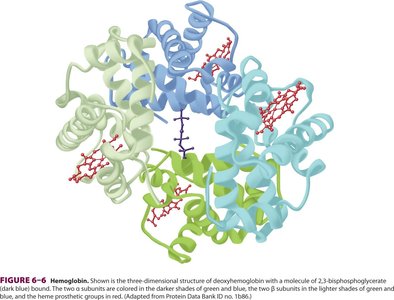
Hemoglobin and myoglobin are homologous proteins involved in oxygen transport and storage. Both contain a heme prosthetic group for oxygen binding.
Hemoglobin: Heterotetramer (2 α, 2 β subunits), binds 4 O2 molecules, displays cooperative binding.
Myoglobin: Monomer, binds 1 O2 molecule, displays hyperbolic binding curve.

Oxygen Binding and Cooperativity
Hemoglobin exhibits cooperative binding due to its quaternary structure, resulting in a sigmoidal oxygen-binding curve. Myoglobin, lacking quaternary structure, binds oxygen with higher affinity and displays a hyperbolic curve.
Allosteric Regulation of Hemoglobin
Hemoglobin's oxygen affinity is modulated by allosteric effectors:
2,3-Bisphosphoglycerate (BPG): Stabilizes the T-state, promoting oxygen release.
Protons (H+): Decreased pH (Bohr effect) reduces oxygen affinity.
CO2: Also stabilizes the T-state.
Clinical Importance of Enzymes
Diagnostic Enzymes
Measurement of specific enzymes in serum can indicate tissue damage or disease:
Serum Enzyme | Role in Metabolism | Major Diagnostic Use |
|---|---|---|
Amylase | Carbohydrate digestion | Acute pancreatitis |
Alanine aminotransferase (ALT) | Amino group transfer | Viral hepatitis, liver/muscle damage |
Lactate dehydrogenase | Anaerobic glycolysis | Liver disease, muscle damage |
Lipase | Lipid digestion | Acute pancreatitis |
Troponin | Cardiac contraction | Heart attack (MI) |
β-Glucocerebrosidase | Lipid metabolism | Gaucher disease |
Transketolase | Pentose phosphate pathway | Thiamine deficiency |
Regulation of Metabolic Pathways
Metabolic Flux and Feedback Inhibition
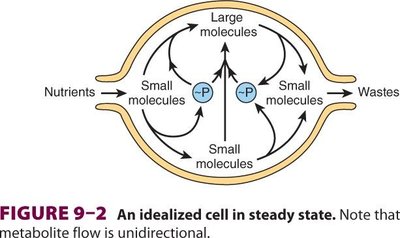
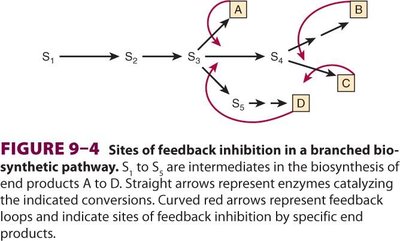
Metabolic pathways are regulated by enzyme quantity and activity, often through feedback inhibition by pathway products.
Protein Turnover and Ubiquitin-Proteasome System
The balance between enzyme synthesis and degradation determines metabolic flux. The ubiquitin-proteasome system targets proteins for degradation, affecting product formation.
Increased ubiquitination → increased degradation → decreased product production
Decreased degradation → enzyme accumulation → increased product production
Summary Table: Enzyme Classes and Functions
Enzyme Class | Reaction Type | Example |
|---|---|---|
Oxidoreductase | Oxidation-reduction | Lactate dehydrogenase |
Transferase | Group transfer | Aminotransferase |
Hydrolase | Hydrolytic cleavage | Chymotrypsin |
Lyase | Bond cleavage by elimination | Aldolase B |
Isomerase | Isomerization | Phosphoglucose isomerase |
Ligase | Bond formation with ATP hydrolysis | DNA ligase |
Additional info: This study guide expands on brief points with academic context, definitions, and examples to ensure completeness and clarity for exam preparation.
