 Indietro
Lecture 11. Enzymes II: Kinetics
Guida di studio - Note intelligenti
 Appunti personalizzati basati sui tuoi materiali, ampliati con definizioni chiave, esempi e contesto.
Enzyme Kinetics: Principles and Importance
Why Study Enzyme Kinetics?
Enzyme kinetics is the study of the rates at which enzymatic reactions occur and how these rates are affected by variables such as substrate concentration, pH, and inhibitors. Understanding enzyme kinetics allows biochemists to:
Define reaction steps in complex biochemical pathways.
Measure regulation and perturbations in enzyme activity.
Quantify enzyme efficiency and substrate affinity.
Develop drugs and understand mechanisms of inhibition.
Reaction rates are typically measured by monitoring substrate ([S]) or product ([P]) concentrations over time using techniques such as UV/Vis spectroscopy, fluorescence, or radioactivity.
General Mechanisms of Enzyme Catalysis
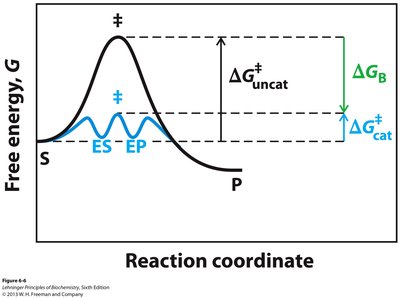
How Enzymes Lower Activation Energy
Enzymes accelerate reactions by lowering the activation energy (ΔG‡) required for the transition state. They stabilize the transition state through specific interactions, making the reaction proceed faster.
Acid/base catalysis: Enzyme donates or accepts protons.
Covalent catalysis: Enzyme forms a transient covalent bond with the substrate.
Metal catalysis: Metal ions facilitate electron transfer or substrate binding.
Steady-State Kinetics: The Michaelis-Menten Model
Basic Concepts and Derivation
The Michaelis-Menten equation describes the initial velocity (V0) of an enzyme-catalyzed reaction as a function of substrate concentration ([S]). The model assumes:
[S] >> [E], so substrate concentration is effectively constant.
The enzyme-substrate complex (E·S) is in a steady state.
Product concentration ([P]) is negligible at early reaction times.
The general reaction scheme is:
E + S ⇌ E·S → E + P
Key rate constants: k1 (binding), k-1 (dissociation), k2 (product formation).
Michaelis-Menten Equation
The Michaelis-Menten equation is:
Where:
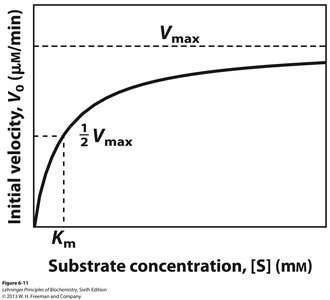
Vmax: Maximum velocity when all enzyme is saturated with substrate.
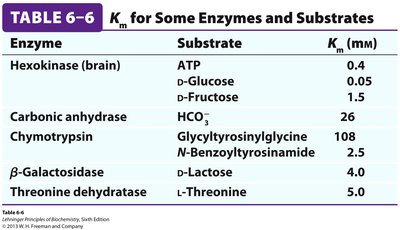
Km: Michaelis constant, a measure of substrate affinity.
Key Parameters and Their Significance
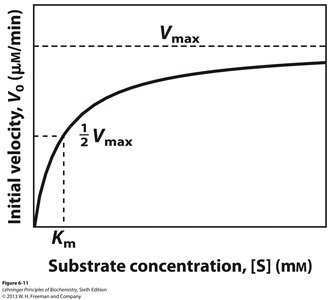
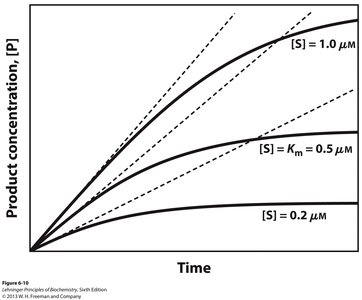
Km: Substrate concentration at which V0 = ½ Vmax. Lower Km indicates higher affinity.
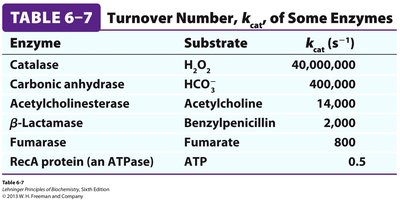
kcat: Turnover number, the number of substrate molecules converted per enzyme per second.
Catalytic efficiency: ; higher values indicate more efficient enzymes.
Michaelis-Menten Insights
At low [S] (), (first-order kinetics).
At high [S] (), (zero-order kinetics).
Km is not the same as dissociation constant (Kd), but related.
Enzyme Inhibition
Types of Inhibition
Enzyme inhibitors reduce enzyme activity by interfering with substrate binding or catalysis. Inhibitors can be reversible or irreversible, and are important in drug design and regulation.
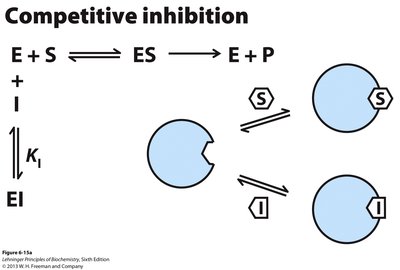
Competitive inhibition: Inhibitor resembles substrate and binds to the active site, preventing substrate binding.
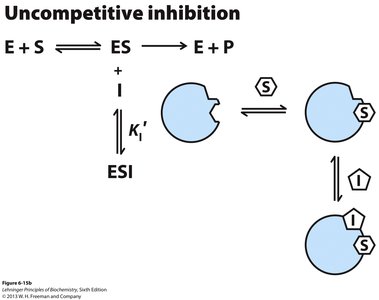
Uncompetitive inhibition: Inhibitor binds only to the enzyme-substrate complex, preventing product formation.
Mixed inhibition: Inhibitor can bind to both the enzyme and the enzyme-substrate complex.
Effects of Inhibitors on Kinetic Parameters
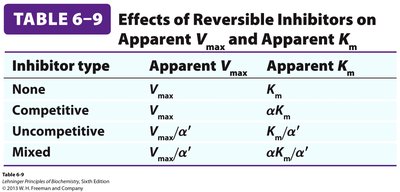
Inhibitors alter apparent Vmax and Km values:
Inhibitor type | Apparent Vmax | Apparent Km |
|---|---|---|
None | Vmax | Km |
Competitive | Vmax | αKm |
Uncompetitive | Vmax/α' | Km/α' |
Mixed | Vmax/α' | αKm/α' |
Summary and Applications
What Can Be Learned?
By mastering enzyme kinetics and inhibition, students can:
Predict enzyme behavior under different conditions.
Understand the impact of inhibitors on metabolic pathways.
Apply kinetic models to drug development and disease treatment.
Example: Competitive inhibitors are often used as drugs to block enzyme activity, such as statins inhibiting HMG-CoA reductase in cholesterol biosynthesis.
Additional info: The notes above expand on the original lecture content, providing definitions, equations, and examples for clarity and completeness.
