 Indietro
Enzyme Mechanisms and Catalysis: Biochemistry Study Notes
Guida di studio - Note intelligenti
 Appunti personalizzati basati sui tuoi materiali, ampliati con definizioni chiave, esempi e contesto.
Enzyme Mechanisms and Catalysis
Introduction to Enzyme Catalysis
Enzymes are biological catalysts that accelerate chemical reactions by lowering the activation energy required for the reaction to proceed. They achieve remarkable rate enhancements, often by factors of 106 to 1017 compared to uncatalyzed reactions. Understanding enzyme mechanisms is crucial for biochemistry students, as it provides insight into how biological systems control and regulate metabolic pathways.
Transition State Theory and Enzyme Binding
The transition state is a high-energy intermediate state during a chemical reaction. Enzymes bind the transition state more tightly than the substrate or product, stabilizing it and lowering the activation energy barrier. This preferential binding is a key feature of enzyme catalysis.
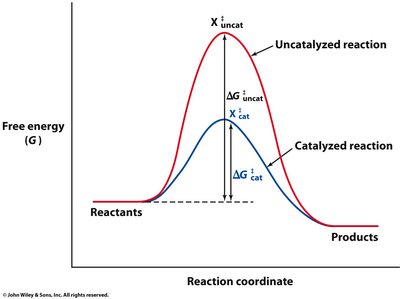
Free Energy Diagram: Enzymes decrease the activation energy (ΔG‡) but do not alter the overall free energy change (ΔG) of the reaction.
Transition State Analogs: Stable compounds that mimic the transition state can act as potent enzyme inhibitors.
Rate Enhancements of Enzymes
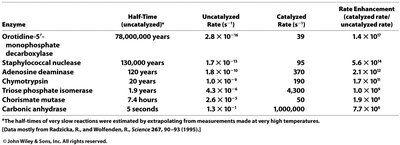
Enzymes can increase reaction rates by many orders of magnitude. The table below compares the rate enhancements of several enzymes:
Enzyme | Half-Time (uncatalyzed) | Uncatalyzed Rate (s-1) | Catalyzed Rate (s-1) | Rate Enhancement |
|---|---|---|---|---|
Orotidine-5'-monophosphate decarboxylase | 78,000,000 years | 2.8 × 10⁻¹⁶ | 39 | 1.4 × 10¹⁷ |
Staphylococcal nuclease | 130,000 years | 1.7 × 10⁻¹³ | 95 | 5.6 × 10¹⁴ |
Adenosine deaminase | 120 years | 1.8 × 10⁻¹⁰ | 370 | 2.1 × 10¹² |
Chymotrypsin | 1.9 years | 1.9 × 10⁻⁸ | 100 | 5.3 × 10⁹ |
Triose phosphate isomerase | 7.4 hours | 2.6 × 10⁻⁵ | 4300 | 1.7 × 10⁸ |
Chorismate mutase | 2 seconds | 1.5 × 10⁻¹ | 1,000,000 | 7.7 × 10⁶ |
Carbonic anhydrase | 5 seconds | 1.3 × 10⁻¹ | 1,000,000 | 7.7 × 10⁶ |
Effect of a Catalyst on a Chemical Reaction
Enzymes lower the activation energy required for a reaction, making it proceed faster. The reaction coordinate diagram illustrates this effect, showing a lower peak for the catalyzed reaction compared to the uncatalyzed one.
Factors That Contribute to Enzyme Catalysis
Proximity and Orientation Effects
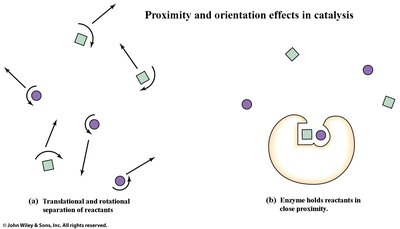
Enzymes increase reaction rates by bringing substrates into close proximity and proper orientation, reducing the entropy barrier for the reaction. This effect is largely entropic, as the freedom of motion of substrates is reduced upon binding to the enzyme.
Proximity: Enzyme holds substrates close together, increasing the likelihood of productive collisions.
Orientation: Enzyme orients substrates to favor the correct alignment for the reaction.
Entropy Loss in Formation of the ES Complex
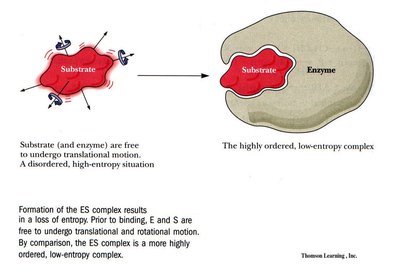
Formation of the enzyme-substrate (ES) complex results in a loss of entropy, as both enzyme and substrate lose translational and rotational freedom. However, this entropy loss can be offset by increased disorder elsewhere in the enzyme or solvent.
Destabilization of ES Complex
Strain: Substrate fits the active site less well than the transition state, introducing strain that is relieved during the reaction.
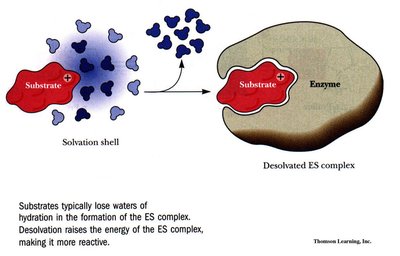
Desolvation: Substrates lose waters of hydration upon binding, raising the energy of the ES complex and making it more reactive.
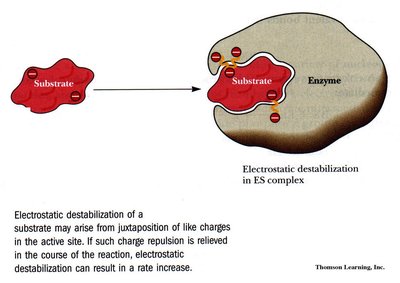
Electrostatic Effects: Like charges on substrate and enzyme are forced into close proximity, destabilizing the ES complex until the reaction relieves these repulsive forces.
General Mechanisms of Enzyme Catalysis
Metal Ion Catalysis
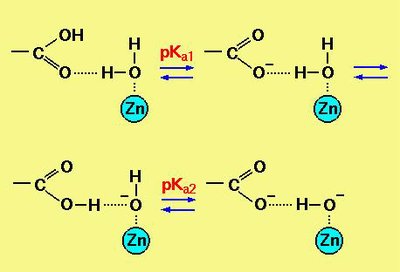
Some enzymes contain metal ions at their active sites. These metal ions can stabilize negative charges, facilitate electronic transitions, or increase the acidity of nucleophiles. Examples include Zn2+ in proteases and dioxygenases.
Stabilization of negative charge: Metal ions can neutralize developing negative charges during the reaction.
Facilitation of nucleophilic attack: Metal ions can increase the reactivity of nucleophiles by lowering their pKa.
Acid-Base Catalysis
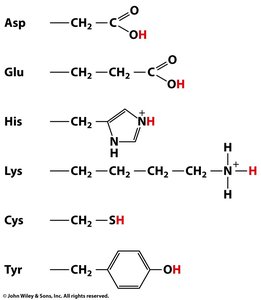
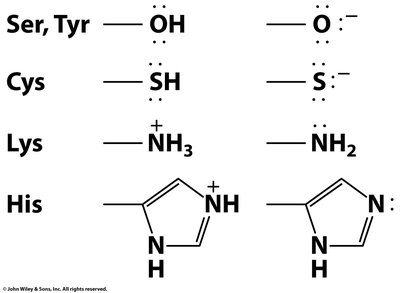
Enzymes can act as acids (proton donors) or bases (proton acceptors) during catalysis, facilitating proton transfer and increasing reaction rates. Common amino acids involved include Asp, Glu, His, Lys, Cys, and Tyr.
Covalent Catalysis
In covalent catalysis, a covalent bond forms between the enzyme and the substrate, creating a transient enzyme-substrate intermediate. This mechanism is common in serine proteases, where the active site serine forms a covalent bond with the substrate.
Serine Proteases and Chymotrypsin Mechanism
Chymotrypsin: Structure and Function
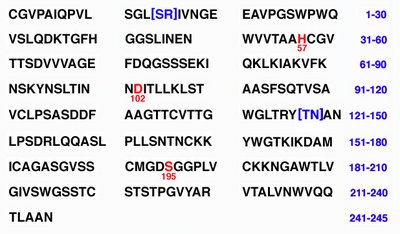
Chymotrypsin is a serine protease that cleaves peptide bonds on the carboxyl side of aromatic amino acids. It is synthesized as an inactive precursor (zymogen) and activated by covalent modification. The active site contains a catalytic triad: Asp102, His57, and Ser195.
Catalytic Triad: Asp102, His57, and Ser195 work together to facilitate nucleophilic attack on the peptide bond.
Oxyanion Hole: Stabilizes the tetrahedral transition state intermediate.
Specificity Pocket: Nonpolar amino acids form a hydrophobic pocket that determines substrate specificity.
Chymotrypsin Reaction Mechanism
The mechanism proceeds in two main steps, each involving a tetrahedral transition state:
His57 withdraws a proton from Ser195, activating it for nucleophilic attack on the peptide carbonyl carbon. The first tetrahedral intermediate forms.
His57 donates a proton to the leaving group, cleaving the peptide bond and forming an acyl-enzyme intermediate.
His57 withdraws a proton from water, which attacks the acyl-enzyme, forming the second tetrahedral intermediate.
His57 donates a proton to Ser195, releasing the carboxyl product and regenerating the enzyme.
The oxyanion hole stabilizes the negative charge on the tetrahedral intermediates throughout the reaction.
Oxyanion Hole and Specificity Pocket
The oxyanion hole is a region in the active site that stabilizes the negative charge on the oxygen atom of the tetrahedral intermediate. The specificity pocket determines which substrates are cleaved by the enzyme.
Applications: Enzyme Mechanisms in Biotechnology
Enzyme mechanisms, such as the serine protease catalytic triad, are utilized in biotechnology for applications like plastic degradation. For example, Ideonella sakaiensis uses a two-enzyme system with a serine protease triad to break down polyethylene terephthalate (PET) plastics.
Summary Table: Key Mechanisms of Enzyme Catalysis
Mechanism | Description | Example Enzyme |
|---|---|---|
Metal Ion Catalysis | Metal ion stabilizes charges or activates nucleophiles | Carbonic anhydrase, Zn proteases |
Acid-Base Catalysis | Enzyme donates/accepts protons | Aspartate proteases, mutarotase |
Covalent Catalysis | Transient covalent bond forms between enzyme and substrate | Serine proteases (chymotrypsin) |
Key Questions for Review
What do enzymes do to the free energy vs. reaction coordinate plot?
To what does an enzyme most tightly bind?
Does overall entropy always decrease when a substrate binds?
What are four general techniques used by enzymes to increase reaction rates?
What is metal-ion catalysis? Acid-base catalysis? Covalent catalysis?
What is the oxyanion hole?
Case Study Example
A 10-month-old boy with defective collagen structure and bleeding gums is best treated with oral vitamin C, which is essential for collagen synthesis and proper enzyme function in connective tissue formation.
Additional info: This guide covers the main mechanisms by which enzymes catalyze reactions, with a focus on serine proteases and chymotrypsin as model systems. Understanding these principles is foundational for advanced studies in biochemistry and molecular biology.
