 Indietro
Genetic Recombination and Antibody Diversity in Eukaryotic Genomes
Guida di studio - Note intelligenti
 Appunti personalizzati basati sui tuoi materiali, ampliati con definizioni chiave, esempi e contesto.
Complexity of Eukaryotic Genomes: Genetic Variability and Recombination
Introduction
Eukaryotic genomes exhibit remarkable complexity, driven by mechanisms that generate genetic variability, recombination, and instability. These processes are fundamental to species diversity and immune system function. This module focuses on meiotic and somatic recombination, with an emphasis on their roles in genetic diversity and antibody production.
Meiotic Recombination: Creation of Genetic Diversity
Mechanism and Significance
Meiotic recombination is a process occurring during gamete formation that results in new combinations of alleles, contributing to species diversity.
DNA Replication: Prior to meiosis, each chromosome replicates, forming two sister chromatids.
Homologous Chromosome Pairing: In prophase I, homologous chromosomes align, allowing all four chromatids to interact.
Crossing-Over: Non-sister chromatids exchange DNA at points called chiasmata, resulting in new allele combinations.
Genetic Diversity: The recombined chromatids segregate into different gametes, increasing genetic variation among offspring.

Additional info: The crossing-over process is facilitated by double-strand DNA breaks, strand invasion, and formation of Holliday junctions, which are resolved by specific enzymes.
Somatic Recombination: Antibody Diversity in B Cells
Immune Response Overview
The immune system relies on somatic recombination to generate a vast diversity of antibodies, enabling recognition of numerous antigens.
B Cells: Produce antibodies and mediate humoral immunity, targeting pathogens in body fluids.
T Cells: Mediate cellular immunity, targeting infected host cells and foreign tissues.

Key Definitions
Antigen: Any substance that elicits an immune response; typically proteins or carbohydrates on pathogens.
Epitope: The specific region of an antigen recognized by B cell receptors.
Antigen Receptor: Membrane-bound protein on B cells that binds epitopes.
Antibody: Secreted form of the B cell receptor, specific to the antigen's epitope.

Main Events in Antibody-Mediated Immune Response
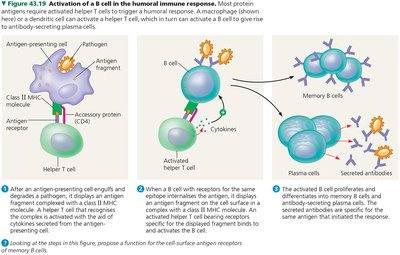
B cell binds to an epitope on an antigen.
Antigen-receptor complex is internalized and processed; fragments are displayed on MHC II proteins.
T helper cells recognize displayed fragments and activate B cells.
B cells proliferate and differentiate into plasma cells, secreting antibodies.
Antibodies neutralize or flag antigens for destruction.
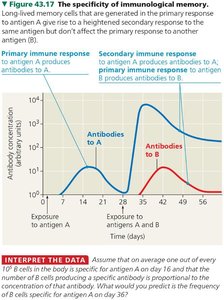
Memory B cells ensure rapid response upon re-exposure to the same antigen.
Role of Antibodies
Neutralisation: Antibodies bind to antigens, preventing pathogen attachment and infection.
Opsonisation: Antibody-antigen complexes are engulfed and digested by phagocytic cells.

Antibody Structure and Diversity
Structure of Immunoglobulins (Ig)
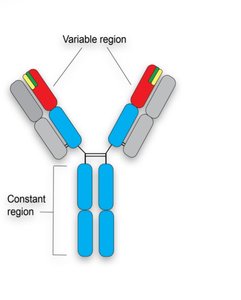
Antibodies are Y-shaped tetramers composed of two heavy and two light chains, held together by disulfide bonds.
Light Chains: Two types (Kappa, Lambda), each with variable (V) and constant (C) regions.
Heavy Chains: Four domains, each with V and C regions.
Variable Regions: Located at the tips of the Y; determine antigen specificity.
Constant Regions: Form the stem and lower arms; determine antibody class.


Classes (Isotypes) of Antibodies
Antibodies exist in five main classes, each with distinct functions and distribution.
Ig Class | Function | Distribution |
|---|---|---|
IgM | First produced after infection; primary response | Blood, does not cross placenta |
IgD | Receptor, unclear function | Blood, small amounts |
IgG | Main antibody class; secondary response | Blood, crosses placenta, breast milk |
IgA | Protects mucosal surfaces | Secretions (milk, saliva, tears) |
IgE | Allergic response | Saliva, nasal secretions |
Genetic Basis of Antibody Diversity
Gene Segments and Somatic Recombination
Antibody diversity arises from somatic recombination of gene segments encoding the variable regions of light and heavy chains.
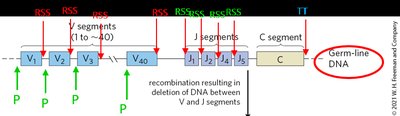
Kappa Light Chain: 40 V segments, 5 J segments, 1 C segment
Lambda Light Chain: 30 V segments, 4 J-C segments
Heavy Chain: 51 V segments, 27 D segments, 6 J segments, 5 C types
Gene Family | Number of V Segments | J, C, D Segments |
|---|---|---|
Kappa L chain | 40 | 5 J, 1 C |
Lambda L chain | 30 | 4 J-C |
Heavy chain | 51 | 27 D, 6 J, 5 C |
Somatic Recombination in Light and Heavy Chains
Recombination Signal Sequences (RSS) guide the joining of V, J, and D segments, mediated by RAG1 and RAG2 proteins. This process is random, resulting in extensive diversity.
Kappa Chain: V-J recombination
Lambda Chain: J-C recombination
Heavy Chain: V-D-J recombination (two steps)

Class Switch Recombination and Alternative Splicing
Class switching allows a B cell to produce different antibody classes against the same antigen, through recombination at switch sequences and alternative mRNA splicing.
IgM and IgD are co-expressed in naïve B cells.
Class switch recombination joins VDJ to different C genes (IgG, IgA, IgE).
Alternative splicing determines membrane-bound vs. secreted forms.
Antibody Diversity Estimation
Combinatorial and Junctional Diversity
The combination of V, J, and D segments, along with random nucleotide additions or deletions at recombination sites, results in an estimated to different antibodies from a limited number of genes.
Combinatorial Diversity: Multiple V, J, D segments recombine randomly.
Junctional Diversity: Nucleotide additions/deletions at recombination sites further increase diversity.
Example Calculation:
For Kappa chains: combinations. For heavy chains: combinations. Total antibody diversity: possible types (not accounting for junctional diversity).
References
Lehninger Biochemistry: Nelson and Cox. Ed. VIII. Ch 25, section 25.3; Ch 5, section 5.2.
