 Indietro
Chapter 12: Glycolysis and Gluconeogenesis
Guida di studio - Note intelligenti
 Appunti personalizzati basati sui tuoi materiali, ampliati con definizioni chiave, esempi e contesto.
Chapter 12: Glycolysis and Gluconeogenesis
Introduction to Glycolysis
Glycolysis is a central metabolic pathway that converts glucose into pyruvate, generating ATP and NADH in the process. Rather than a sequence of reactions to memorize, glycolysis should be understood as a thermodynamic and chemical strategy for energy conversion. The pathway is divided into two phases: the preparatory (investment) phase and the energy-harvesting (payoff) phase. Glycolysis is tightly regulated and interconnected with other metabolic pathways, including gluconeogenesis and glycogen metabolism.
Sugar Basics
Carbohydrates are organic molecules with the general formula (CH2O)n. They include monosaccharides (e.g., glucose, ribose), disaccharides (e.g., lactose), and polysaccharides (e.g., glycogen).
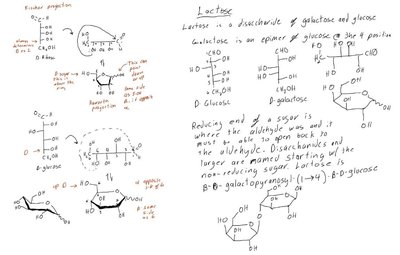
Fischer projections are used to represent the stereochemistry of sugars. The orientation of hydroxyl groups determines the identity and properties of each sugar.
D- and L-sugars refer to the configuration at the highest-numbered chiral carbon, based on D-glyceraldehyde. Most biologically relevant sugars are D-isomers.
Cyclic sugars form via intramolecular attack of a hydroxyl group on the carbonyl, generating a hemiacetal (aldoses) or hemiketal (ketoses).
Anomers are isomers formed at the new stereocenter (anomeric carbon) created during cyclization, designated as α or β.
Mutarotation is the interconversion between α and β anomers in solution.
Lactose and Disaccharides
Lactose is a disaccharide composed of galactose and glucose, linked by a β(1→4) glycosidic bond. Galactose is an epimer of glucose at the C-4 position. Reducing sugars have a free anomeric carbon capable of acting as a reducing agent; lactose is a reducing sugar because its glucose unit retains a free anomeric carbon.
Overview of Glycolysis Pathway
The overall reaction for glycolysis is:
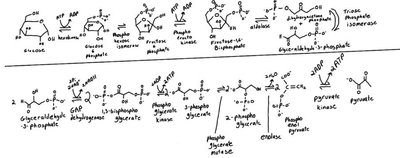
The pathway consists of ten enzyme-catalyzed steps, divided into two phases:
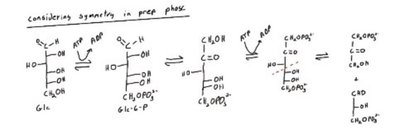
Preparatory phase: ATP is invested to phosphorylate glucose and generate a symmetrical intermediate (fructose-1,6-bisphosphate).
Payoff phase: Energy is harvested as ATP and NADH are produced from the breakdown of three-carbon intermediates.
Hexokinase and Glucokinase: First Step of Glycolysis
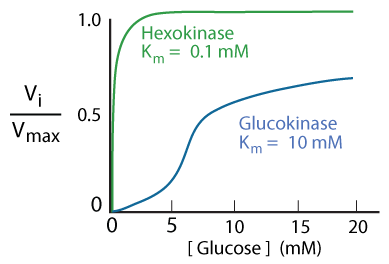
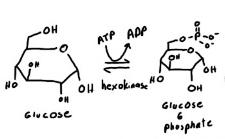
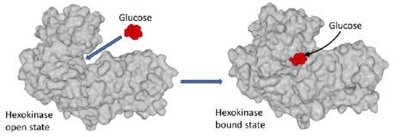
Hexokinase catalyzes the phosphorylation of glucose to glucose-6-phosphate, trapping glucose inside the cell and committing it to metabolism. Glucokinase (hexokinase IV) performs the same reaction in the liver but with a much higher Km, allowing the liver to respond to high blood glucose levels after meals.
Hexokinase: Low Km (~0.1 mM), active at low glucose concentrations, found in most tissues.
Glucokinase: High Km (~10 mM), active only at high glucose concentrations, found in liver and pancreatic β-cells.
Glycogen Storage and Synthesis
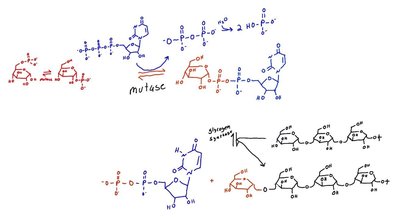
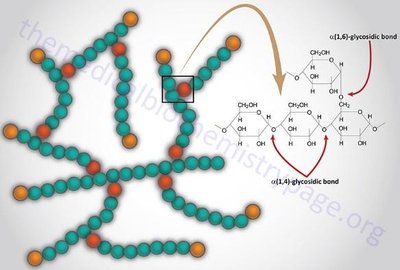
When glucose is abundant, glucose-6-phosphate can be diverted into glycogen synthesis. Glycogen is a branched polymer of glucose, serving as a compact, rapidly mobilizable energy reserve and reducing osmotic stress compared to free glucose.
UDP-glucose is the activated form used for glycogen synthesis.
Glycogen synthase adds glucose units via α(1→4) linkages, with branching via α(1→6) bonds.
Induced Fit and Hexokinase Mechanism
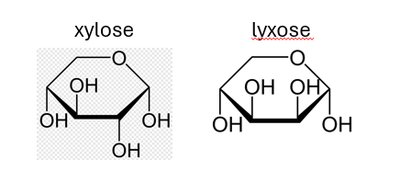
Hexokinase undergoes an induced-fit conformational change upon glucose binding, positioning the substrate for efficient catalysis. Experiments with alternative sugars (xylose, lyxose) show increased ATP hydrolysis due to water acting as a nucleophile in the absence of the correct hydroxyl group.
Generating a Symmetric Intermediate: Preparation for Cleavage
To split glucose into two similar three-carbon units, the pathway first converts glucose-6-phosphate (an aldose) to fructose-6-phosphate (a ketose) via phosphoglucose isomerase. Phosphofructokinase-1 (PFK-1) then adds a second phosphate, generating fructose-1,6-bisphosphate—a symmetrical intermediate suitable for cleavage by aldolase into dihydroxyacetone phosphate (DHAP) and glyceraldehyde-3-phosphate (G3P).
Energy Harvesting Phase: Oxidation and ATP Generation
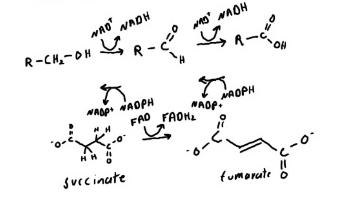
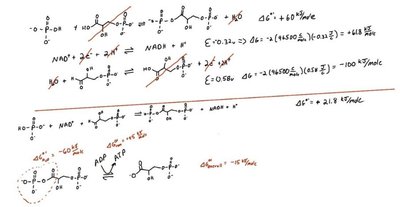
Glyceraldehyde-3-phosphate dehydrogenase (GAPDH) catalyzes the oxidation of G3P, reducing NAD+ to NADH and forming 1,3-bisphosphoglycerate (a high-energy mixed anhydride). Phosphoglycerate kinase then transfers a phosphate to ADP, generating ATP via substrate-level phosphorylation.
Substrate-level phosphorylation: Direct transfer of a phosphate group from a high-energy intermediate to ADP, forming ATP.
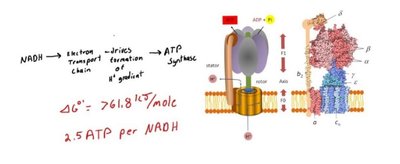
Oxidative phosphorylation: ATP synthesis driven by the electron transport chain and proton gradient in mitochondria.
2,3-Bisphosphoglycerate and Hemoglobin Regulation
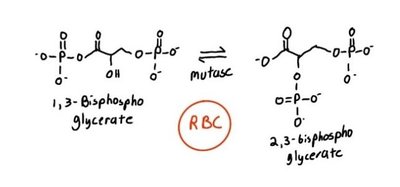
1,3-bisphosphoglycerate can be converted to 2,3-bisphosphoglycerate (2,3-BPG) in red blood cells, regulating hemoglobin's oxygen affinity. This detour sacrifices ATP production but enhances oxygen delivery to tissues, especially under hypoxic conditions.
Generating a Second ATP: Pyruvate Kinase Reaction
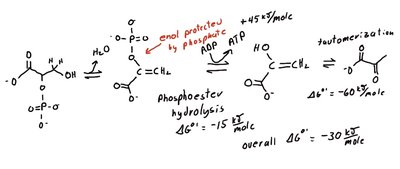
Phosphoenolpyruvate (PEP) is formed via enolase and is a high-energy intermediate. Pyruvate kinase catalyzes the transfer of phosphate from PEP to ADP, generating ATP. The reaction is strongly favorable due to the subsequent tautomerization of the enol form of pyruvate to the more stable keto form.
Fate of Pyruvate
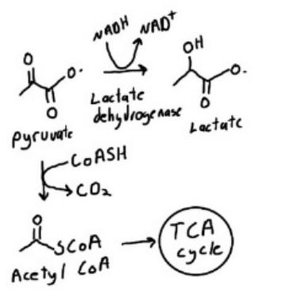
Pyruvate, the end product of glycolysis, has several metabolic fates:
Anaerobic conditions: Reduced to lactate by lactate dehydrogenase, regenerating NAD+ for continued glycolysis.
Aerobic conditions: Transported into mitochondria, converted to acetyl-CoA, and enters the TCA cycle for complete oxidation.
ATP Yield from Complete Oxidation of Glucose
Complete aerobic oxidation of one glucose molecule yields approximately 30–32 ATP in eukaryotic cells, accounting for substrate-level phosphorylation and ATP equivalents from NADH and FADH2 via oxidative phosphorylation. The exact yield depends on shuttle systems and mitochondrial efficiency.
Source | ATP Equivalent |
|---|---|
Glycolysis (substrate-level) | 2 ATP |
Glycolytic NADH (2 × 2.5 ATP) | ~5 ATP |
Pyruvate Dehydrogenase (2 NADH) | ~5 ATP |
TCA Cycle NADH (6 × 2.5 ATP) | ~15 ATP |
TCA Cycle FADH2 (2 × 1.5 ATP) | ~3 ATP |
TCA Cycle GTP (2 ATP equiv.) | ~2 ATP |
Total | ~30–32 ATP |
Gluconeogenesis: Overcoming Thermodynamic Barriers
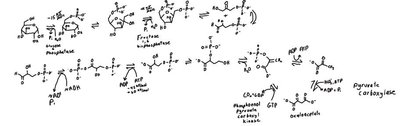
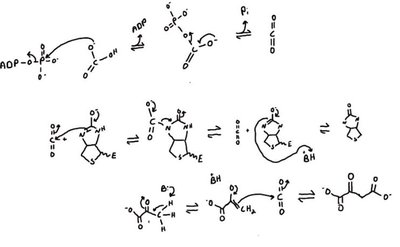
Gluconeogenesis is the synthesis of glucose from non-carbohydrate precursors. It is not simply glycolysis in reverse; instead, it uses alternate enzymes to bypass the three irreversible steps of glycolysis (hexokinase, phosphofructokinase, pyruvate kinase). Key bypasses include:
Pyruvate carboxylase (with biotin cofactor) converts pyruvate to oxaloacetate (OAA).
Phosphoenolpyruvate carboxykinase (PEPCK) converts OAA to PEP, using GTP and releasing CO2.
Fructose-1,6-bisphosphatase hydrolyzes F-1,6-BP to F-6-P.
Glucose-6-phosphatase hydrolyzes G-6-P to free glucose (in liver).
Clinical Connections and Regulation
Glucokinase mutations can cause MODY2 diabetes due to impaired glucose sensing.
Hereditary fructose intolerance results from aldolase B deficiency, leading to metabolic dysfunction.
Pyruvate kinase deficiency causes hemolytic anemia due to impaired ATP production in red blood cells.
Von Gierke disease (glucose-6-phosphatase deficiency) leads to fasting hypoglycemia due to inability to release free glucose from the liver.
Lactic acidosis occurs when anaerobic glycolysis predominates, leading to lactate accumulation and decreased blood pH.
The Warburg effect describes increased glycolytic flux in cancer cells, supporting biosynthetic needs and forming the basis for FDG-PET imaging.
Key Concepts and Review
Glycolysis and gluconeogenesis are regulated at key irreversible steps to ensure thermodynamic favorability and metabolic control.
Substrate-level phosphorylation and oxidative phosphorylation are distinct mechanisms for ATP generation.
Redox cofactors (NAD+, NADH, FAD, FADH2) play central roles in energy conservation and transfer.
Glycogen storage solves both energy and osmotic challenges for cells.
Many glycolytic enzymes are reversible and function in both glycolysis and gluconeogenesis, except at major regulatory steps.
Additional info: This summary integrates chemical logic, regulation, and clinical relevance, providing a comprehensive overview suitable for exam preparation in a college-level biochemistry course.
