 Indietro
Glycolysis and Pyruvate Catabolism: Biochemistry Study Guide
Guida di studio - Note intelligenti
 Appunti personalizzati basati sui tuoi materiali, ampliati con definizioni chiave, esempi e contesto.
Glycolysis: Overview and Stages
Introduction to Glycolysis
Glycolysis is a central metabolic pathway in biochemistry, responsible for the breakdown of glucose into pyruvate, generating energy in the form of ATP and NADH. This pathway is essential for cellular energy production, especially under anaerobic conditions. - Key Point 1: Glycolysis converts one molecule of glucose (6 carbons) into two molecules of pyruvate (3 carbons each). - Key Point 2: The process occurs entirely in the cytoplasm of animal cells. - Key Point 3: Glycolysis is divided into three stages: Glucose Transport, Investment Stage, and Payoff Stage. 

 Example: Glycolysis is the primary pathway for glucose catabolism in most cells.
Net Result of Glycolysis
The overall equation for glycolysis is: - Key Point: Net gain of 2 ATP and 2 NADH per glucose. 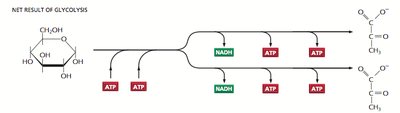
Glucose Transport
Facilitated Diffusion and Active Transport
Glucose enters cells via two main mechanisms: facilitated diffusion and active transport. - Facilitated Diffusion: Glucose transporters (GLUT1, GLUT2, GLUT3, GLUT4) allow glucose to move down its concentration gradient. 
 - Active Transport: In certain tissues (e.g., kidneys), glucose is recovered against its gradient via sodium-glucose symporters (SGLT), powered by ATP.
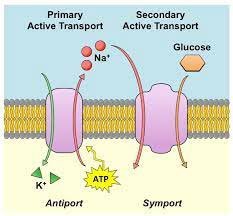

 Example: SGLT is critical for glucose reabsorption in the kidneys.
Investment Stage of Glycolysis
Step 1: Glucose Phosphorylation
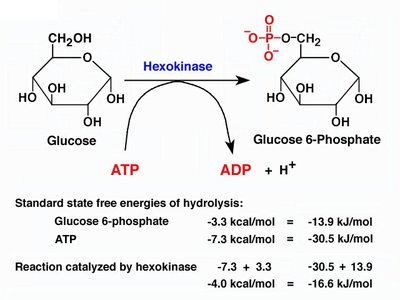
The first step involves phosphorylation of glucose to glucose-6-phosphate by hexokinase, using ATP. - Key Point: This step is highly exergonic and essentially irreversible. - Key Point: Phosphorylation traps glucose inside the cell, as glucose-6-phosphate cannot cross the membrane. 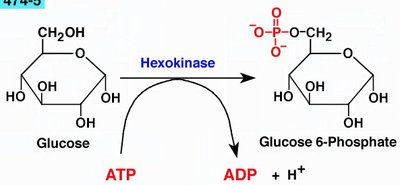
Regulation of Hexokinase
Hexokinase exists as four isozymes, with different tissue distributions and regulatory properties. - Hexokinase I: Low Km, present in all cells, functions in glycolysis. - Hexokinase IV (Glucokinase): High Km, present in liver and pancreas, acts as a glucose sensor. 

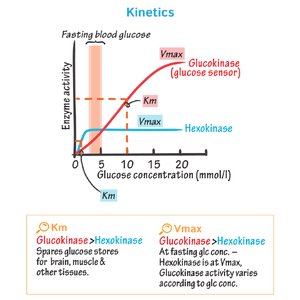 Example: Mutations in glucokinase are associated with diabetes.
Step 2: Glucose Isomerization
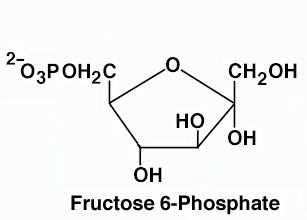
Glucose-6-phosphate is isomerized to fructose-6-phosphate by phosphoglucose isomerase. - Key Point: This step is reversible and prepares the molecule for further phosphorylation. 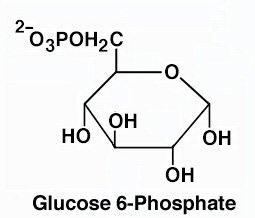
Step 3: Second Phosphorylation
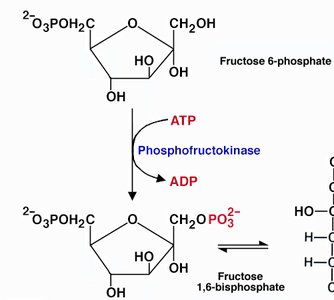
Fructose-6-phosphate is phosphorylated to fructose-1,6-bisphosphate by phosphofructokinase-1 (PFK-1), using ATP. - Key Point: This is the most highly regulated and rate-limiting step of glycolysis. - Key Point: The reaction is irreversible. 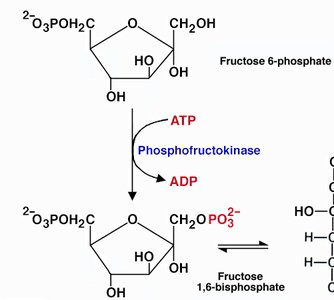
Regulation of Phosphofructokinase-1 (PFK-1)
PFK-1 is regulated allosterically by several effectors: - Negative Effectors: ATP, citrate, phosphoenolpyruvate (PEP) - Positive Effectors: AMP, ADP, Pi, fructose-2,6-bisphosphate - Hormonal Regulation: Fructose-2,6-bisphosphate levels are controlled by insulin and glucagon. 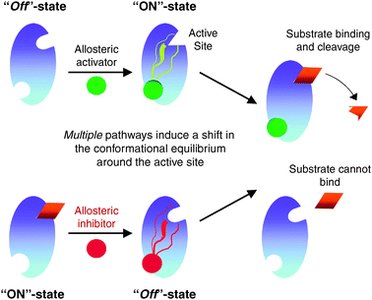
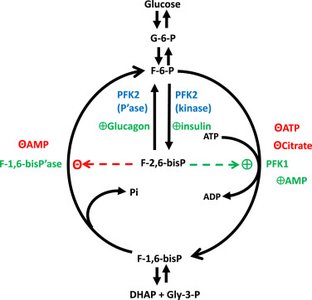 Example: High ATP inhibits PFK-1, even though ATP is a substrate, due to binding at a separate allosteric site.
Steps 4 & 5: Splitting and Isomerization
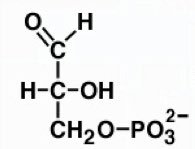
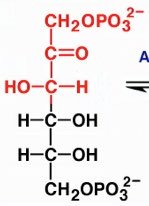
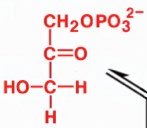
Fructose-1,6-bisphosphate is split into two 3-carbon molecules: dihydroxyacetone phosphate (DHAP) and glyceraldehyde-3-phosphate (G3P). Only G3P continues in glycolysis. - Key Point: Triose phosphate isomerase converts DHAP to G3P, ensuring both products enter the payoff stage. 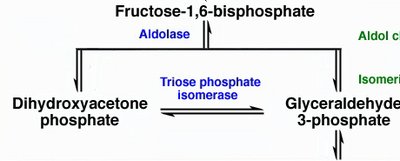
Payoff Stage of Glycolysis
Step 6: Oxidation and NADH Formation
Glyceraldehyde-3-phosphate is oxidized and phosphorylated to 1,3-bisphosphoglycerate, producing NADH. - Key Point: This step does not require ATP; the phosphate is inorganic (Pi). - Key Point: NAD+ is reduced to NADH, capturing energy. 





Step 7: Substrate-Level Phosphorylation
1,3-bisphosphoglycerate donates a phosphate to ADP, forming ATP and 3-phosphoglycerate. - Key Point: This is the first substrate-level phosphorylation in glycolysis. - Key Point: The energy from the high-energy bond in 1,3-bisphosphoglycerate drives ATP formation.
Steps 8 & 9: Formation of Phosphoenolpyruvate
Isomerization and dehydration reactions convert 3-phosphoglycerate to phosphoenolpyruvate (PEP), a high-energy intermediate.
Step 10: Second Substrate-Level Phosphorylation
PEP donates its phosphate to ADP, forming ATP and pyruvate. - Key Point: This step is highly exergonic and irreversible. - Key Point: No oxygen is required for ATP formation in glycolysis.
Regulation and Irreversible Steps
Irreversible Steps in Glycolysis
There are three irreversible kinase steps in glycolysis: 1. Hexokinase (glucose to glucose-6-phosphate) 2. Phosphofructokinase-1 (fructose-6-phosphate to fructose-1,6-bisphosphate) 3. Pyruvate kinase (PEP to pyruvate)
Entry of Other Sugars into Glycolysis
Fructose and Galactose Entry
- Fructose: Enters glycolysis by bypassing PFK-1 regulation, which can contribute to obesity in high-fructose diets. - Galactose: Isomerizes to glucose-1-phosphate while attached to UDP, entering glycolysis.
Fates of Pyruvate
Anaerobic and Aerobic Catabolism
Pyruvate is a major branch point in metabolism. - Anaerobic: Pyruvate is converted to lactate (animals) or ethanol (bacteria), regenerating NAD+ for glycolysis. - Aerobic: Pyruvate is transported into mitochondria and oxidized to acetyl-CoA by the pyruvate dehydrogenase complex, producing NADH and CO2.
Pyruvate Dehydrogenase Complex
- Key Point: The complex uses lipoamide and thiamine pyrophosphate (TPP) as prosthetic groups. - Key Point: The reaction is irreversible and is the first step where CO2 is formed in glucose catabolism. - Key Point: Acetyl-CoA enters the Krebs cycle for further oxidation.
Study Strategies for Metabolic Pathways
Key Concepts to Master
- Identify enzymes and their reactions. - Know which steps use or produce ATP, NADH, FADH2, or CO2. - Recognize irreversible and regulated steps. - Understand catabolic/anabolic branch points. - Distinguish between aerobic and anaerobic conditions.
Case Studies and Clinical Relevance
Branch-Chain Amino Acid Disorders
Elevated branch-chain amino acids (isoleucine, leucine, valine) can indicate metabolic disorders such as Maple Syrup Urine Disease.
Muscle Glycolysis Disorders
Defects in glycolytic enzymes can lead to exercise intolerance, myoglobinuria, and abnormal lactate/pyruvate ratios.
Summary Table: Key Steps and Enzymes in Glycolysis
Step | Enzyme | Reaction | ATP/NADH | Regulation |
|---|---|---|---|---|
1 | Hexokinase | Glucose → Glucose-6-phosphate | -1 ATP | Irreversible |
2 | Phosphoglucose isomerase | G6P → F6P | Reversible | |
3 | Phosphofructokinase-1 | F6P → F1,6BP | -1 ATP | Irreversible, regulated |
4 | Aldolase | F1,6BP → DHAP + G3P | Reversible | |
5 | Triose phosphate isomerase | DHAP ↔ G3P | Reversible | |
6 | G3P dehydrogenase | G3P → 1,3-BPG | +2 NADH | Reversible |
7 | Phosphoglycerate kinase | 1,3-BPG → 3-PG | +2 ATP | Reversible |
8 | Phosphoglycerate mutase | 3-PG → 2-PG | Reversible | |
9 | Enolase | 2-PG → PEP | Reversible | |
10 | Pyruvate kinase | PEP → Pyruvate | +2 ATP | Irreversible, regulated |
Additional info:
- The notes include clinical case studies relevant to glycolysis and pyruvate metabolism. - Mnemonics are provided for memorizing glycolytic enzymes and intermediates. - The regulation of glycolysis is tightly linked to cellular energy status and hormonal signals.
