 Indietro
Introduction to Metabolism: Catabolic and Anabolic Pathways, ATP, Coenzymes, and Vitamins
Guida di studio - Note intelligenti
 Appunti personalizzati basati sui tuoi materiali, ampliati con definizioni chiave, esempi e contesto.
Metabolism: Overview and Definitions
Definition and Scope
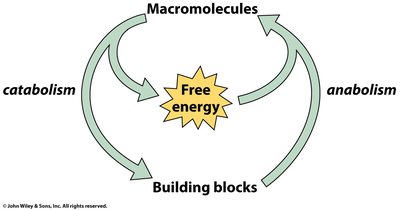
Metabolism encompasses all chemical reactions that occur within living organisms to sustain life. It is divided into two main categories:
Catabolism: The breakdown of complex molecules into simpler ones, releasing energy.
Anabolism: The synthesis of complex molecules from simpler ones, requiring energy input.
Amphibolism: Pathways that function in both catabolic and anabolic processes, such as the Krebs cycle.
Metabolic Pathways
Metabolic pathways are sequences of enzymatic reactions that transform substrates into products. Major pathways include glycolysis, Krebs cycle, oxidative phosphorylation, and β-oxidation. 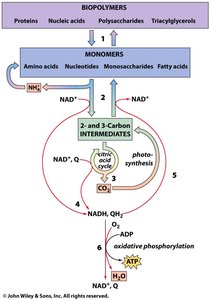
Metabolic Classification of Organisms
Carbon and Energy Requirements
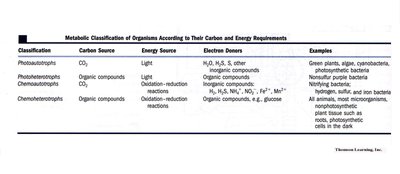
Organisms are classified based on their carbon source, energy source, and electron donors.
Classification | Carbon Source | Energy Source | Electron Donors | Examples |
|---|---|---|---|---|
Photoautotrophs | CO2 | Light | H2O, H2S, & others | Green plants, algae, cyanobacteria |
Photoheterotrophs | Organic compounds | Light | Organic compounds | Photosynthetic purple bacteria |
Chemoautotrophs | CO2 | Oxidation-reduction reactions | Inorganic compounds (e.g., H2, NH3, NO2-, Fe2+) | Nitrifying bacteria, hydrogen/sulfur/iron bacteria |
Chemoheterotrophs | Organic compounds | Oxidation-reduction reactions | Organic compounds (e.g., glucose) | Animals, fungi, most microorganisms |
Catabolism vs. Anabolism
Key Differences and Examples
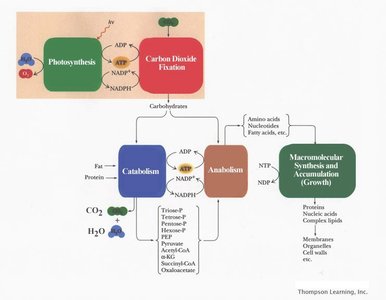
Catabolism: Oxidative degradation of biomolecules (e.g., glycolysis).
Anabolism: Biosynthetic formation of biomolecules (e.g., photosynthesis).
Amphibolism: Pathways with both catabolic and anabolic roles (e.g., Krebs cycle).

Oxidation Levels of Carbon
Progression from Reduced to Oxidized States
Carbon atoms in biomolecules can exist in various oxidation states, which are important in metabolic reactions.
Alkane: Most reduced form
Alcohol
Aldehyde/Ketone
Acid
Carbon Dioxide: Most oxidized form
Each step to the right represents a two-electron oxidation. 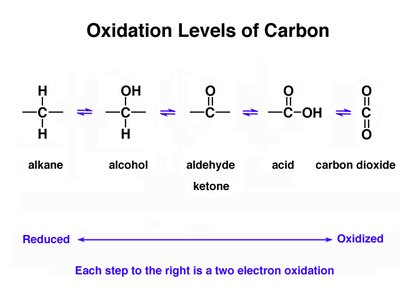
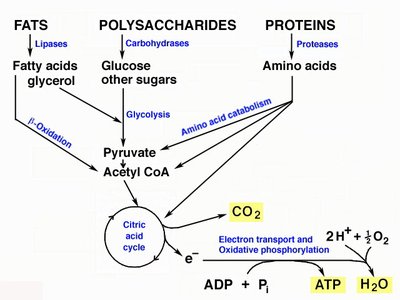
Major Catabolic Pathways
Overview of Pathways
Glycolysis: Catabolism of sugars to pyruvate.
Krebs Cycle (Citric Acid Cycle): Oxidation of acetyl-CoA to CO2 and production of NADH and FADH2.
Electron Transport/Oxidative Phosphorylation: Generation of ATP from NADH and FADH2.
β-Oxidation: Catabolism of fatty acids.
ATP: The Energy Currency of the Cell
Structure and Hydrolysis
ATP (adenosine triphosphate) is the primary energy carrier in cells. Its hydrolysis releases energy used to drive cellular processes.
Phosphoanhydride bonds: High-energy bonds between phosphate groups.
Hydrolysis reaction:
Standard free energy change:


ATP Turnover and Cellular Demand
Each ATP molecule is recycled thousands of times per day.
ATP reserves in muscle are depleted in minutes and must be regenerated rapidly.
Coupled Reactions in Metabolism
Thermodynamic Favorability
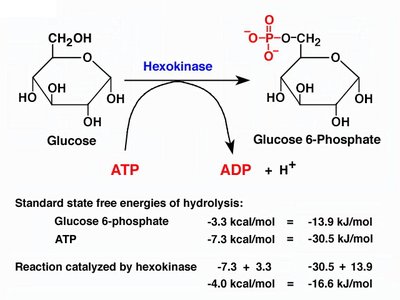
Unfavorable reactions (positive ) can occur in cells by coupling them to favorable reactions (negative ), often involving ATP hydrolysis.
Example: Glucose phosphorylation coupled to ATP hydrolysis.


Coenzymes and Vitamins
Definitions and Functions
Coenzyme: An organic molecule that assists enzyme-catalyzed reactions, often derived from vitamins.
Cosubstrate: Coenzyme that enters and leaves the active site.
Prosthetic group: Coenzyme tightly bound to the enzyme.
Vitamin: Essential nutrient required for coenzyme synthesis.
Examples of Coenzymes
Niacin (Vitamin B3): Component of NAD+ and NADP+, involved in oxidation-reduction reactions.
Riboflavin (Vitamin B2): Component of FAD and FMN, involved in electron transfer.
Thiamine (Vitamin B1): Component of thiamine pyrophosphate (TPP), involved in transfer of 2-carbon fragments.
Pantothenic acid (Vitamin B5): Component of Coenzyme A (CoA), involved in acyl group transfer.
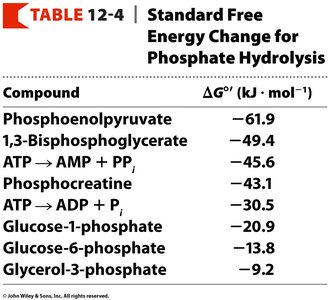
Summary Table: Standard Free Energy Change for Phosphate Hydrolysis
Comparison of Compounds
Compound | ΔG°' (kJ·mol-1) |
|---|---|
Phosphoenolpyruvate | -61.9 |
1,3-Bisphosphoglycerate | -49.4 |
ATP → AMP + PPi | -45.6 |
Phosphocreatine | -43.1 |
ATP → ADP + Pi | -30.5 |
Glucose-1-phosphate | -20.9 |
Glucose-6-phosphate | -13.8 |
Glycerol-3-phosphate | -9.2 |
Case Studies and Clinical Relevance
Vitamin Deficiency and Metabolic Disorders
Vitamin C deficiency: Leads to defective collagen synthesis, resulting in symptoms such as weakness, pallor, hemorrhages, and bleeding gums.
Branched-chain amino acid disorders: Elevated levels of isoleucine, leucine, and valine can indicate metabolic diseases such as Maple Syrup Urine Disease.
Key Skills for Studying Metabolic Pathways
Essential Abilities
Identify enzyme-catalyzed reactions and their substrates/products.
Recognize which reactions use or produce ATP, CO2, NADH, FADH2.
Distinguish irreversible and highly regulated steps.
Understand coupling of unfavorable reactions with ATP hydrolysis.
Recognize key coenzymes: NAD+, NADP+, NADH, NADPH, FAD, FADH2, FMN, TPP, CoA.
Additional info:
Metabolic pathways are interconnected and highly regulated to maintain cellular homeostasis.
Energy transfer and redox reactions are central to metabolism, with ATP and coenzymes playing key roles.
