 Indietro
RNA Metabolism: Transcription, RNA Processing, and Ribozymes
Guida di studio - Note intelligenti
 Appunti personalizzati basati sui tuoi materiali, ampliati con definizioni chiave, esempi e contesto.
RNA Metabolism: Transcription, RNA Processing, and Ribozymes
Introduction to RNA Metabolism
RNA metabolism encompasses the synthesis (transcription), processing, and function of RNA molecules in cells. This module covers the fundamental concepts of gene transcription, the diversity of RNA types, the mechanisms of RNA processing, and the catalytic roles of RNA (ribozymes), as well as the evolutionary implications of the 'RNA world' hypothesis.
Types of RNA and Their Functions
Major Classes of RNA
mRNA (messenger RNA): Carries genetic information from DNA to ribosomes for protein synthesis.
tRNA (transfer RNA): Brings specific amino acids to the ribosome during translation.
rRNA (ribosomal RNA): Structural and catalytic component of ribosomes; some rRNAs act as ribozymes.
snRNA (small nuclear RNA): Involved in splicing of pre-mRNA in the nucleus.
snoRNA (small nucleolar RNA): Guides chemical modifications of rRNAs.
siRNA (small interfering RNA): Regulates mRNA stability and translation by targeting specific mRNAs for degradation.
miRNA (microRNA): Regulates gene expression post-transcriptionally, often by inhibiting translation or promoting mRNA degradation.
lncRNA (long non-coding RNA): Regulates gene transcription by interacting with transcriptional machinery.
TUFs (Transcripts of Unidentified Function): Small RNAs with unknown roles, identified by genomics.
Gene Expression: Housekeeping vs. Regulated Genes
Housekeeping genes: Expressed constitutively at constant levels in all cells; essential for basic cellular function (e.g., rRNA, tRNA genes).
Regulated genes: Expression varies according to cellular needs; can be inducible (turned on) or repressible (turned off).
Transcription is tightly regulated to control the amount of each RNA or protein produced by a cell.
Transcription: Synthesis of RNA from DNA
Key Features of RNA Polymerase
RNA polymerase synthesizes RNA using a DNA template, adding ribonucleoside triphosphates (NTPs) to the 3' end of the growing RNA chain.
Unlike DNA polymerase, RNA polymerase does not require a primer.
The enzyme operates in the 5' to 3' direction, reading the DNA template in the 3' to 5' direction.
The catalytic site contains two Mg2+ ions and conserved aspartate residues.
RNA polymerase lacks proofreading activity, resulting in a higher error rate (1 in 104–105 nucleotides).
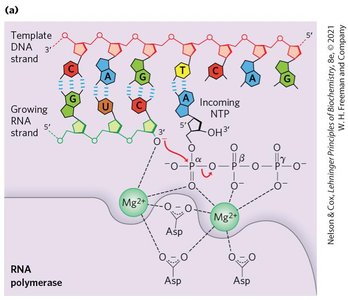
The Transcription Bubble
During transcription, only a small region (~17 base pairs) of DNA is unwound to form a transcription bubble. About 8 bases of the newly synthesized RNA remain paired with the DNA template at any time.
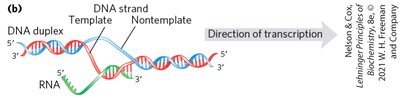
Template and Coding Strands
Only one DNA strand (the template strand, 3' to 5') is copied into RNA for each gene.
The coding (non-template) strand has the same sequence as the RNA (except T is replaced by U).

Stages of Transcription
Initiation: RNA polymerase binds to the promoter region and unwinds DNA.
Elongation: RNA polymerase synthesizes RNA by adding NTPs (ribonucleotide triphosphate)
Termination: Transcription ends at a terminator sequence; RNA is released.
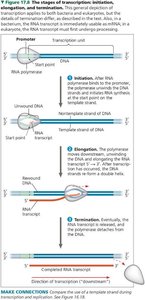
Prokaryotic Transcription
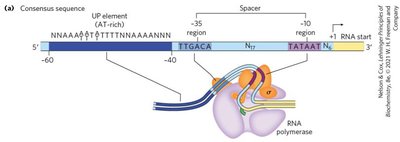
Promoters and RNA Polymerase in Bacteria
Prokaryotic promoters have conserved -10 (TATAAT) and -35 (TTGACA) regions upstream of the transcription start site (+1).
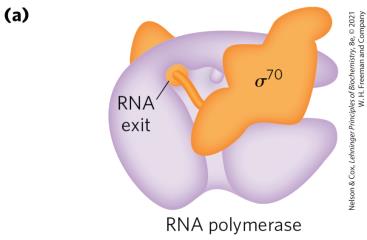
Bacteria have a single RNA polymerase composed of 5 core subunits and a sigma (σ) factor, which directs the enzyme to specific promoters.
Different sigma factors allow regulation of gene subsets (e.g., σ70 for general genes, σ32 for heat shock response).
Translation can begin on mRNA before transcription is complete due to the absence of a nuclear membrane.
Eukaryotic Transcription
RNA Polymerases in Eukaryotes
RNA Polymerase | Types of RNA Synthesized |
|---|---|
I | Pre-ribosomal RNA (precursor to 28S, 18S, 5.8S rRNAs) |
II | mRNA, some ncRNAs |
III | tRNA, 5S rRNA, other small RNAs |
Plants have RNA polymerase IV for siRNA synthesis; mitochondria have their own RNA polymerase.
Promoter Elements
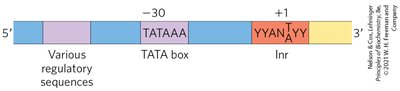
RNA polymerase II promoters often contain a TATA box (~-30) and an initiator (Inr) element at the transcription start site.
Promoters for RNA pol I and III can be partially or fully internal to the gene sequence. (RNA pol III (gene sits inside
Processing of Eukaryotic mRNA
Three Key Processing Events
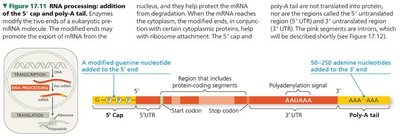
c via a 5',5'-triphosphate linkage. Protects mRNA from degradation and aids in translation initiation.
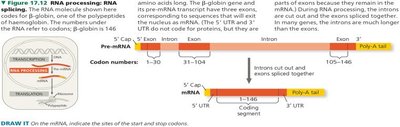
Splicing: Removal of introns and joining of exons. Introns are non-coding regions; exons code for protein.
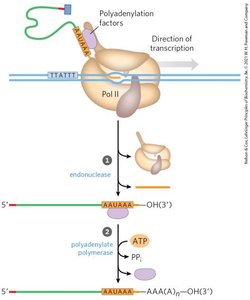
3' Polyadenylation: Addition of a poly(A) tail (~80–250 adenines) after cleavage at a conserved AAUAAA signal. Enhances mRNA stability and translation.
Processing of rRNA and tRNA
rRNA Multigenes and Processing
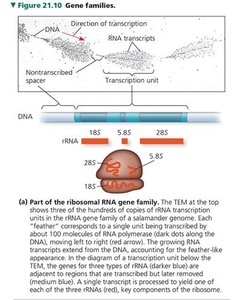
rRNA genes are present in tandem repeats in the nucleolus (nucleolar organizer regions, NORs).
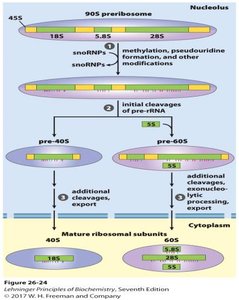
Transcribed as a long precursor, then processed into 18S, 5.8S, and 28S rRNAs by snoRNPs (small nucleolar ribonucleoproteins).
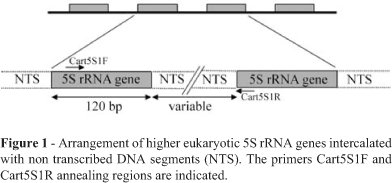
5S rRNA genes are separate, transcribed by RNA pol III, and also organized in multigenes.
tRNA Processing
Primary tRNA transcripts are processed by removal of 5' and 3' sequences, addition of CCA at the 3' end, and base modifications (e.g., pseudouridine, dihydrouridine).
Some tRNAs contain introns that are removed by endonucleases and ligated.
Mechanisms of Intron Splicing
Mechanism | Components | Features | Location |
|---|---|---|---|
Group I Intron | Catalytic RNA | Self-splicing using guanine cofactor | Nuclear, mitochondrial, chloroplast genes; bacteria |
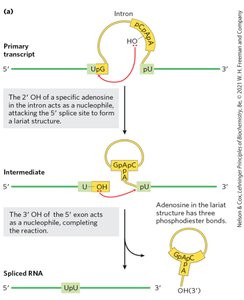
Group II Intron | Catalytic RNA, proteins | Self-splicing, forms lariat | Mitochondrial, chloroplast genes; bacteria |
Spliceosome | snRNAs, proteins | Large RNP complex, forms lariat | Nuclear genes of eukaryotes |
Protein-catalyzed | Protein enzymes | Splicing endonuclease and ligase | tRNAs, some mRNAs |
Spliceosome-Mediated Splicing
Most eukaryotic mRNA introns begin with GU and end with AG (GU/AG rule).
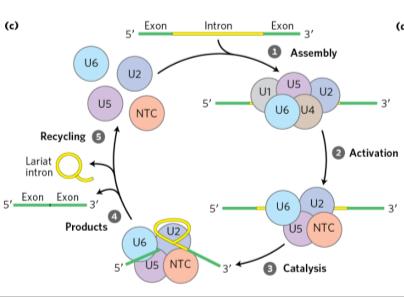
Spliceosome is composed of snRNPs (U1, U2, U4, U5, U6) and proteins.
Splicing involves assembly, activation, catalysis (lariat formation), and product release.
Ribozymes and the RNA World Hypothesis
Some RNAs (ribozymes) can catalyze their own splicing (e.g., Group I and II introns).
Discovery of self-splicing introns in Tetrahymena rRNA led to the Nobel Prize for Thomas Cech and Sidney Altman.
The catalytic properties of RNA support the 'RNA world' hypothesis, suggesting that RNA may have been the first genetic material.

Summary Table: DNA, Gene, and Chromosome Content in Some Genomes
Organism | Total DNA (bp) | Number of Chromosomes | Approximate Number of Protein-Coding Genes |
|---|---|---|---|
Escherichia coli | 4,641,652 | 1 | 4,394 |
Saccharomyces cerevisiae | 12,157,105 | 16 | 6,600 |
Caenorhabditis elegans | 100,286,401 | 6 | 20,470 |
Arabidopsis thaliana | 119,667,750 | 5 | 27,379 |
Drosophila melanogaster | 148,046,002 | 8 | 13,651 |
Oryza sativa | 430,000,000 | 12 | 37,544 |
Mus musculus | 2,730,471,774 | 40 | 22,450 |
Homo sapiens | 3,096,649,725 | 46 | 20,454 |
Additional info: The above content is based on selected concepts from Lehninger Biochemistry (Nelson and Cox), Campbell Biology, and current genomics data. For further reading, refer to the indicated textbook chapters and figures.
